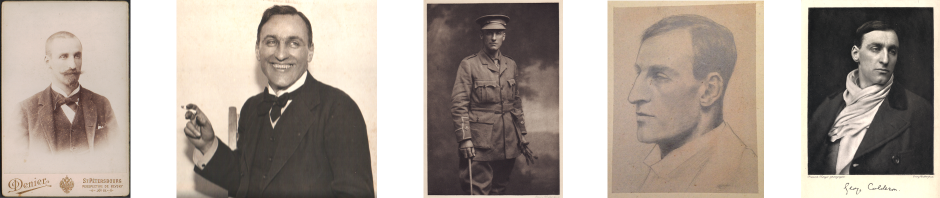

William Page (1888-1962) and Maria Page, née Beck (1891-1982)
When I began to read George and Kittie Calderon’s archive for my biography of them both, I little thought I would be drawn deeper and deeper into the question of ‘Edwardianism’. Yet I instantly felt as I read George’s letters of the 1890s, that he was not Victorian. My knowledge of him, his times and contemporaries broadened (after some years) to the point where I even decided that he exemplified a special Edwardian form of genius — and the adjective entered the subtitle of my book.
It has been really stimulating to revisit this subject in the series of eight posts since 4 June 2022 — of which this is the last — devoted to a fan of aspects of the Edwardian Age. I’m immensely grateful to Alison Miles, John Pym, Laurence Brockliss and Damian Grant for their painstaking guest posts that have shed fresh and fascinating light on this beguiling, often contentious period of British life.
My own living link with the Edwardians was my maternal grandparents (photographed above in about 1914). I knew them well as I spent long holidays between 1953 and 1958 living with them in a thatched cottage adjoining the 1.5 acre smallholding in the Kent countryside that was their livelihood. Edward VII reigned only from 1901 to 1910, so my grandfather was an Edwardian in the strict historical sense between the ages of thirteen and twenty-two, and my grandmother from ten to nineteen. But I sense deeply now that the pre-1914 era was when their whole outlook was formed, and they remained Edwardians in their outlook till they died, although they doubtless did not think of themselves as ‘Edwardians’.
They both spoke with affection of the King, calling him ‘Teddy’. The only other king I ever heard my grandfather mention was George VI, and that was to tell me sotto voce that he had had ‘a stammer’. My grandfather’s hero was Robert Baden-Powell. He adored cricket, golf, the wireless, flowers, and birds. When I received a copy of Bertrand Russell’s A History of Western Philosophy at a school Speech Day, my grandmother remonstrated with my mother that it was by ‘Bertie Russell — he’ll turn the boy into a Bolshie!’ My grandparents’ favourite modern writer was H.G. Wells (not Henry James, whose house in Rye my grandmother visited as a junior tailoress, and never D.H. Lawrence). They were far more accepting of modern technology, and far more interested in travel, than my parents. In fact they were far better read, more independent-minded and more enterprising. They were charitable and saw poverty as everyone’s problem. My grandmother was as anti cruelty to animals as Kittie Calderon. My grandfather, I surmise, thought the First World War destroyed the Edwardian world (in which they knew the King as ‘The Peacemaker’ for his attempts to contain Germany), and was the worst thing that had happened to him. He served at Gallipoli, in Mesopotamia and at Ypres, suffered from PTSD, and raved on his death bed about a dead Turk beneath it. My childhood spent in their loving care and free to wander the smallholding was idyllic.
However, as Adrian Gregory has written in his brilliant 2014 book The Last Great War: British Society and the First World War (p. 278):
Any discussion of the world before the war, the world we have lost, must start from the realisation that Edwardian Britain contained not one, but several worlds within it.
My grandfather was gentle, soft, passive (many thought), and when my mother was leaving him in his hospital bed for the last time and turned to look at him from a distance, he simply opened wide his emaciated arms to her in a gesture of love. So why was he so pro-hanging (he even told me the name of the public hangman), why did he say seriously ‘the only good German is a dead German’, tell me that in Moslem countries they cut a thief’s hand off, or inform me as I was about to go to the local grammar school, ‘Mr Oakes [the headmaster] beats boys’? All these things were terrifying to a child… As I wrote on this blog long ago with reference to George Calderon and others, the Edwardians seem to have believed they had a right to be nasty. That side of them, in both male and female, is undeniable. In The Edwardians (1972) Peter Brent insisted that ‘for the pre-1914 British chauvinism was the cement that held the social fabric together’ (p. 10); was that the source, then, of the cruel and regressive side of Edwardian life? This acceptance of violence as normal is what for me disqualifies the Edwardian Age from being ‘great’.
And was it an ‘Edwardian Age’? On the death of Queen Victoria, Wells famously said that she was ‘like a great paperweight that for half a century sat upon men’s minds and when she was removed, their ideas began to blow’. A 2017 ‘culturonomic’ computer analysis of local newspapers confirmed that ‘the years around Queen Victoria’s death were a fulcrum when the country changed abruptly in almost every way imaginable’ (Oliver Moody, The Times, 10 January 2017, p. 3). Yet I sensed immediately that George Calderon and his Trinity College friends of the 1890s were ‘post-Victorian’, and as Professor Brockliss has pointed out, ‘there can be no doubt that all the chief characteristics of the new age date from the early 1880s’ in the aftermath of the 1870s economic depression. Similarly, when did the ‘Edwardian Age’ end? In the 1920s it was commonly thought to have ended in 1914 (during the reign of George V), but of course it was the process of the war, not its commencement, that struck much of Edwardianism dead — in the course of writing my biography, I felt that the Edwardian ethos/syndrome succumbed in 1916 after the Somme, and was gratified to discover later that D.H. Lawrence thought the same. Yet Professor Brockliss makes a very convincing case for the end-date of the Edwardian Age being ‘the early 1930s in the midst of another and greater economic depression’.
Whatever dates one chooses, the ‘Edwardian Age’ was a far longer period than the reign of Edward VII. I would be tempted to rename it ‘the Post-Victorian Age’ (preceding the new Georgian Age), except that Queen Victoria was still alive when it started! If the Edwardian Age began in the early 1880s, she still had nearly twenty more years to reign. Is there an analogy here with our late Queen’s long reign? In the 1950s to 1980s Elizabeth II’s reign was widely perceived as the ‘New Elizabethan Age’ (the theatrical renaissance, for instance, was often compared to that of the first Elizabeth). But in my experience people ceased doing that in the 1990s, when Elizabeth II still had another thirty years to reign. Did the present Carolean Age begin with, say, the premiership of Tony Blair and the death of Diana Princess of Wales — twenty-five years before Charles III became King?


ADVERTISEMENT

SOME RESPONSES TO GEORGE CALDERON: EDWARDIAN GENIUS
‘This meticulous yet nimble book is bound to remain the definitive account of Calderon’s life’ Charlotte Jones, The Times Literary Supplement
‘The effort of detection, it must be said, was worth it. The biography is a delight to read.’ Emeritus Professor Laurence Brockliss, The London Magazine
‘It is a masterly synthesis of your own approach with scholarship and very judicious discussion of the evidence.’ Emeritus Professor Catherine Andreyev, historian
‘This comprehensive, meticulously researched and highly readable biography, which the author describes as a “story” rather than an academic biography…’ Michael Pursglove, East-West Review
‘A monumental scholarly masterpiece that gives real insight into how the Edwardians viewed the world.’Arch Tait, Translator of Natalya Rzhevskaya’s Memoirs of a Wartime Interpreter
‘The book is written with great assurance and the reader always feels in safe hands. I liked the idea of it being a story and I read it the same way I would read a novel.’ Harvey Pitcher, writer
‘Presents the Edwardian age, and Calderon in particular, as new and forward-looking.’ Emeritus Professor Michael Alexander, in Trinity College, Oxford, Report 2017-18
A review by DAMIAN GRANT appears in the comments to Calderonia’s 7 September post.
A review by JOHN DEWEY appears on Amazon UK.


From the diary of a writer-publisher: 19
4 November
On its back page, the voluminous weekly DIE ZEIT, which I still think is the best newspaper in Europe, always carries a large photograph of an animal looking at the camera with a distinctive expression, and the caption above Du siehst aus, wie ich mich fühle (You look how I feel). I might say the same of this creature:
No-one left a Comment on my previous diary post suggesting what the mystery object there might be…and because I berated people for emailing me in such circumstances rather than leaving a Comment, no-one emailed me either! I now reveal that the object was a soapstone ink and brush holder brought back by my great-grandfather from China. But, as you can tell from the wear across the front and the blue mark extreme right, it was used for holding and striking matches.
The above has been variously described as ‘a crocodile’, ‘a toy horse trough’, and ‘something Aztec for a Mexico project’. It was made by Sam2 at the age of seven. It is invaluable for holding and drying out those slivers of soap you’re left with from a bar.
12 November
Returning from buying my morning paper, I pass the professor at his five-bar gate. He initiates a conversation: ‘Patrick, I disagree with your position on Ukraine.’ (How he knew my ‘position’, I don’t know.) ‘I have come to the conclusion that what is needed is a peace conference.’ Subduing a tidal splutter, I reply: ‘I entirely agree with you, Philip. How are you going to get Putin to the conference table?’ The professor believes that Zelensky’s position, e.g. that all Russian forces have to be withdrawn and he will never negotiate as long as Putin is in power, is ‘not helpful’ and the war requires United Nations arbitration. In order not to raise the temperature too quickly, I suggest that Hitler would not have agreed to ‘international arbitration’ over the Sudetenland. What I wanted to do was quote Winston Churchill’s ‘You cannot reason with a tiger when your head is in its mouth’, but the prof. is probably not a Churchill fan. I actually said that I thought Russia had a case about Crimea and this should be evaluated by an independent body, but neither side would ever accept that; otherwise why would Putin have annexed it in 2014? Then I put the wind up the prof. by explaining my theory that the Russians want to evacuate Kherson of their troops and ‘subjects’, entice the Ukrainians in, and detonate a tactical nuclear weapon over them. Needless to say, I hope I am wrong. But anything mad is possible.
13 November
If you want to know what the war is like for a flesh and blood Ukrainian, a poet of international standing who knows his native country and his people, read this book:
Click the cover to find this book on Amazon.
Soon after 24 February, Alexander Korotko started writing ‘in complete prostration’ two or three poems a night. There are 88 in all, numbered and mostly without titles. They are printed in their original Russian, with Ukrainian and English translations.
At first, they are short, conventional and declarative (‘we pay/the West/for help/with blood,/but the West/makes no haste/to deliver’ (13)). Then Korotko finds his form in quite long poems of only two or three words a line, rhymed at various intervals. The effect is zerfetzt, finely torn up, and jagged down the right hand side like the bricks of a wall that a missile has passed through. There are anapaestic overtones of Mandel’shtam (e.g. 48), which is utterly to the good, and the verse is never without musical concentration.
But the body of the book presents a world that has flown apart — literally. Like a figure in a Chagall painting, a dead soldier finds himself ‘flying/in a wooden envelope/with friends./I am the moon,/born early/in the sky’ (34). Angels fly, souls fly, dreams, a steamer, houses, stars; the commonest tropes are blood, death, sun, sky, moon, night, life, dawns; the commonest word is ‘pain’ (in at least fifteen poems, and it becomes the central obsession of the latter half of the book); the commonest phrase, ‘eyes charred with tears’.
This is a sequence that conveys unbearably powerfully the trauma of a nation; but it enacts also the terrible trauma of a poet. Korotko reminds one of no-one so much as Georg Trakl. Certainly he often slips into incoherence (which the English translator faithfully conveys), but what else would one expect? The truth of the Ukrainian war demands straining the rationality of language and imagination beyond breaking point. For all its unevennesses, Korotko’s War Poems is a masterpiece that will be read and pondered to futurity.
20 November
We have been on the Inner Hebridean island of Islay (pronounced Eye-la) for the best part of a week. It was a wonderful visit from every point of view. The island is a complete world of its own, with an astonishing range of natural habitats (and weathers). Stars of the show were the very old Iona-style crosses, the malt whiskies, the great friendliness of the inhabitants, and this Learesque corvid, which I had never seen before:
A Chough on Islay, photographed by Will Miles
Returning from far,
we find the chrysanthemums
got sick of waiting.
ADVERTISEMENT
SOME RESPONSES TO GEORGE CALDERON: EDWARDIAN GENIUS
‘This meticulous yet nimble book is bound to remain the definitive account of Calderon’s life’ Charlotte Jones, The Times Literary Supplement
‘The effort of detection, it must be said, was worth it. The biography is a delight to read.’ Emeritus Professor Laurence Brockliss, The London Magazine
‘It is a masterly synthesis of your own approach with scholarship and very judicious discussion of the evidence.’ Emeritus Professor Catherine Andreyev, historian
‘This comprehensive, meticulously researched and highly readable biography, which the author describes as a “story” rather than an academic biography…’ Michael Pursglove, East-West Review
‘A monumental scholarly masterpiece that gives real insight into how the Edwardians viewed the world.’Arch Tait, Translator of Natalya Rzhevskaya’s Memoirs of a Wartime Interpreter
‘The book is written with great assurance and the reader always feels in safe hands. I liked the idea of it being a story and I read it the same way I would read a novel.’ Harvey Pitcher, writer
‘Presents the Edwardian age, and Calderon in particular, as new and forward-looking.’ Emeritus Professor Michael Alexander, in Trinity College, Oxford, Report 2017-18
A review by DAMIAN GRANT appears in the comments to Calderonia’s 7 September post.
A review by JOHN DEWEY appears on Amazon UK.