It may seem surprising that I can bring myself to say anything positive about Russians at a time when their country has become, to quote Joseph Conrad again, ‘the negation of everything worth living for’. But, of course, these four short videos are inspired by one of the most positive Russians who ever lived, Anton Chekhov, who happened also to believe deeply in democracy. Russians’ love of creating and telling anecdotes is a very engaging trait, but in the Soviet era the endless production of so-called political anecdotes became for many merely a way of avoiding real political belief, integrity and engagement.
I fluffed this video at the end of the quotation from pages 1-2 of my Chekhov biography because I suddenly thought I should change ‘Suvorin’, who most listeners would not have heard of, to ‘his [Chekhov’s] publisher’. One should never make these snap decisions! For your interest, here is the whole passage as it appears in the book:
Once, when he was still a schoolboy, […] somewhere in the steppe, Anton Pavlovich was standing by a deserted well, looking down at his reflection in the water, when a girl of about fifteen came up to draw water, and so charmed the future writer that there, in the steppe, he began to embrace her and kiss her, and then they stood together at the well a long time, in silence, staring down at their two reflections. He did not want to leave her, and she had forgotten all about her water. He told Suvorin this once, when they were talking about lives being like parallel lines, whether they can ever meet, and love at first sight.
Aleksei Sergeevich Suvorin (1834-1912) was a journalist, newspaper owner and book publisher who was a close friend of Chekhov’s until their differences in 1898 over the Dreyfus Affair (see chapter 11 of Anton Chekhov: A Short Life).
ADVERTISEMENT
SOME RESPONSES TO GEORGE CALDERON: EDWARDIAN GENIUS
‘It is a masterly synthesis of your own approach with scholarship and very judicious discussion of the evidence.’Emeritus Professor Catherine Andreyev, historian
‘This comprehensive, meticulously researched and highly readable biography, which the author describes as a “story” rather than an academic biography…’ Michael Pursglove, East-West Review
‘A monumental scholarly masterpiece that gives real insight into how the Edwardians viewed the world.’Arch Tait, Translator of Natalya Rzhevskaya’s Memoirs of a Wartime Interpreter
‘The book is written with great assurance and the reader always feels in safe hands. I liked the idea of it being a story and I read it the same way I would read a novel.’ Harvey Pitcher, writer
Catherine Brown on The diary of a writer-publisher: 38 Thank you so much for this wonderful recollection of Mr Prynne. In case of interest, my own, which concerns Prynne in the 1990s, is here:... (May 21, 2026 at 11:20 am)
harvey pitcher on The diary of a writer-publisher: 37 well, i had a shock when you said you'd acquired a dog but then i saw it wasn't. i have nothing against dogs though i prefer cats but fiona is very opposed to dogs or rather... (April 15, 2026 at 4:35 pm)
Laurence Brockliss on A new story by John Melmoth: ‘Snowballs’ What a pitch perfect short story: crisp, graphic, nostalgic, evocative and mischievous.
The injustice of schoolboy punishments comes in many forms, is never forgotten and is... (March 10, 2026 at 10:09 am)

 Michel and Vera Fokine in “Scheherazade”, 1914 (The Music And Theatre Library of Sweden, creative commons)
 Monarch Butterfly Madeira
 Frontis piece by Frank Calderon
 Patrick Miles in his summer house, 11 December 2016
 Jean Ryckaert, May 1916.
 Sir Richard Vincent Sutton c. 1913
 Book sent to George Calderon in Russia by his mother, Christmas 1895.
 Figure from Gauguin’s 1899 painting ‘Tahitian Women with Mango Blossoms’ (left); George Calderon’s pencil sketch ‘Manu’ (right)
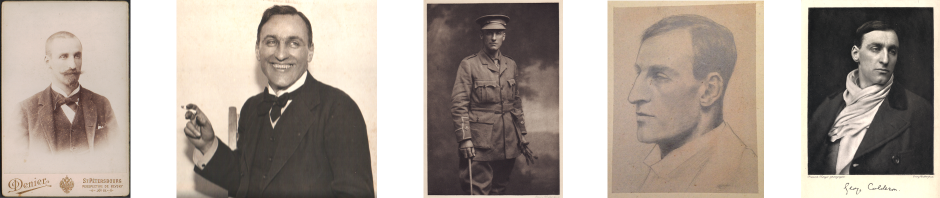
 George Calderon c.1901

 Christmas 1901 Cartoon by George Calderon
 A happy memory of Trinity College: undergraduates breakfast together in Downy V. Green, p. 77.
 Basic form of the Calderon coat of arms
 Captain of the 11
 Colonel Sir Walter Coote Hedley c. 1920
 The entrance to Fort Brockhurst (picture from Britain’s Past)
 Unpublished watercolour by George Calderon, Tahiti 1906
 George and Kittie Calderon 1905
 K.N. Das Gupta and Margaret Mitchell in an Indian Dramatic Society production of The Maharani of Arakan, 1913?
 George Calderon, 1912


Mayakovsky’s pancake
It may seem surprising that I can bring myself to say anything positive about Russians at a time when their country has become, to quote Joseph Conrad again, ‘the negation of everything worth living for’. But, of course, these four short videos are inspired by one of the most positive Russians who ever lived, Anton Chekhov, who happened also to believe deeply in democracy. Russians’ love of creating and telling anecdotes is a very engaging trait, but in the Soviet era the endless production of so-called political anecdotes became for many merely a way of avoiding real political belief, integrity and engagement.
I fluffed this video at the end of the quotation from pages 1-2 of my Chekhov biography because I suddenly thought I should change ‘Suvorin’, who most listeners would not have heard of, to ‘his [Chekhov’s] publisher’. One should never make these snap decisions! For your interest, here is the whole passage as it appears in the book:
Aleksei Sergeevich Suvorin (1834-1912) was a journalist, newspaper owner and book publisher who was a close friend of Chekhov’s until their differences in 1898 over the Dreyfus Affair (see chapter 11 of Anton Chekhov: A Short Life).
ADVERTISEMENT
SOME RESPONSES TO GEORGE CALDERON: EDWARDIAN GENIUS
‘This meticulous yet nimble book is bound to remain the definitive account of Calderon’s life’ Charlotte Jones, The Times Literary Supplement
‘The effort of detection, it must be said, was worth it. The biography is a delight to read.’ Emeritus Professor Laurence Brockliss, The London Magazine
‘It is a masterly synthesis of your own approach with scholarship and very judicious discussion of the evidence.’ Emeritus Professor Catherine Andreyev, historian
‘This comprehensive, meticulously researched and highly readable biography, which the author describes as a “story” rather than an academic biography…’ Michael Pursglove, East-West Review
‘A monumental scholarly masterpiece that gives real insight into how the Edwardians viewed the world.’Arch Tait, Translator of Natalya Rzhevskaya’s Memoirs of a Wartime Interpreter
‘The book is written with great assurance and the reader always feels in safe hands. I liked the idea of it being a story and I read it the same way I would read a novel.’ Harvey Pitcher, writer
‘Presents the Edwardian age, and Calderon in particular, as new and forward-looking.’ Emeritus Professor Michael Alexander, in Trinity College, Oxford, Report 2017-18
A review by DAMIAN GRANT appears in the comments to Calderonia’s 7 September post.
A review by JOHN DEWEY appears on Amazon UK.
Share this:
Related