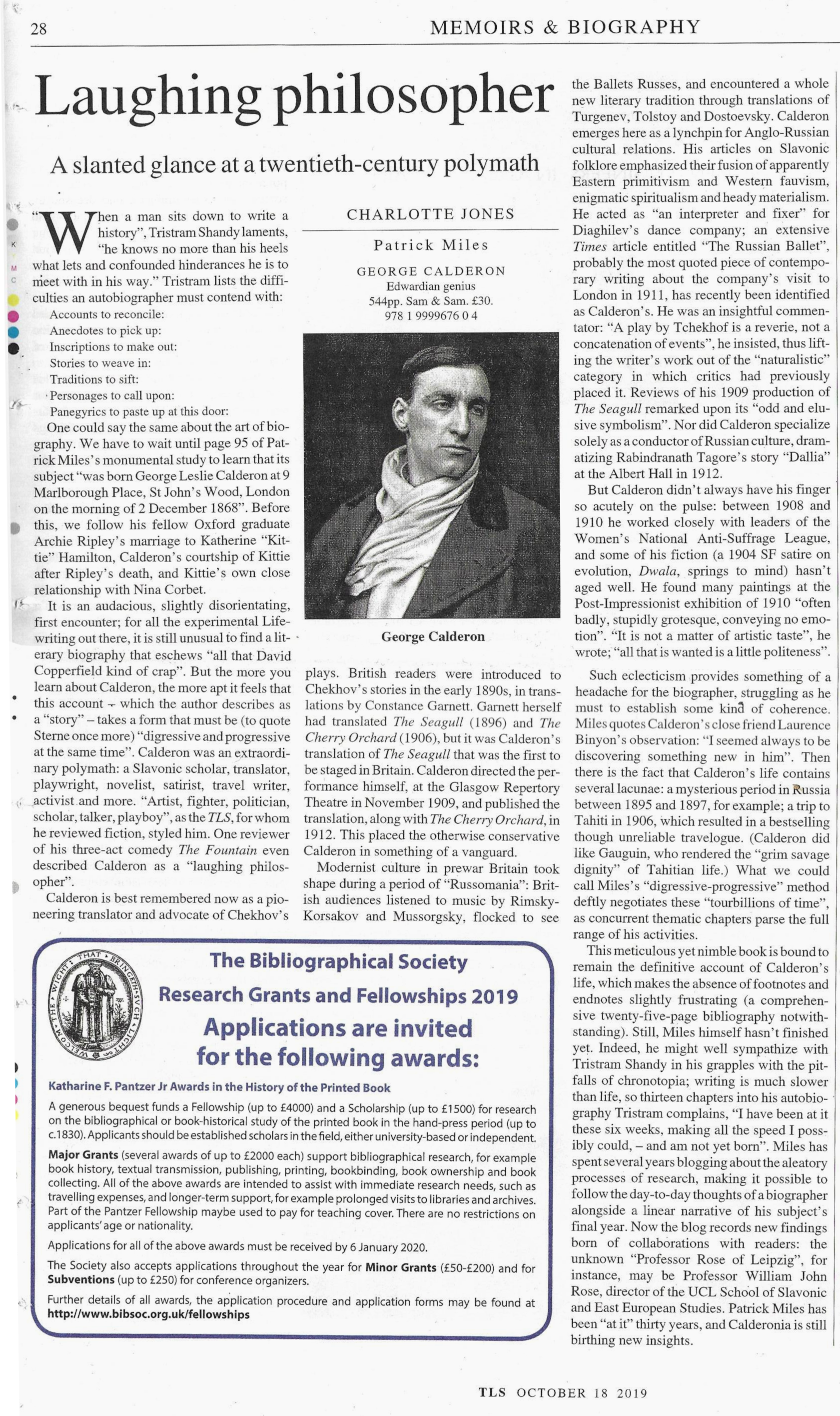
The diary of a writer-publisher: 38

21 April 2026
A one-to-one meeting in the RSC theatre at Stratford with Tamara Harvey, Co-Artistic Director. In October I had printed out from the RSC website the two-page publicity for her production of The Cherry Orchard in the Swan Theatre 10 July-29 August and sent it to her with ten robust criticisms written on it. ‘I owe it to you to say,’ I wrote, ‘that on the basis of this blurb you are heading for disaster with ORCHARD’. Wherefore, Patrick, put it so strongly/rudely? Well, this is an opportunity for the RSC to stage the first successful production of Cherry Orchard in the history of our subsidised theatre, and they owe it to us to do that. The publicity was chock-full of crass inaccuracies about the nature of the conflict in Chekhov’s play, its narrative, and the Russian historical context. Frankly, I could not believe that Tamara Harvey had written it. Alternatively, though, she and Laura Wade (the creator of the ‘version’ they are using) were simply out of their depth.

I am still not convinced that they know what they are doing, but I do, of course, humbly thank Tamara for her positive, tolerant, generous and forgiving nature in inviting me to meet her and talk about it. This happened after I wrote to her in January congratulating her on the choice of space for her production (Peter Hall’s characteristically lavish NT production was killed simply by the wrong space, as he admitted to me himself), and offering my consultancy. Since then I had sent her extracts from all Chekhov’s letters on the play, the whole of my up-to-date literal of it (already used for two major Irish productions), and a survey of English misconceptions about the Russian original and plot.

Helen Hunt: a possibly inspired casting as Ranyevskaya
© 2026 Royal Shakespeare Company, promotional materials for The Cherry Orchard

Why am I ‘still not convinced’ etc? Well, although our conversation ranged exhaustively and delightfully over all the characters in the play, over key productions since 1961, Kenneth Branagh’s possibly excessive charm for Lopakhin, the proven instability of having two big stars in the leading roles of the play, the difficulty of Sharlotta Ivanovna (according to Chekhov the ‘most difficult part’ and the ‘only one’ he liked), the perennial question of whether Yasha is Ranyevskaya’s gigolo, the meaning of the word nedotepa, etc etc, I still was not told whether the publicity actually reflected Tamara’s and Laura’s view of the play, or was written by PR people wanting at all costs to ‘sell’ the two ‘stars’ and churning out conventional wisdom (crap) about the state of Russian society in 1903. Tamara revealed very little of what she intends to do with the play — other than ensure that it is a comedy, which would certainly be great, as long as it wasn’t phoney comedy/RSC stage ‘improv’ stuck on to Chekhov’s throughline. It was surprising, to me at least, that there seemed no settled script for the production yet and only two parts had been officially cast.

Nevertheless, Tamara Harvey asked me to send her ‘everything’ and said she will ask me whatever she needs to. Marvellous. I concluded by thanking her for forgiving me my dreadful Meldrewism, and she kissed me saying ‘I am allowed to kiss you, it’s theatre’. As she exited, however, she shot back: ‘I hope you enjoy [my production of] Henry V — and I’m sure you will tell me if you don’t!’ I managed to expostulate ‘No, no!’. We saw the production that evening and were blown away by it. Great ensemble. Watch this space…

7 May
Jim Miles (Goat2) has now submitted the corrected second proof of my book of short stories The White Bow/Ghoune to Amazon for their first proof. It lacks the back cover, which is graphically complex and will take us some time to get right. But we have a breathing space in which to do that, because, Jim said rather mournfully, there would be ‘quite a long wait’ for Amazon’s first proof, by which I think he means longer than for our other three books they have printed. On receiving this news, I trotted out my mantra that ‘so many books are now being written that soon even Amazon won’t be able to cope’!

Goat2’s belief, though, is that the way to maintain our publishing standards is to ‘sand the book with finer- and finer-grain papers’, i.e. not to be in too much hurry between proofs or read them too quickly. Goat1’s version of that  has always been the Russian saying ‘measure the cloth seven times but cut it once’. Even with this slower progress than usual, the book should be out only about four weeks behind schedule, i.e. around 15 June. No problem. An appropriate business meeting at Polonia restaurant will then be called.

12 May
Taken aback to see the death aged eighty-nine of ‘Experimental poet and Cambridge don’ J.H. Prynne announced in The Times today. I have been reading and not understanding Prynne’s poetry since Kitchen Poems of 1968, but I don’t intend to get embroiled in that controversy; it’s a matter for the philosophy of language. The point for me is that he was extremely encouraging ever since he became my tutor at Caius College in 1967 (remember, at Cambridge a tutor is for moral and general well being, not teaching: Prynne was Director of Studies in English, whereas I was a student of Russian and German). He told me of travel grants to help with going to Germany and Russia in the vacations, and procured them for me himself. When the option of a dissertation in Russian to replace a Finals paper — which I had signed up for and was researching on my undergraduate gap year in Moscow — was suddenly withdrawn by the Faculty, Prynne personally remonstrated with them and I was allowed to submit what I believe was the only one ever. When I returned from Russia for my final year, he asked me to supervise some of his English Literature students in their Russian translation paper. This was incredibly innovative and trusting of him, seeing that I had not even graduated! Thereafter, I supervised in this subject for nearly ten years as well as assisting his efforts to build up the Russian section of Caius Library (he was the Fellow Librarian). All his communications were meticulous, efficient, jovial and kind. His wine parties were certainly demanding, but his claret of the very best. Here is a typical invitation from him (1987):

Jeremy Prynne’s individualism and protection of his privacy are infamous and exemplary. It was said that on National No Smoking Day, when other Caius Fellows refrained,  he would take a cigar from the tobacco box offered at dessert and smoke it, although he never otherwise smoked, simply to assert his freedom not to endorse state conformism. When he married in 1969 without telling anyone, he was said, as the Times puts it, ‘to have responded to a polite request of a colleague about his wife’s name with a curt “Mrs Prynne”.’ The version I heard, as a twenty-one-year-old, was that the Fellows asked him whom he had married and he replied (smiling): ‘Oh, a friend…’ Shortly afterwards I bumped into them both on Trinity Street and they looked very happy. I am glad I have kept all his correspondence. It was always sudden and calligraphic. On one occasion, he sent me a photocopy of a very short manuscript Russian poem (by Mikhail Kuz’min?) with surrounding decorations rather like Blake, asking me to translate it for him. It was very difficult to read, let alone translate, and took me about a week. R.I.P.

15 May
SOME HAVE IMPOSTORSHIP THRUST UPON THEM
Feeling rather weary after walking into town, I took a taxi back to our nearest landmark, the Catholic church. The driver insisted on delivering me to the church’s front door in its spacious car park. I did not want to reveal to him that I’d economised by leaving myself the last 500 m to walk home, so I just looked inside the church whilst he drove off. The doors are of that ‘assisted’ kind that you have to start with a heave. When I emerged, a man was just outside, holding a rosary of enormous wooden beads, so I held the door open for him to go in. ‘Thank you, father,’ quoth he. Goodness, it took me back to 1972-73 when I used to deliver translations to the Moscow Patriarchate editorial office and as I walked through Novodevichy Convent’s grounds little old ladies would bow low to me and say ‘Kind day to you, batiushka!’ (‘little father’). Back then, it was the beard that did it.

Comment Image


ADVERTISEMENT

George Calderon: Edwardian Genius Front Cover

SOME RESPONSES TO GEORGE CALDERON: EDWARDIAN GENIUS 

‘This meticulous yet nimble book is bound to remain the definitive account of Calderon’s life’ Charlotte Jones, The Times Literary Supplement

‘The effort of detection, it must be said, was worth it. The biography is a delight to read.’ Emeritus Professor Laurence Brockliss, The London Magazine

‘It is a masterly synthesis of your own approach with scholarship and very judicious discussion of the evidence.’ Emeritus Professor Catherine Andreyev, historian

‘This comprehensive, meticulously researched and highly readable biography, which the author describes as a “story” rather than an academic biography…’  Michael Pursglove, East-West Review

‘A monumental scholarly masterpiece that gives real insight into how the Edwardians viewed the world.’Arch Tait, Translator of Natalya Rzhevskaya’s Memoirs of a Wartime Interpreter

‘The book is written with great assurance and the reader always feels in safe hands. I liked the idea of it being a story and I read it the same way I would read a novel.’ Harvey Pitcher, writer

‘Presents the Edwardian age, and Calderon in particular, as new and forward-looking.’ Emeritus Professor Michael Alexander, in Trinity College, Oxford, Report 2017-18

A review by DAMIAN GRANT appears in the comments to Calderonia’s 7 September post.

A review by JOHN DEWEY appears on Amazon UK.

Click here to purchase my book.


Posted in Personal commentary | Tagged , , , , , , , , , , , , , , , , , , , , | 1 Comment

The Europeans 2019

Pull on your driving gloves, Gordon,
Light up your Billiard pipe!
Edge out and I’ll slam shut the garage,
We’re off to the civilized life!
In two hours we’ll be down at Dover,
This Bentley’s not going near Fife!

Cher Bertrand, chère Ninette…we made it…
what fresh fruits de mer on your terrace
au Cap…do take a photograph, dear.

First in Paris: my hair! Then L’Alceste
with escargots…the waiters are charming…
raise your glass, dear, I’ll snap you together.

Melissa goes topless at Cagnes.
O quelle compagnie for the socca!
Let’s raise our rosé to la France!

It’s a quick flight to Marco. We’ll wear
our new blue Bermudas and soak up
the sunsets through chilled pink Bellinis…
Ugh! Why must we always go ‘home’?

He kicked their old Bentley, clenched pipe,
and they crawled through the boneyard of Europe
back to Brexit, and Bojo, and gravy.

© Patrick Miles, 2026

For the context to these verses, see here.
Socca is a speciality of the Nice area.

Comment Image


ADVERTISEMENT

George Calderon: Edwardian Genius Front Cover

SOME RESPONSES TO GEORGE CALDERON: EDWARDIAN GENIUS 

‘This meticulous yet nimble book is bound to remain the definitive account of Calderon’s life’ Charlotte Jones, The Times Literary Supplement

‘The effort of detection, it must be said, was worth it. The biography is a delight to read.’ Emeritus Professor Laurence Brockliss, The London Magazine

‘It is a masterly synthesis of your own approach with scholarship and very judicious discussion of the evidence.’ Emeritus Professor Catherine Andreyev, historian

‘This comprehensive, meticulously researched and highly readable biography, which the author describes as a “story” rather than an academic biography…’  Michael Pursglove, East-West Review

‘A monumental scholarly masterpiece that gives real insight into how the Edwardians viewed the world.’Arch Tait, Translator of Natalya Rzhevskaya’s Memoirs of a Wartime Interpreter

‘The book is written with great assurance and the reader always feels in safe hands. I liked the idea of it being a story and I read it the same way I would read a novel.’ Harvey Pitcher, writer

‘Presents the Edwardian age, and Calderon in particular, as new and forward-looking.’ Emeritus Professor Michael Alexander, in Trinity College, Oxford, Report 2017-18

A review by DAMIAN GRANT appears in the comments to Calderonia’s 7 September post.

A review by JOHN DEWEY appears on Amazon UK.

Click here to purchase my book.


Posted in Personal commentary | Tagged , , , , , , , , , , , , , , , , , , , , , | Leave a comment

The diary of a writer-publisher: 37

23 March 2026
Ten days after jotting down the first lines, I type up some verses entitled ‘The Europeans 2019’. I’ve long wanted to write something like it, as a joke, and various recent events triggered it. If you recall, 2019 fell in the agonized hiatus between the EU referendum (2016) and its result being ratified by Parliament (2020) — a period that included the resignation of two Tory prime ministers and the election of Boris Johnson to Get Brexit Done. Passions about the EU ran higher than ever. Some of our intelligentsia ascribed the Leave vote to sheer xenophobia. Equally, though, I felt there were Remainers who suffered from oikophobia, i.e. a hatred of their own oikos (home/culture). I knew a few. They were exponents of the Oo-la-la school of xenophilia who were hooked on European travel, food, drink, climate, beaches, tourist sights etc. Essentially they were voting for their own hedonism. I couldn’t resist opening with a riff on Betjeman’s ‘How To Get On In Society’:

Pull on your driving gloves, Gordon,
Light up your Billiard pipe!
Edge out and I’ll slam shut the garage:
We’re off to the civilized
 life!
In two hours we’ll be down at Dover,
This Bentley’s not going near Fife!

The couple call at Cap Gris-Nez, Paris and Cagnes, indulging their appetites on the way, then flit to Venice. The last four lines read:

Ugh! Why must we always go ‘home’?

He kicked their old Bentley, clenched pipe,
and they crawled through the boneyard of Europe

back to Brexit, and Bojo, and gravy.

If this light verse is published somewhere, I will post it on Calderonia (if there is a demand!). Lest I should be accused of xenophobia myself, I remind subscribers that I voted Remain. I’ve experienced a dozen European countries, however, and genuinely do regard Greater Europe as a boneyard of wars, betrayals and bad governance.

2 April
Everyone in the area these days seems to have a dog, if not two, so I decided we should keep up with the Joneses and acquire this one:

Poor chap, he had been put in front of a neighbour’s house for anyone to take, but no child or parent wanted him. Finally I saw him out in the rain and decided I must rescue him. The owner told me he is nearly a hundred years old, but stuffed with sawdust, so no charity shop would take him (H&S). I identified the breed as Clumber Spaniel, which a few days later won Top Dog at Crufts. I am considering walking him every morning to get the paper, as he has wheels and a convenient handle at the back. Apparently he was called Rufus, but now he is Woofus. Wonderfully low maintenance, of course, and no vet bills.

11 April
When does ‘early 2026’ end..? My book of twenty short stories is announced for then, and I even have a feeling that sometime last year I said it would be out in the autumn. Will I never learn just to keep my mouth shut? But I know it’s a common disease of writers, missing their own publication deadlines… The suspense must be killing you out there.

Some good has come of it, though, for me at least. GOAT1 (as I must call myself after the rebranding of Sam&Sam) took almost a year to write the last story in the book (9700 words), as its subject matter and style were a new and uncertain departure. So it was finally finally finally finished in February 2026. The rest was ready to go and GOAT2 got straight down to typesetting the book in March, with all the added efficiency of his now eight years’ experience since typesetting George Calderon. A problem soon coagulated: I thought it was going to be about 185 pages, I certainly didn’t want it to hit 200 pages, but it is running at over 250. This is partly because we are having to put in some blank pages so that all the stories start on a recto (right hand page), and partly because we are very committed to an easily legible font size. But what to do about the total length?

Having to address this has proved a very positive thing. You see, I had always thought of this as a short book of stories, because there would be at least one more book of them in the future. But the problem led me to see the current book differently. The twenty stories it contains date from 1967 to 2026 (a few early published ones were rejected), but…I literally have no more stories in my head. I hadn’t been aware of this myself. But I think it’s true. So The White Bow/Ghoune is in effect my ‘collected stories’, basta! In that context, it doesn’t seem s-o pretentious sticking to recto starts and coming in at 250+ pages.

ETA now is mid-May. Would you say that is still early 2026? Watch this space, of course.

Comment Image


ADVERTISEMENT

George Calderon: Edwardian Genius Front Cover

SOME RESPONSES TO GEORGE CALDERON: EDWARDIAN GENIUS 

‘This meticulous yet nimble book is bound to remain the definitive account of Calderon’s life’ Charlotte Jones, The Times Literary Supplement

‘The effort of detection, it must be said, was worth it. The biography is a delight to read.’ Emeritus Professor Laurence Brockliss, The London Magazine

‘It is a masterly synthesis of your own approach with scholarship and very judicious discussion of the evidence.’ Emeritus Professor Catherine Andreyev, historian

‘This comprehensive, meticulously researched and highly readable biography, which the author describes as a “story” rather than an academic biography…’  Michael Pursglove, East-West Review

‘A monumental scholarly masterpiece that gives real insight into how the Edwardians viewed the world.’Arch Tait, Translator of Natalya Rzhevskaya’s Memoirs of a Wartime Interpreter

‘The book is written with great assurance and the reader always feels in safe hands. I liked the idea of it being a story and I read it the same way I would read a novel.’ Harvey Pitcher, writer

‘Presents the Edwardian age, and Calderon in particular, as new and forward-looking.’ Emeritus Professor Michael Alexander, in Trinity College, Oxford, Report 2017-18

A review by DAMIAN GRANT appears in the comments to Calderonia’s 7 September post.

A review by JOHN DEWEY appears on Amazon UK.

Click here to purchase my book.


Posted in Uncategorized | Tagged , , , , , , , , , , , , , , , , , , , , | 1 Comment

‘The Women’ (after Pasternak)

‘The Myrrh-Bearing Women’, Russian icon, 16th  century

Garden real, not real, mere real, unreal,
indivisible for them, their being.
Green-gilt catkins hang — then shudder, hurl
angelstruck: ‘He is not dead, but living!’

And everything they knew is put aside.
A rock may move. Myrrh is not needed more.
Nor linen shards. Death’s empire he has tight-
ly rolled up like a bandage. ‘Go, therefore…’

And they run. And straightway meet the gardener,
and fall down, and worship, cry, and clutch
his stabbed feet. But what for women harder than
this could be: ‘You must let go, not touch…’?

As slow lithologies, whole plates, tear off
their bedrock, so their hair unkisses him.
They stand, still bowed. And then he says: ‘Fear not.
I shall be with You till the end of time.’

© Patrick Miles, 1995

HAPPY EASTER!

Comment Image


ADVERTISEMENT

George Calderon: Edwardian Genius Front Cover

SOME RESPONSES TO GEORGE CALDERON: EDWARDIAN GENIUS 

‘This meticulous yet nimble book is bound to remain the definitive account of Calderon’s life’ Charlotte Jones, The Times Literary Supplement

‘The effort of detection, it must be said, was worth it. The biography is a delight to read.’ Emeritus Professor Laurence Brockliss, The London Magazine

‘It is a masterly synthesis of your own approach with scholarship and very judicious discussion of the evidence.’ Emeritus Professor Catherine Andreyev, historian

‘This comprehensive, meticulously researched and highly readable biography, which the author describes as a “story” rather than an academic biography…’  Michael Pursglove, East-West Review

‘A monumental scholarly masterpiece that gives real insight into how the Edwardians viewed the world.’Arch Tait, Translator of Natalya Rzhevskaya’s Memoirs of a Wartime Interpreter

‘The book is written with great assurance and the reader always feels in safe hands. I liked the idea of it being a story and I read it the same way I would read a novel.’ Harvey Pitcher, writer

‘Presents the Edwardian age, and Calderon in particular, as new and forward-looking.’ Emeritus Professor Michael Alexander, in Trinity College, Oxford, Report 2017-18

A review by DAMIAN GRANT appears in the comments to Calderonia’s 7 September post.

A review by JOHN DEWEY appears on Amazon UK.

Click here to purchase my book.


Posted in Heroism and Adventure, Personal commentary | Tagged , , , , , , , , , , , , , , , , , , , | Leave a comment

A new story by John Melmoth: ‘Snowballs’

Some of the snowballs have a kind of animal energy.’—Andy Goldsworthy

The moment the snowball left Anton’s hand he knew exactly what was about to happen. He didn’t understand physics well enough to know how he knew, but the fact was that he did. Maybe the world ceased turning for a millionth of a second. Everything stopped and then caught up with itself, like a global ectopic heartbeat. And for that tiny fragment of time, he was treated to a view of the future. Or maybe, an inanimate object— one snowball—had suddenly taken on a life of its own, with its own needs and wants and intentions. Or maybe, the molecules of air between them suddenly parted for some reason, allowing the snowball an uninterrupted and unerring passage to its destination. He was pretty sure that if only Newton’s second law of motion had applied as normal, the snowball would have dropped well short, and what happened would never have happened.

As it was, whatever the explanation, it felt predestined that a snowball he’d aimed elsewhere should hit Mr Lanyon—a particularly charmless teacher, and there was stiff competition for that accolade—on the side of his head, knocking his glasses off.

Anton knew at that moment that he was in deep shit.

It was January 1963. The UK was entombed in snow and ice; locked in a frozen dream. By day, Brits dug themselves out of historically unprecedented drifts up to twenty feet deep, and attempted to get on with their lives. Cattle and sheep died in the iron fields. Up to half the population of wild birds perished, ninety per cent of kingfishers. The snow lay on the ground for sixty days. Milk bottles in their millions exploded on doorsteps. Night after night, the darkness crackled with bitter, occult, apparently permanent cold. The stars looked down pitilessly. The frost conjured ghosts’ breath above polluted inland waterways too rank to freeze. Extending up to a mile from the shore, the sea reared up, stilled and turned to glass. The sound of the waves on the shore ceased.

Anton was a pupil at an inner-city boys’ grammar school. The buildings were Edwardian and there was only a small tarmacked playground, with a couple of sickly yews in brick-edged beds. There was no room for ball games and, consequently, during lunch-break the boys were allowed into the nearby park—caps to be worn at all times, needless to say—to play football and cricket. Equally needless to say, they were forbidden from fraternizing in the park with the girls from the sister school—berets never to be removed. Which may explain why, more than sixty years later, the word ‘fraternize’ is for him so erotically charged. And don’t get him started on ‘berets’.

Nor was there considered to be room in the playground for snowball fights, which were strictly prohibited. Once again, if they wanted to do it, the boys had to go to the park. (Oddly, there was no rule against making lethal slides in the playground. In his seven years at the school, at least two boys broke legs skidding across the ice, and another was badly concussed. This was obviously felt not to be as significant as the risk of broken windows.)

He was normally a law-abiding member of the community, but the sight of his best mate Graham wandering unwittingly towards the tuck shop was too much for him. He picked up a handful of snow, compressed it in the palms of his hands, and lobbed it at him. At that moment, Graham turned, saw the snowball in flight and did what any reasonable person would do—ducked. It passed noiselessly over his head and hit Lanyon, who just a second ago had been a couple of yards to the left, full on.

He was instantly furious, and who could blame him? He knelt down and picked up his steel-rimmed specs which, fortunately, were undamaged. And then he turned to Anton.

Apart from the fact that he wasn’t a man of joy, the other thing you need to know is that Lanyon was a biology teacher. And biology was pretty much a second-class subject at that school. Those who were considered clever were shoe-horned, regardless of their preferences, into a classical stream, where the emphasis was on endless Latin and Greek. This created timetabling issues. These clever boys were obliged to study physics and chemistry, a modern language, maths and English Language, as these would be required for university entrance, but there were other subjects such as art, English Literature, woodwork and biology, that were simply unavailable to them. The generally unspoken feeling seemed to be that they were fine for the lower streams but were not needed by the elite. That they were not entirely serious. That they were just a bit soft.

This meant that he had never been taught by Lanyon, who possibly nursed a sense of grievance that his beloved subject was not considered important for the cleverest boys. That he was the victim of a kind of unspoken intellectual snobbery, and that the likes of Anton were the intellectual snobs. Consequently, it was unlikely that a single word had ever passed between them. Maybe if it had, Lanyon might have been more inclined to be merciful or at least to deal with Anton himself, rather than immediately escalating the issue to the headmaster, which is what—puce-faced—he did.

(Added to that was the fact that Graham was, by common consent, the prettiest boy in the entire school—chestnut curls, green eyes, a girl’s skin. A face by Raphael, and, in consequence, hated and targeted by the majority of masters, who apparently regarded his beauty as a personal affront, a challenge to their bleak and ordered view of things.)

‘Both of you, Headmaster’s office, now.’

Anton apologized but Lanyon wasn’t listening. It may be doing him an injustice—and if so, who really cares?—but his attitude seemed vengeful, born out of a long, simmering frustration at his career choice. Anton tried to explain that there was only one culprit here not two, but Mr Biology was so angry that he refused to hear him.

‘Don’t argue with me, boy. Just get inside or I’ll drag you both in by the hair.’

Anton doubted he’d be able to do this, but didn’t want to give him the chance to try.

Being sent to the headmaster could mean only one thing.

Anton’d acted instinctively but, nonetheless, had been aware of what he was doing. Graham, on the other hand, had acted reflexively, without thinking, doing what his body was designed to do. He may not have known it, but in that moment his behaviour was determined by the escape reflex. In response to potential danger—such as a snowball coming at you—the body initiates an escape motion. Dodging, or in this case, ducking. You don’t have any choice in the matter. There is no way you can switch it off, decide in the instant not to duck.

Anton subsequently read up on it and the escape response is apparently located (if that’s the right word) in the telencephalon region of the brain, which might have meant more to him if he’d known where that was or what it did. Ironically, that’s the kind of stuff he might have learned in Lanyon’s class. But, then again, probably not. He had the sense, although no evidence to back it up, that Lanyon spent his days in the company of tadpoles and fruit flies. Possibly slugs.

To punish someone for ducking would be like punishing them for their pupils changing size when a bright light was shone into their eyes, sweating in the heat, sneezing when their nostrils filled with dust, or jumping at a sudden loud noise. No one in their right mind would do such a thing. Consequently, Anton assumed that Graham, at least, was safe.

More fool him.

Such was the awe in which the headmaster was held, that boys were not allowed to approach his inner sanctum directly. Instead, they had to knock at the door of the school secretary, who would pass on the message to his Holiness (via a door linking their two offices) that another batch of miserable sinners was awaiting punishment. She was not normally a sympathetic person, but when Anton told her why they were there, he thought he spotted a glint of amusement in her eyes.

‘So, you knocked Mr Lanyon’s glasses off with a snowball?’

‘Yes, Ma’am.’

‘I see. Oh, dear. I imagine he wasn’t particularly pleased.’

Could it be that the school’s intellectual snobbery extended as far as the secretary’s office?

‘No, Ma’am.’

‘Well, I’ll tell Headmaster that you are here.’

‘Ma’am, I just want to say that Miller didn’t do anything.’

‘I’m sure Headmaster will take account of that.’

Did he detect a flicker of sympathy? Probably not.

Unlike Lanyon, the headmaster did not seem in the least vengeful. If anything, he seemed bored. Punishing boys was just one of those things in his day that had to be got through, like approving the following week’s lunch menus or working on his speech for Founders’ Day. And if you think about that for a moment, maybe you’ll see how totally weird it was. A grown man was about to unleash legalized, ritualized violence on a boy of thirteen, and that wasn’t in any way notable or unusual. It wasn’t the kind of thing he needed to give any particular thought to, or take home with him after work. He wasn’t even required to be angry. It was simply usual and tedious. Routine and impersonal.

How did he live with himself?

He’d obviously just had a cigarette; his room was full of smoke.

He said, ‘I’m sick and tired of telling you boys that snowball fights in the playground are strictly forbidden. When will you ever learn? You know, don’t you, that I’m going to have to punish you?’

So, in his version of events: it was not that he particularly wanted to punish them, but that the school rules dictated that he must. He had no choice in the matter. Talk about bad faith. Or mala fides, as those in the classical stream preferred.

Graham said nothing.

Anton said, ‘Please, Sir, Miller (first names were recherché when talking to the authorities) did nothing wrong. I threw the snowball at him. He didn’t throw anything.’

‘So you say. But Mr Lanyon has sent me a chitty claiming that both you and Miller are to blame. And unless you are prepared to challenge his version of events, you’re each going to receive four strokes of the cane.’

Honour demanded that Anton put his life on the line for Graham.

‘But, Sir, that isn’t fair.’

‘Don’t you dare talk to me about fairness. Unless you want six strokes. I’ll decide what’s fair and what’s not. Now, bend over.’

Anton looked at Graham who, almost imperceptibly, shook his head.

So, Graham and Anton were both caned for what Anton did. Anton found it hard to believe at the time, and still finds it hard to believe, that life could be so unfair. That nobody would listen to what he had to say. That the innocent could be punished along with the guilty. That teachers hated their lives so much, and took out their despair on children.

He could imagine the headmaster or Lanyon, saying, ‘Well, that’s an important life lesson for you both.’ But he was very clear that it was one he had no interest in learning.

The thing about being caned was that it hurt. A lot. Anton had to fight back the tears. He was caned first, which meant that Graham had to watch while he waited. Then Anton watched him receive his four without flinching.

Anton had seen school movies in which the custom was for the beaten to thank the beater for what had just happened. None of that nonsense applied at this school. At least, they didn’t expect pupils to express gratitude for being hurt. But they were required to shake hands with the headmaster afterwards, presumably to demonstrate that there were no hard feelings. As if. Anton shook his hand but refused to make eye contact with him. He might have to go along with this charade but he didn’t have to buy into it. The shaking of hands added a ritualistic aspect to the injuries done to them, which might make it more acceptable or less transgressive, normalize it. And he certainly had no interest in any of that. And he supposed Graham didn’t either.

They left the headmaster’s smoky lair via the secretary’s office. She said nothing. Did they detect a look of sympathy? Almost certainly not.

Back in the playground, Anton apologized to Graham, but he wasn’t having any of it.

‘Not your fault. Lanyon’s a bastard.’

‘My dear chap, I can’t take issue with your second statement, but your first is erroneous. It most certainly was my fault.’ (They thought it amusing to talk like that.)

‘Oh well, my dear old thing, it’s over now. You only did what anyone would have done in the circumstances. Might I suggest that we go to the park after school and I’ll try to extract my revenge?’

Such grace under fire.

If only the adults around them had been capable of anything like it.

When they returned to their form room after the bell, Anton was told that Lanyon wanted to see him. He couldn’t imagine why. He found him in the biology lab.

‘Did you see Headmaster?’

‘Yes, sir.’

‘And what happened?’

‘He caned me.’

‘He caned you what, boy?’

‘He caned me, Sir.’

‘And what about Miller?’

‘He caned him as well, Sir.’

Right up to this point, Anton’s residual respect for authority was such that he almost expected Lanyon to apologize, to say that he hadn’t meant things to go as far as they had. That he would have been satisfied with a detention.

But, of course, he didn’t.

Instead, he looked at Anton with what can only be described as malevolence, and said, ‘Well, let that be a lesson to you. School rules are there for a reason. You would do well to remember that. You may go.’

So, Anton went. Gladly. Looking back, he doesn’t think another word passed between them in his remaining five years at school. He certainly hopes not. Back then, he’s not sure why, he couldn’t decide whether he felt more bitterness towards Lanyon or towards the headmaster. The headmaster was bored at having to punish them, whereas Lanyon relished handing the task over to someone else.

These days, he’d like to think that, in retirement, perhaps while he and his wife were on a walking holiday in the Lake District, Lanyon had looked back on his career and wished he’d been nicer, gentler, more understanding; that in retrospect he couldn’t understand how he’d been so awful. But that probably didn’t happen. On the other hand, he was a sad, deeply flawed human being. Whereas the headmaster routinely hit people smaller and younger than himself who had no way of defending themselves. Probably they were as bad as each other in their own ways.

Second period that afternoon was gym. As they were getting changed, he and Graham compared bums. They both had clearly-visible scarlet welts on their butt-cheeks, a couple of which were bleeding.

Their gym master asked Graham, in his usual hectoring bark, why he was limping, so Graham told him what had been done to them. To Anton’s surprise and to his eternal gratitude, the gym master then performed a small act of kindness. And kindness in that place, at least on the part of the teaching staff, was as rare as hens’ teeth, horses’ toes or fish fingers.

‘Hurry up, boys,’ he said in a voice that would pass for gentle among the fraternity of gym teachers, if among no other demographic. ‘I won’t mind if you both take things a little easy this afternoon. Go carefully now.’

Everyone concerned appeared to feel that there was a lesson to be learned here. So, did Anton learn it? Well, he learned that to get caught breaking school rules was never a good idea. He learned that Lanyon and Headmaster were possessed of squalid souls and were best avoided. But did he learn anything about life? Did he learn to repress the urge to throw snowballs at friends? I’m afraid the answer has to be a resounding NO.

—————

Fast forward ten years, Anton’s at university, doing his best to take postgraduate research seriously.

At this precise moment, he’s standing on Oxford station. It has been snowing for days. He’s working on the Christmas post; his job is to get as many sacks of mail as possible on and off each train that comes in. The train guards don’t like being held up, are generally uncooperative, and he rarely gets more than two minutes. So, after a brief burst of frantic activity, he has to wait for the next train.

In the course of an eight-hour shift, he hears the recorded platform announcements over and over again. It sounds as though they’ve been made by someone with a speech impediment. The no doubt delightful Cotswold market town of Moreton-in-Marsh emerges from the speaker system as the terrifying and possibly post-apocalyptic ‘Noreton-en-Garsh’, where zombies roam. It isn’t that he thinks it’s necessarily a job for Richard Burton, but still…

Anton’s supervisor is a gentle, dreamy, softly-spoken, rather odd postman called Curly, who is as bald as an egg, a father of six, and an enthusiast for the recordings of Richard Tauber. He’s constantly warbling bits of Tauber’s repertoire to Anton: ‘Dein ist mein ganzes Herz,’ ‘Du bist meine Sonne,’ and so on. Anton doesn’t take it personally. It’s hard to know how to respond as he’s never previously heard of the guy and has zero interest in light opera. There’s another postman and another student on the opposite platform. The woman running the station café is generous with sausage rolls and cups of tea. Working here is fun.

Curly and Anton move the mail sacks around in something called a BRUTE—which stands for British Rail Universal Trolley Equipment—a three-sided, blue-painted metal cage on wheels. As the days tick towards the twenty-fifth, so the volume of mail decreases—everyone has already posted their cards and letters. Because they now have more BRUTEs than they need, Curly asks Anton if he would mind wheeling a couple of them to the very end of the platform, where they will be out of the way.

It’s quiet and dark here. None of the trains coming through is as long as the platform. There are no waiting passengers at this point, just Anton. He reflects that snow enables a kind of time travel; has transformed a late-twentieth-century station into a station of the mid-nineteenth century. He wouldn’t be totally surprised if Charles Dickens or Queen Victoria suddenly materialized out of the night.

And then he sees Henry Dangerfield, standing on the opposite platform underneath one of the station lights, about forty yards away, the snow drifting past his perfect head.

Henry is everything that he is, and some of the things Anton secretly wants to be. For a start, he’s uber-confident to a point way beyond effortless arrogance. He’s tall and imposing and has great hair. He and Anton play for the college cricket team. He opens the batting and regularly scores elegant fifties and sixties. Anton’s a second-change, seam-up bowler, a trundler who picks up the occasional lower-order wicket. In college everyone is aware of Henry: of Anton, not so much. Henry’s doing something important in the field of number theory, whereas Anton’s fiddling around half-heartedly with a minute sliver of English literature.

In other words, if anyone ever had it coming, Henry Dangerfield does. Anton is about to wreak a kind of cosmic justice; his self-appointed role is to right one of life’s myriad unfairnesses.

He melds the perfect snowball together in his gloved hands and chucks it. To be honest, he doesn’t have much hope of hitting the appalling Henry; the snowball will more than likely fall just short. But as Andy Goldsworthy observed, animal energy has a lot to answer for. The snowball disappears into the darkness as it crosses the tracks, and then suddenly reappears in the light of the lamp that Henry is so decorously and languidly standing under. And it keeps going. Anton can’t believe it. Snowballs don’t usually travel forty yards. And things get better. Something makes Henry look up. It’s as if he hears something or scents something on the wind. It couldn’t have been more perfect. The snowball hits him in the middle of his face and explodes all around his head and shoulders.

Exulting, Anton ducks down behind a BRUTE even though he thinks he can’t possibly be seen in the darkness. Henry shakes his head, brushes snow from the shoulders of his coat, and then looks around for the culprit. But there is no one—given the snowball’s trajectory, it’s obvious that it couldn’t have been launched by any of the few passengers sharing his platform. Besides, tweedy professors of classics and elderly ladies are not notorious for their snowballing proclivities. (Their loss.) And there appears to be no one opposite him on the other side of the tracks. The snowball that biffed him so wonderfully on the snoot appears to have come out of nowhere. (It seems that snowballing has its own vocabulary—chucking, biffing and snooting, and possibly even a little hallooing—straight out of Enid Blyton.) Perhaps, Henry imagines some supernatural power behind it, some vengeful spirit, some ghost of Christmas past. But since he is a mathematician, probably not.

From Anton’s point of view, the only downside to this wonderful event is that he has to remain hidden and motionless behind his trusty BRUTE for about ten minutes, until Henry’s train pulls in, he boards it and is whisked towards his destination. Anton is cold, and besides, Curly must be wondering where his ‘Sonne’ has got to. But it’s worth it. It’s worth it.

—————

The next morning, Anton took a train home for the holidays. In his suitcase was a large gift box of Walnut Whips, which Curly had presented him with at the end of their final, day-before-Christmas-Eve shift. (Anton was puzzled by this choice of gift. Why not something more popular like Mars Bars or Milky Ways, Toblerones or even Turkish Delights? He’d never previously eaten a Walnut Whip, never so much as thought of buying one, didn’t think he knew anyone who had. He’d always imagined that they were the confectionery of choice only of late-middle-aged ladies who lived in Surrey and wore gilets and floral head-scarves. This was marginally more interesting than most of his research.)

It snowed for much of the next two weeks. Anton helped his younger sisters build the world’s largest snowman in the garden, which they wrote to him took three weeks to melt fully.

Back at college for Hilary term, it seemed that he saw more of Henry than previously. They kept running into one another, and sat next to each other at supper a couple of times. Anton was profoundly conflicted every time. He really wanted to tell Henry that he was the one who’d lobbed the snowball that hit him while he was waiting blamelessly for his train. The urge to confess was almost impossible to resist. Henry might be annoyed, even these weeks afterwards, but at least Anton could claim credit for his marksmanship. At the same time, he really wanted to keep the secret, to prolong the star student’s bafflement.

In the end, he managed to say nothing. He hoped that for the next few months Henry would occasionally think of the incident and wonder what exactly had happened and why. And maybe even today, all these years later, after his long and distinguished academic career, after all those honours, he might still wonder who the phantom thrower was. Wonder why he had been marked out as his victim.

—————

Anton’s in his seventies now. School and even university are faint memories; dreams dreamed by someone else. It’s Christmas week and, amazingly, there was a considerable fall of snow last night. He’s walking the dog with his two sons-in-law. They’ve left his wife, daughters and grand-kids back at the house, watching The Snowman on TV. The snow in the park is wonderful, deep, crisp and drifted unevenly. Anton’s sent Joe and David back to retrieve the dog’s ball. He’s gone on ahead fifty yards or so. He’s standing behind an oak tree, out of sight, with a snowball in each hand. He’s been practising throwing with both hands at once, and has got pretty good at it. These middle-aged boys won’t see it coming until it’s too late, but they’re about to be ambushed.

© John Melmoth, 2026

For John Melmoth’s biography and novels go to the previous post under 26 February. His collections of short stories include Swimsuit Fandango (2022)Things Being Various (2023)and The Suburban Enchantress (2024). ‘Snowballs’  is included in his latest collection, A Certain Exhilaration (2026).

Comment Image


ADVERTISEMENT

George Calderon: Edwardian Genius Front Cover

SOME RESPONSES TO GEORGE CALDERON: EDWARDIAN GENIUS 

‘This meticulous yet nimble book is bound to remain the definitive account of Calderon’s life’ Charlotte Jones, The Times Literary Supplement

‘The effort of detection, it must be said, was worth it. The biography is a delight to read.’ Emeritus Professor Laurence Brockliss, The London Magazine

‘It is a masterly synthesis of your own approach with scholarship and very judicious discussion of the evidence.’ Emeritus Professor Catherine Andreyev, historian

‘This comprehensive, meticulously researched and highly readable biography, which the author describes as a “story” rather than an academic biography…’  Michael Pursglove, East-West Review

‘A monumental scholarly masterpiece that gives real insight into how the Edwardians viewed the world.’Arch Tait, Translator of Natalya Rzhevskaya’s Memoirs of a Wartime Interpreter

‘The book is written with great assurance and the reader always feels in safe hands. I liked the idea of it being a story and I read it the same way I would read a novel.’ Harvey Pitcher, writer

‘Presents the Edwardian age, and Calderon in particular, as new and forward-looking.’ Emeritus Professor Michael Alexander, in Trinity College, Oxford, Report 2017-18

A review by DAMIAN GRANT appears in the comments to Calderonia’s 7 September post.

A review by JOHN DEWEY appears on Amazon UK.


Posted in Heroism and Adventure, Uncategorized | Tagged , , , , , , , , , , , , | 1 Comment

The diary of a writer-publisher: 36

12 January 2026
I don’t know why I have always had ridiculously sensitive hearing (my ears have been described as ‘tiny’ and ‘porcelain’), but at seventy-seven I still have. A year or two ago I was walking to get the morning paper and heard a small boy tell his father, fifty yards away on the other side of the road, ‘Daddy, that man walks like a penguin’ (I deny it, of course).

This morning, when it was a bit icy, I was cautiously bearing my newspaper home wearing a dull green Parka and carrying a Rexine shopping bag, when I noticed four or five boys aged about 8-11 on the other side of the road waiting for parents to emerge and take them to school. They glanced across the road and said something to each other. Suddenly it flashed upon me that they were seeing, and committing to memory, an image that I often beheld myself at that age: an old fogey in drab coat shuffling along with his daily paper and carrying the de rigueur Rexine bag…the only difference from about 1957 being that I wasn’t wearing a flat cap and smoking a roll-up!

28 January
Over the past four years, I have had the task of finding homes for the libraries of four academics, totalling about 2500 books and mainly in Russian. As some readers will know, it’s difficult enough to relocate books in English these days. Russian books are almost impossible, as interest in the country’s language and culture is understandably at an all-time low. The experience convinced me that one should make provision for the proper disposal of one’s books well before one pops it, and especially if they are in a foreign language that no-one else in the family commands. One should spare one’s executors.

I once had a Russian working library of 1500+ books. Most (380 volumes) of my Chekhov library went to Nottingham University in 2000, along with 30 boxes of ‘materials’. About twenty years ago I provided in a Will for the rest of my Russia-subject books (some in English, of course) to go to my old college library, whose Russian section I’d helped build up in the 1970s. But a few years ago it became clear they wouldn’t be able to accommodate them; or they would have to shed about 80% first. Most of our museums can’t take any more items, apparently, and I have discovered it is the same with our libraries.

You may ask yourself why I ‘really’ want to get rid of this comprehensive subject-library built up over sixty years. Well, the first reason is as stated — that if I don’t, I am going to create a real problem for my executors. But I also don’t now read, or consult, 90% of the books, so I feel they should go to people who would cherish and use them. Yes, I do think the ‘Patrick Miles Russian Library’ is worth preserving as an entity, a time capsule of a late twentieth century Russianist’s interests, but who else thinks that?! (It grieves me that George Calderon’s Russian library was split up and we have only two volumes from it, though annotated and really useful.) None of the specialist dealers in Russian books, whom I have spoken to, can contemplate buying or selling mine. What then to do?

Quite breathtakingly — without my advertising, as it were — a serious American bibliophile, whom I did not previously know, has contacted me about acquiring the lot and keeping them all together. It’s a miracle! So I have set about cataloguing the 1100+ works, spanning from the earliest byliny (folk epics) to the war on Ukraine (my disgust with Russia, I admit, is another factor in wanting to stop seeing Cyrillic book spines).

It’s a strange experience, because I have to hold each book in my hand and I involuntarily remember when and how I acquired it. Some are inscribed ‘Leningrad, 1970’ etc, many bear a variety of my ex libris, and some I can’t help but dip into. Here’s a book I was very proud of finding on the Moscow secondhand book market for four roubles in 1974:

It’s the second edition (1912) of Tolstoi’s essay ‘On Shakespeare and the Drama’. I’d read Orwell’s brilliant essay ‘Lear, Tolstoy and the Fool’ at least twice in the 1960s, but never been able to find a copy of Tolstoi’s essay in Russian. (Orwell read the 1906 American translation, I believe.) This Russian copy is coverless and a bit battered, so I had the venerable Grays bookbinders of Cambridge make a box for it. And this box enabled me to enclose with it a photograph of Tolstoi that is to me at least as evocative as the book.

Moscow, 1972. I had just met Sam1, who had contacts all over the Russian literary world. He took me to meet the second wife, Elena Ivanovna, of Aleksandr Borisovich Gol’denveizer, a top classical pianist who was a close friend of Tolstoi (he played for Tolstoi, was present at his death, and was the person who had to go outside the stationmaster’s house at Astapovo and tell the world Tolstoi had passed). I was particularly keen on Gol’denveizer as he had written a good memoir of Chekhov, from which I had quoted in my undergraduate dissertation. The widow seemed quite young still (Gol’denveizer had died in 1961), and was charming. She lived in an old corner flat overlooking Pushkin Square. She showed me various items in glass cases, then gave me this photograph, which was one of a series taken of Tolstoi in the 1900s. Suspecting I was having problems with the hard Russian winter, she even offered me Gol’denveizer’s long, dark, padded overcoat! It would, of course, have been an extraordinary experience, wearing around Moscow the coat of someone so famous who had known Lev Tolstoi, but it was far too big for me, so I had to decline. Of the series of photographs, I remember Sam1 saying that ‘you can see Lev Nikolaevich had gone a bit dotty by then’. Per-haps.

13 February
Putin is now firmly stuck to the Trump fly paper. His 2022 bid to annex Ukraine has been a catastrophe for Russia, the longer it drags on the more Russians realise that, and Putin has no alternative but to negotiate. However, in his own mind he doesn’t do negotiation. He wants the rest of Donbas, but there is no way the Ukrainians are going to give him it. The latest military assessment is that he can’t take it by force and the Ukrainians are even gaining. He is, then, in a lose-lose situation: he has to get the war over as  fast as possible (the Russian economy is breaking up, Russians can’t even buy cucumbers), yet his own megalomania delays it. Whether the war grinds on into a fifth year or whether he has to settle for what is blatantly not victory, I would not be surprised if there were some attempt to unseat him this year. Very interestingly, facts have suddenly started circulating about Putin’s long-term advisor Dmitrii Kozak being opposed in 2022 to the invasion, even telling Putin that he could ‘arrest me or shoot me’ for not carrying out an order to demand the Ukrainians’ surrender, and delivering a prophetic analysis of the invasion’s consequences for Russia. Kozak himself remains silent, but evidently certain other people now want it to be known that from the start there was opposition at the top to Putin’s Great Russia power ambitions. These people are very cautiously testing the waters. On the pro-war side, if Kyiv hung on to a large piece of Donbas Putin would face ‘blow-back’ from the rabid nationalist elements in his power base. He’s trapped.

26 February
Next week (5 March) Calderonia is honoured to be posting John Melmoth’s short story ‘Snowballs’, which will be appearing soon in his next collection:

John is one of the finest, most varied and productive of the relatively few male writers of English short stories today. He has just sent me this ‘biog’:

After a spectacularly modest and uneventful career in corporate communications, John bit off HR’s hand when offered early retirement.

No longer required to earn a living, he has been able to spend more of his time writing. In the past fifteen years he has produced five novels and eight collections of short stories. He has become ever more convinced that pensions are wonderful things.

His novels consist of a supernatural trilogy set in Norfolk (The Revenant Trilogy), a time-shifting ghost story set in Turkey both now and almost two thousand years ago (Alexander’s Dream), and — something of an outlier — a novel about Freud (The Book of Dreams).

John likes to think that his short stories are witty, strange, moving and sometimes surreal. His most recent collection is The Suburban Enchantress.

All of these are available from Amazon Books, where you can read a number of the stories for free.

Comment Image


ADVERTISEMENT

George Calderon: Edwardian Genius Front Cover

SOME RESPONSES TO GEORGE CALDERON: EDWARDIAN GENIUS 

‘This meticulous yet nimble book is bound to remain the definitive account of Calderon’s life’ Charlotte Jones, The Times Literary Supplement

‘The effort of detection, it must be said, was worth it. The biography is a delight to read.’ Emeritus Professor Laurence Brockliss, The London Magazine

‘It is a masterly synthesis of your own approach with scholarship and very judicious discussion of the evidence.’ Emeritus Professor Catherine Andreyev, historian

‘This comprehensive, meticulously researched and highly readable biography, which the author describes as a “story” rather than an academic biography…’  Michael Pursglove, East-West Review

‘A monumental scholarly masterpiece that gives real insight into how the Edwardians viewed the world.’Arch Tait, Translator of Natalya Rzhevskaya’s Memoirs of a Wartime Interpreter

‘The book is written with great assurance and the reader always feels in safe hands. I liked the idea of it being a story and I read it the same way I would read a novel.’ Harvey Pitcher, writer

‘Presents the Edwardian age, and Calderon in particular, as new and forward-looking.’ Emeritus Professor Michael Alexander, in Trinity College, Oxford, Report 2017-18

A review by DAMIAN GRANT appears in the comments to Calderonia’s 7 September post.

A review by JOHN DEWEY appears on Amazon UK.
Click here to purchase my book.


Posted in Uncategorized | Tagged , , , , , , , , , , , , , , , , , , , , , , , , , , , | 2 Comments

The essential Oxford novel

Click the cover to find this book on Amazon.

As Calderonians know, there were two wildly popular novels about Oxford University in the nineteenth century: Cuthbert Bede’s The Adventures of Mr Verdant Green (1853) and George’s  The Adventures of Downy V. Green, Rhodes Scholar at Oxford (1902). They have gone through every media metamorphosis including film and are still in print today. But where are the Oxford campus authors of the twentieth century to compare with Cambridge’s M.R. James, C.P. Snow, Tom Sharpe or F.T. Unwin? Apart from the countless Oxford murder mysteries, there seems to have been no novel about the Oxford dons’ world since Dorothy Sayers’ Gaudy Night (also a murder mystery) of 1935.

Until now! A distinguished subscriber to Calderonia has sent me a copy of Horace Hare’s Confessions of an Oxford Don, which came out just before Christmas, and I can honestly say it is up there with Bede and Calderon. It is a comedic, eviscerating, exhaustive portrait of Oxford college and university life between 1963 and 2006. The archivist of St Jocasta’s College, Mary-Jo Poltowa, who is responsible for the meticulous and delightfully woke 471 notes at the back of this blockbuster, says on page xiii that she is sure it will ‘in time bear comparison with the Confessions of St Augustine, Rousseau and De Quincy’, but I would suggest a closer affinity with classic picaresque novels such as Don QuixoteMoll Flanders, or Dead Souls. For Hare is pícaro — a conman and fraud.

Unexpectedly for ‘confessions’, the novel is narrated not in the first person but in the third; in other words Hare is trying to distance himself from his own self. Why he would want to do this is explained by Poltowa in her admirable Preface, just as the nature of what Hare calls his ‘original sin’ is gradually revealed in the course of the novel, and I am not going to spoil either here. Suffice it to say, Hare was born (1938) into a poor Bradford family, had a brilliantly historical mind, as well as real acting talent, graduated from Leeds, began a Ph.D. on Voltaire, made a mould-breaking discovery about him in Paris archives, and this catapulted him into a research fellowship at St Jocasta’s College, Oxford, and a culture of which he had previously known zilch. He is taken under the wing of Lewis Cadogan, known as ‘the Colossus’, who is the prime college politician and grooms Hare as his tool. But Hare is a master of dissimulation. It is 1970 and the college is tearing itself apart over admitting women. Hare appears to support the conservative faction under the Colossus and to engineer its victory, but manages to escape the vote, whereas Cadogan dies of a stroke when the vote goes against him. Although a natural conservative, Hare sees the way the wind is blowing, joins the college’s liberal faction, gets himself appointed the college’s Women’s Officer, and even produces the bestseller Nuns, Nymphos and Noblewomen: Female Sexuality in the French Enlightenment. His own career as the college’s Machiavellian is launched and on retirement he is said to have ‘ruled’ St Jocasta’s.

Along the way, there is plenty of action: a murder on the college’s premises, drugs, an attempted suicide, sudden deaths (including from an escaped boa constrictor), shocking philandery, consumption of malt whisky on a Rabelaisian scale, a nude miracle at the Founder’s tomb, forgery and skullduggery. Despite its length (401 pages), there is never a dull moment in this epic because the telling itself explodes with humour, irony and Hare’s copious obiter dicta, e.g. ‘All Oxford dons are fallen angels’, ‘All historians were cheats’, ‘There were more and more foreign Fellows. They were part of the people from nowhere, who found Oxford provincial and archaic, and were applying to Harvard, Berkeley or MIT within two years’. The author (who s/he?) has an inexhaustible talent for creating hilarious names, details of appearance and book titles. My favourite is Professor Penfold Huddlestone, who had ‘done his own doctorate at Cambridge on Rousseau and chess and become an academic superstar overnight with his first book Lighting up the Enlightenment, a study of the social and cultural influence of the chandelier’. Ouch!

Professor Hare recalls his life at Oxford through twelve self-contained story-chapters, often with many years between them. Thus it might look as though there is no plot. But this is exactly what you should expect and want: as the critic J.P. Stern once said apropos of The Good Soldier Švejk, in the picaresque novel ‘one damn thing follows another’. And Confessions of an Oxford Don bursts with all the features of what one might call ‘satire for grown-ups’ from Juvenal to Swift and Orwell: body fluids, seediness (Hare always wears ‘a threadbare tweed jacket, rumpled white shirt and frayed tie’), bad food, grotesquerie (every third person has acne), fornication, swearing and political incorrectness.

The novel’s architecture, however, is bigger than this. Hare the picaresque rogue is to be redeemed, or in his own word ‘reborn’. This is a notoriously ambitious and difficult task in literature. When Gogol’ tried to redeem his confidence trickster Chichikov in a sequel to Dead Souls, it broke him. Some would say Milton similarly failed in Paradise Regained. But I think that the author of Confessions of an Oxford Don pulls the act off as far as it is artistically feasible, partly by leaving it to chapter ten before he broaches it — and then through a flashback — and partly by leaving it to Hare’s acolyte Silas Burke to report in an Appendix the crumbs of intelligence he has gathered about Hare’s possible happiness in Ireland after retiring and completely breaking with Oxford. Spoilers aside, I think I can say that Hare’s redemption is effected by Deirdre Maguire and Mary Magdalene.

Altogether, I warmly endorse the judgement of Morton Pinkney, whose closest friend Hare was at Oxford and who has supplied the Introduction. He writes: ‘I cannot recommend this autobiography too highly. Read it, and your life will be changed.’ I agree. The tale it tells ‘Of carnal, bloody, and unnatural acts,/Of accidental judgements, casual slaughters’ etc (Hamlet) is quite different from college life in Cambridge.

Comment Image


ADVERTISEMENT

George Calderon: Edwardian Genius Front Cover

SOME RESPONSES TO GEORGE CALDERON: EDWARDIAN GENIUS 

‘This meticulous yet nimble book is bound to remain the definitive account of Calderon’s life’ Charlotte Jones, The Times Literary Supplement

‘The effort of detection, it must be said, was worth it. The biography is a delight to read.’ Emeritus Professor Laurence Brockliss, The London Magazine

‘It is a masterly synthesis of your own approach with scholarship and very judicious discussion of the evidence.’ Emeritus Professor Catherine Andreyev, historian

‘This comprehensive, meticulously researched and highly readable biography, which the author describes as a “story” rather than an academic biography…’  Michael Pursglove, East-West Review

‘A monumental scholarly masterpiece that gives real insight into how the Edwardians viewed the world.’Arch Tait, Translator of Natalya Rzhevskaya’s Memoirs of a Wartime Interpreter

‘The book is written with great assurance and the reader always feels in safe hands. I liked the idea of it being a story and I read it the same way I would read a novel.’ Harvey Pitcher, writer

‘Presents the Edwardian age, and Calderon in particular, as new and forward-looking.’ Emeritus Professor Michael Alexander, in Trinity College, Oxford, Report 2017-18

A review by DAMIAN GRANT appears in the comments to Calderonia’s 7 September post.

A review by JOHN DEWEY appears on Amazon UK.


Posted in Edwardian literature, Heroism and Adventure, Personal commentary | Tagged , , , , , , , , , , , , , , , , , , , , , , , , , , , , , | 2 Comments

Bill Lewis: ‘The Turning’

Bill Lewis performing at the 2024 Rainham Poetry Festival. His shaman’s drum was made for him by a Native American craftsman from elk skin stretched on a cedar wood frame.

Kevin Bailey, editor of the long-running HQ Poetry Magazine, has described Bill Lewis as ‘one of our best contemporary poets’.  Lewis is a national poet: he is rooted in his rural Kentish childhood (he was a founder of the Medway Poets), but his spirit flies to the ends of the world (particularly the Spanish-speaking world) and in between lies Britain. He is a magical realist who converses with foxes, bears, birds and the Green Man. He has true duende.

THE TURNING

1

Aspects of the year arm wrestle.

The running of the deer
On the bright apron of snow

As you sit sceptred
Holly-crowned and mistletoed

While nine cold children rise
From the ashes of the universe.

Fire you old shape-shifter, I have
Seen so many versions of you.

2

Invisible doors open and
An unseen messenger passes
Amongst the guests causing
All conversation to fall silent.

These are the Dead Days
Between one year and the next.
Castaway on an island made
Of unread and unwritten books

I remember my father using
A scythe to cut grass.
I remember a war that was
Fought decades before my birth.

I remember a tin bath that
Hung on the wall in the yard
It became symbol of our shame.

Black volcanic sand falls from
One glass chamber to the next.

I miss you now that you
No longer live in the mirror.
I came early to party and
Want to be the last to leave.

3

Now even the dead days have died.
January is up ahead and the god
Of doorways will close the white door
And open the green door for me.

Janus is such a Gentleman but no one
Asked if I wanted to step through.

He can look in two directions at once.
What use is that? Maybe for crossing
Roads but that’s look right, left then

Right again whereas he looks forward
And back. I ask myself is this a gift?
I think it is a curse to see all the mistakes
And good times that are now history.

The final door is steel. Behind it a furnace.

© Bill Lewis, 2024

The running of the deer: from ‘The Holly and the Ivy’
Nine cold children: refers to the 1962 Hammer film The Damned

The traditional Yuletide ‘hooden horse‘ of Kent today (Deal Hoodeners)

Comment Image


ADVERTISEMENT

George Calderon: Edwardian Genius Front Cover

SOME RESPONSES TO GEORGE CALDERON: EDWARDIAN GENIUS 

‘This meticulous yet nimble book is bound to remain the definitive account of Calderon’s life’ Charlotte Jones, The Times Literary Supplement

‘The effort of detection, it must be said, was worth it. The biography is a delight to read.’ Emeritus Professor Laurence Brockliss, The London Magazine

‘It is a masterly synthesis of your own approach with scholarship and very judicious discussion of the evidence.’ Emeritus Professor Catherine Andreyev, historian

‘This comprehensive, meticulously researched and highly readable biography, which the author describes as a “story” rather than an academic biography…’  Michael Pursglove, East-West Review

‘A monumental scholarly masterpiece that gives real insight into how the Edwardians viewed the world.’Arch Tait, Translator of Natalya Rzhevskaya’s Memoirs of a Wartime Interpreter

‘The book is written with great assurance and the reader always feels in safe hands. I liked the idea of it being a story and I read it the same way I would read a novel.’ Harvey Pitcher, writer

‘Presents the Edwardian age, and Calderon in particular, as new and forward-looking.’ Emeritus Professor Michael Alexander, in Trinity College, Oxford, Report 2017-18

A review by DAMIAN GRANT appears in the comments to Calderonia’s 7 September post.

A review by JOHN DEWEY appears on Amazon UK.


Posted in Uncategorized | Tagged , , , , , , , , , , , , , , , , , , , , , , | Leave a comment

Joseph Brodsky: A Christmas poem

‘The Flight into Egypt’ by Giotto di Bondone (1304–1306, Scrovegni Chapel, Padua)

They didn’t care about the desert that lay all around,
or the blizzard that wrapped them in ghoulish sounds,
or how cramped it was in a shepherd’s hut;
that from all other spaces the world pushed them out.

For, firstly, they had each other. Secondly,
Mary and Joseph and Child were a three,
and whatever was happening, cooking, or traded,
from now on at least into three was divided.

As the bigger is wont to bend over the little
the frost-seized heavens above their poor bivvy
gleamed with a star — which had nowhere to hide
henceforth from the gaze of this bundled up Child.

Their campfire still flickered, though fuel was over;
all of them slept. The star differed from others
less by its brightness, which seemed too severe,
than its power to mingle the far with the near.

25 December 1990


© Translation, Patrick Miles, 2025

❄️ A very Happy Christmas to all Calderonia’s subscribers and visitors! ❄️

Comment Image


ADVERTISEMENT

George Calderon: Edwardian Genius Front Cover

SOME RESPONSES TO GEORGE CALDERON: EDWARDIAN GENIUS 

‘This meticulous yet nimble book is bound to remain the definitive account of Calderon’s life’ Charlotte Jones, The Times Literary Supplement

‘The effort of detection, it must be said, was worth it. The biography is a delight to read.’ Emeritus Professor Laurence Brockliss, The London Magazine

‘It is a masterly synthesis of your own approach with scholarship and very judicious discussion of the evidence.’ Emeritus Professor Catherine Andreyev, historian

‘This comprehensive, meticulously researched and highly readable biography, which the author describes as a “story” rather than an academic biography…’  Michael Pursglove, East-West Review

‘A monumental scholarly masterpiece that gives real insight into how the Edwardians viewed the world.’Arch Tait, Translator of Natalya Rzhevskaya’s Memoirs of a Wartime Interpreter

‘The book is written with great assurance and the reader always feels in safe hands. I liked the idea of it being a story and I read it the same way I would read a novel.’ Harvey Pitcher, writer

‘Presents the Edwardian age, and Calderon in particular, as new and forward-looking.’ Emeritus Professor Michael Alexander, in Trinity College, Oxford, Report 2017-18

A review by DAMIAN GRANT appears in the comments to Calderonia’s 7 September post.

A review by JOHN DEWEY appears on Amazon UK.


Posted in Heroism and Adventure, Personal commentary | Tagged , , , , , , , , , , , , , , , , , | Leave a comment

The diary of a writer-publisher: 35

13 October 2025
There were a number of letters in The Times earlier this month describing butterflies that the authors had witnessed turning up at funerals and even settling on the coffin. The point was that people found it mysterious and strangely comforting, as though it were a sort of sign from the beyond, or a ‘second presence’. I had discussed this well attested phenomenon (in one case, a couple of barn owls flew in and perched on the coffin) with John Polkinghorne in our dialogathon published as What Can We Hope For? in 2019:

Click the cover to find this book on Amazon.

On 6 October the newspaper printed a brief letter from me drawing attention to the relevant pages (50-52), but they cut the page reference. I then discovered that butterflies weren’t specifically indexed (the phenomenon comes under ‘animism’), so I don’t know how Times readers could be expected to find the subject in a 90-page book. I hope they weren’t disappointed. But when we looked yesterday at the sales for our books through Amazon, there was a conspicuous spike for What Can We Hope For? after 6 October!

(Ol’ga Leonardovna was unsettled by the fact that a ‘large black moth’ flew into the hotel room at Badenweiler where Chekhov had just died and beat itself against lights.)

30 October
It is, of course, very good news that Trump has at last sanctioned Russia’s biggest oil companies and that the Coalition of the Willing is getting its act together to inject Russia’s frozen overseas assets into the Ukrainian war economy. Even so, there is relatively little in our newspapers these days about the war and yesterday Roger Boyes wrote in The Times of the ‘rotten heart of European war fatigue’ under the headline ‘I hate to say it, but Kyiv won’t last till spring: for all the EU’s rousing words, there just isn’t the money or the will to keep defending Ukraine’. Surprisingly for Boyes, who is a very respectable commentator, I think he has muddled cause and effect in this article. I still maintain that the will to help Ukraine defeat Putin remains firm both in Britain and Europe. The will isn’t fatigued. But if the money literally isn’t there, then of course it won’t be possible to implement the will. However, it is going to be to Europe’s everlasting shame if it doesn’t come up with the money to match the existing will (which Boyes brands ‘rhetoric’). So it is a question now not of the will but of the determination. Nor do I personally underestimate Trump’s increasing impatience with Putin. In his own eyes, Trump is not ‘a loser’.

13 November

A qualified subscriber has jocularly asked: ‘Why on earth did you bring that stuffed seagull into the first line of your translation of Brodsky’s “October madrigal”, as though you were Shamraev in Act 4 of Chekhov’s play? There is no “gull” in Brodsky’s poem, or faintest whiff of one, just a “stuffed female quail on the mantelpiece”!’

Quite so. Actually the two lines translate literally as ‘a stuffing [chuchelo] of a female quail/stands on the mantelpiece’. That is how you say in Russian what we say in English as ‘a stuffed female quail’. Except that in English you can’t say ‘stuffed’ here of the bird as it would suggest a culinary delicacy involving shallots, herbs etc. (There is another meaning of ‘stuffed’, of course, and that too could interfere here; there’s definitely a sense in the play that by Act 4 Nina is a ‘stuffed seagull’.) So how do you not say ‘a stuffed female quail’? Well, these days perhaps a chuchelo is more a solid ‘model’ of a female quail? We can’t tell which Joseph Brodsky saw/meant in 1971, as he is not here to tell us.

The solution I hit on was to get the adjectival participle ‘stuffed’ away from qualifying ‘female quail’: by saying first that a stuffed seagull did not grace the mantelpiece, I could convey that a stuffed female quail did without having to repeat ‘stuffed’ to qualify ‘quail’. I liked this solution (a) because it was a solution, (b) because you might well expect a stuffed seagull in a cottage by the sea, not a quail, (c) it is a joke, alluding to the hilarious stuffed seagull appearing upstage in Act 4 of the play, and Joseph Brodsky loved ‘allusions’.

But there is another problem: ‘female quail’. Yes, perepelka is the feminine form of perepel, a quail. The female is perhaps more attractive, with her speckledy breast, but it is too late to ask Joseph whether he knew it was a hen bird, or just needed the extra syllable and rhyme. In any case, the -elka ending could equally well be a diminutive/affectionate form; the accepted affectionate form of perepelperepelochka, would have had too many syllables and anyway have sounded tautological, since the bird is tiny in the first place. So I chose to take perepelka as an affectionate form; a ‘darling’ quail to the lovers.

I don’t like ‘explaining’ a translation — they either work for the reader or they don’t — but equally I feel a reader’s gauntlet deserves to be picked up. Who said translation was easy?

20 October
I can imagine the mirth triggered in some subscribers by the communication on the Goathead Press’s new website that my book of twenty short stories ‘will be published in early 2026’. They doubtless recall more vividly than I do the trail of missed publication dates for this book that has been laid by announcements on Calderonia over the past year!

‘Going forward’, yes, it is so. If I am honest with myself, the main reason is that the last story in the collection, ‘Pouring Out’, has taken me far longer to write than I was expecting. Maybe it will completed before Christmas. But I should also say that the unplanned turmoil with Sam&Sam has taken up a great deal of our time since 16 June. Getting a basic website like the Goathead Press’s up and running may not look very complicated, but as well as the new ‘Who We Are’ it included checking all our stock figures connecting directly with PayPal, updating all three postage rates for every one of our available books after weighing them, adding new books, compiling the new list of secondhand books, buying the website name etc etc. Well, it’s done and we have already had some nice feedback.

What it means, though, for this blog is that I shall probably be posting only once a month from now until February 2026. My name really would be mud if I didn’t get The White Bow/Ghoune out when I said this time! I will try to post things seasonal, of course.

30 November
As I write, Ukraine’s delegation (now led by Rustem Umerov) is in the U.S. to discuss Steve Witkoff’s 28-point peace plan. Witkoff has come in for a lot of mockery for his apparent amateurism and I think that using only Putin’s interpreters in his three-day Miami discussions with Dmitriev was probably unconstitutional (treasonous). Witkoff appears simply to have swallowed Russia’s maximalist wish-list. But nothing less than that would have got the Russians on board. Whether it was a conscious bait or not, it has succeeded in at last hooking Putin onto serious negotiations. It will now be difficult for Putin to ditch the peace process — although he promptly rejected the Europeans’ rewriting of Witkoff’s plan, of course. Putin lost his war long ago, he knows it, and is now entangled in a Trumpian ‘deal’. That’s about as positively as one can put it. Ukraine has not won the war and looks as though it is going to lose the peace. Sorry, I mean ‘peace’.

Comment Image


ADVERTISEMENT

George Calderon: Edwardian Genius Front Cover

SOME RESPONSES TO GEORGE CALDERON: EDWARDIAN GENIUS 

‘This meticulous yet nimble book is bound to remain the definitive account of Calderon’s life’ Charlotte Jones, The Times Literary Supplement

‘The effort of detection, it must be said, was worth it. The biography is a delight to read.’ Emeritus Professor Laurence Brockliss, The London Magazine

‘It is a masterly synthesis of your own approach with scholarship and very judicious discussion of the evidence.’ Emeritus Professor Catherine Andreyev, historian

‘This comprehensive, meticulously researched and highly readable biography, which the author describes as a “story” rather than an academic biography…’  Michael Pursglove, East-West Review

‘A monumental scholarly masterpiece that gives real insight into how the Edwardians viewed the world.’Arch Tait, Translator of Natalya Rzhevskaya’s Memoirs of a Wartime Interpreter

‘The book is written with great assurance and the reader always feels in safe hands. I liked the idea of it being a story and I read it the same way I would read a novel.’ Harvey Pitcher, writer

‘Presents the Edwardian age, and Calderon in particular, as new and forward-looking.’ Emeritus Professor Michael Alexander, in Trinity College, Oxford, Report 2017-18

A review by DAMIAN GRANT appears in the comments to Calderonia’s 7 September post.

A review by JOHN DEWEY appears on Amazon UK.


Posted in Heroism and Adventure, Personal commentary | Tagged , , , , , , , , , , , , , , , , , , , , , , , , , , , , , , , , , , | Leave a comment

Goathead is launched

Dear Subscribers to Calderonia,

The Anglo-Russian publisher Sam&Sam, which was founded in Moscow in 1974 and published George Calderon: Edwardian Genius in Britain in 2018, has now been divided into Sam&Sam owned and based exclusively in Russia, and The Goathead Press owned and based exclusively in this realm of England. Here is the link to the new website:

thegoatheadpress.co.uk

We hope you will like it!

Patrick and James Miles,
Cambridge U.K.
10 November 2025

Comment Image


ADVERTISEMENT

George Calderon: Edwardian Genius Front Cover

SOME RESPONSES TO GEORGE CALDERON: EDWARDIAN GENIUS 

‘This meticulous yet nimble book is bound to remain the definitive account of Calderon’s life’ Charlotte Jones, The Times Literary Supplement

‘The effort of detection, it must be said, was worth it. The biography is a delight to read.’ Emeritus Professor Laurence Brockliss, The London Magazine

‘It is a masterly synthesis of your own approach with scholarship and very judicious discussion of the evidence.’ Emeritus Professor Catherine Andreyev, historian

‘This comprehensive, meticulously researched and highly readable biography, which the author describes as a “story” rather than an academic biography…’  Michael Pursglove, East-West Review

‘A monumental scholarly masterpiece that gives real insight into how the Edwardians viewed the world.’Arch Tait, Translator of Natalya Rzhevskaya’s Memoirs of a Wartime Interpreter

‘The book is written with great assurance and the reader always feels in safe hands. I liked the idea of it being a story and I read it the same way I would read a novel.’ Harvey Pitcher, writer

‘Presents the Edwardian age, and Calderon in particular, as new and forward-looking.’ Emeritus Professor Michael Alexander, in Trinity College, Oxford, Report 2017-18

A review by DAMIAN GRANT appears in the comments to Calderonia’s 7 September post.

A review by JOHN DEWEY appears on Amazon UK.


Posted in Edwardian literature, Personal commentary | Tagged , , , , , , , , , , , , , | 1 Comment

Goathead: The Complete Sonnets

As promised in our previous post, here is a facsimile of the first, only, and definitive edition of all the sonnets of Samuel Goathead, published ‘by CUP’  in 1975:

© Patrick Miles, 1975

Comment Image


ADVERTISEMENT

George Calderon: Edwardian Genius Front Cover

SOME RESPONSES TO GEORGE CALDERON: EDWARDIAN GENIUS 

‘This meticulous yet nimble book is bound to remain the definitive account of Calderon’s life’ Charlotte Jones, The Times Literary Supplement

‘The effort of detection, it must be said, was worth it. The biography is a delight to read.’ Emeritus Professor Laurence Brockliss, The London Magazine

‘It is a masterly synthesis of your own approach with scholarship and very judicious discussion of the evidence.’ Emeritus Professor Catherine Andreyev, historian

‘This comprehensive, meticulously researched and highly readable biography, which the author describes as a “story” rather than an academic biography…’  Michael Pursglove, East-West Review

‘A monumental scholarly masterpiece that gives real insight into how the Edwardians viewed the world.’Arch Tait, Translator of Natalya Rzhevskaya’s Memoirs of a Wartime Interpreter

‘The book is written with great assurance and the reader always feels in safe hands. I liked the idea of it being a story and I read it the same way I would read a novel.’ Harvey Pitcher, writer

‘Presents the Edwardian age, and Calderon in particular, as new and forward-looking.’ Emeritus Professor Michael Alexander, in Trinity College, Oxford, Report 2017-18

A review by DAMIAN GRANT appears in the comments to Calderonia’s 7 September post.

A review by JOHN DEWEY appears on Amazon UK.


Posted in Uncategorized | Tagged , , , , , , , , , , , , , , , , , , , , , , , , | Leave a comment

Announcing: THE GOATHEAD PRESS

On 16 June this year the website www.samandsam.co.uk, which had existed since 2018, disappeared from the Web. Here is a reminder of what the splash page looked like:

The header for the old Sam&Sam site.

A selection of books from the old Sam&Sam site.

I refused to waste much time over who had perpetrated this, because I realised it was a blessing in disguise. I had been dithering too long for my Russian publishing partner’s good about severing his public association with me; now I had to do it. So I am setting up a new imprint which will be exclusively based in Britain.

What to call it?

Well, I once explained the origin of Sam&Sam on Calderonia, so you can see there that not only did the Sam bit back in 1974 stand for ‘self’, as in samizdat (self-publishing), but each of the two publishers, Russian and English, had written sonnets under the name of Samuel Goathead, purportedly a Jacobean poet. So I thought old Sam&Sam should transmogrify into The Goathead Press. Its website will be available in November. Sam&Sam will exist as an exclusively Russia-based and Russian-owned imprint.

The Goathead Press’s logo will be far removed from that of Sam&Sam, which had as its motto (in Russian) ‘The Tree of the Knowledge of Good and Evil’. The new logo will be the goat’s head that I drew on the frontispiece of the 1975 edition of Goathead’s sonnets, to which the great poet obligingly set his hand. The spade and rake symbolise Goathead’s early life as a gardener, and his Latin motto means ‘I never give in’.

Frontispiece to 1975 edition, Goathead Press logo at top

For the world’s enlightenment, we will publish a facsimile of the 1975 Complete Sonnets of Samuel Goathead on Calderonia in a fortnight’s time. When I was providing the ‘originals’ of my co-publisher’s Russian sonnets of S.G. in Moscow nearly fifty years ago, I also gave him a copy of the Signet Classic edition of John Donne and inscribed it thus: ‘Take, O friend, and savour it,/This book of poems by my favourite — /Whose reputation, though, seems bloated,/ When you compare him with Samuel Goathead.’

The Goathead Press will continue to sell books in Russian published by Sam&Sam in Russia, but will concentrate on its own and other small presses’ new English-language titles. The ‘Who we are’ blurb will say that the Goathead Press is ‘owned and managed exclusively by Patrick Miles and James Miles in Cambridge, UK’. Serendipitously, Jim tells me that in the language of his generation GOAT stands for ‘Greatest Of All Time’…

Comment Image


ADVERTISEMENT

George Calderon: Edwardian Genius Front Cover

SOME RESPONSES TO GEORGE CALDERON: EDWARDIAN GENIUS 

‘This meticulous yet nimble book is bound to remain the definitive account of Calderon’s life’ Charlotte Jones, The Times Literary Supplement

‘The effort of detection, it must be said, was worth it. The biography is a delight to read.’ Emeritus Professor Laurence Brockliss, The London Magazine

‘It is a masterly synthesis of your own approach with scholarship and very judicious discussion of the evidence.’ Emeritus Professor Catherine Andreyev, historian

‘This comprehensive, meticulously researched and highly readable biography, which the author describes as a “story” rather than an academic biography…’  Michael Pursglove, East-West Review

‘A monumental scholarly masterpiece that gives real insight into how the Edwardians viewed the world.’Arch Tait, Translator of Natalya Rzhevskaya’s Memoirs of a Wartime Interpreter

‘The book is written with great assurance and the reader always feels in safe hands. I liked the idea of it being a story and I read it the same way I would read a novel.’ Harvey Pitcher, writer

‘Presents the Edwardian age, and Calderon in particular, as new and forward-looking.’ Emeritus Professor Michael Alexander, in Trinity College, Oxford, Report 2017-18

A review by DAMIAN GRANT appears in the comments to Calderonia’s 7 September post.

A review by JOHN DEWEY appears on Amazon UK.


Posted in Personal commentary | Tagged , , , , , , , , , , , , , | Leave a comment

Joseph Brodsky: ‘October madrigal’

No stuffed gull
on our mantelpiece
but a darling quail.
Grandfather ticking at his pace
soothes each evening our battered drums.
Outside, the tree is a candle with the glums.

Four days now sea has pounded on its wall.
Lay aside your book, take up your needle;
sit and darn my shirt, no lamp is needed
in your corner:
hair gold lights all.

1971


© Translation, Patrick Miles 2025

Comment Image


ADVERTISEMENT

George Calderon: Edwardian Genius Front Cover

SOME RESPONSES TO GEORGE CALDERON: EDWARDIAN GENIUS 

‘This meticulous yet nimble book is bound to remain the definitive account of Calderon’s life’ Charlotte Jones, The Times Literary Supplement

‘The effort of detection, it must be said, was worth it. The biography is a delight to read.’ Emeritus Professor Laurence Brockliss, The London Magazine

‘It is a masterly synthesis of your own approach with scholarship and very judicious discussion of the evidence.’ Emeritus Professor Catherine Andreyev, historian

‘This comprehensive, meticulously researched and highly readable biography, which the author describes as a “story” rather than an academic biography…’  Michael Pursglove, East-West Review

‘A monumental scholarly masterpiece that gives real insight into how the Edwardians viewed the world.’Arch Tait, Translator of Natalya Rzhevskaya’s Memoirs of a Wartime Interpreter

‘The book is written with great assurance and the reader always feels in safe hands. I liked the idea of it being a story and I read it the same way I would read a novel.’ Harvey Pitcher, writer

‘Presents the Edwardian age, and Calderon in particular, as new and forward-looking.’ Emeritus Professor Michael Alexander, in Trinity College, Oxford, Report 2017-18

A review by DAMIAN GRANT appears in the comments to Calderonia’s 7 September post.

A review by JOHN DEWEY appears on Amazon UK.

Posted in Personal commentary | Tagged , , , , , , , , , , , , , , | Leave a comment

Joseph Brodsky: ‘I put my arms…’

I put my arms around these shoulders,
glanced at what lay behind her back,
and saw a displaced chair that faded
into the brightness of the wall.
The light bulb’s filament was too
intense for furniture so ripe,
which meant the corner sofa shone
yellow, though actually brown.
The table was bare, a floorboard gleamed,
the stove just darkled, a dusty frame
froze dead its landscape, only one thing
seemed animate to me: the sideboard.
But a tiny moth whirred round the room,
which broke my stare’s rigidity.
And if a ghost once did live here,
then it has left this house. It’s left it.

1962


© Translation, Patrick Miles 2025

Comment Image


ADVERTISEMENT

George Calderon: Edwardian Genius Front Cover

SOME RESPONSES TO GEORGE CALDERON: EDWARDIAN GENIUS 

‘This meticulous yet nimble book is bound to remain the definitive account of Calderon’s life’ Charlotte Jones, The Times Literary Supplement

‘The effort of detection, it must be said, was worth it. The biography is a delight to read.’ Emeritus Professor Laurence Brockliss, The London Magazine

‘It is a masterly synthesis of your own approach with scholarship and very judicious discussion of the evidence.’ Emeritus Professor Catherine Andreyev, historian

‘This comprehensive, meticulously researched and highly readable biography, which the author describes as a “story” rather than an academic biography…’  Michael Pursglove, East-West Review

‘A monumental scholarly masterpiece that gives real insight into how the Edwardians viewed the world.’Arch Tait, Translator of Natalya Rzhevskaya’s Memoirs of a Wartime Interpreter

‘The book is written with great assurance and the reader always feels in safe hands. I liked the idea of it being a story and I read it the same way I would read a novel.’ Harvey Pitcher, writer

‘Presents the Edwardian age, and Calderon in particular, as new and forward-looking.’ Emeritus Professor Michael Alexander, in Trinity College, Oxford, Report 2017-18

A review by DAMIAN GRANT appears in the comments to Calderonia’s 7 September post.

A review by JOHN DEWEY appears on Amazon UK.

Click here to purchase my book.

Posted in Personal commentary | Tagged , , , , , , , , , , , | 1 Comment

The diary of a writer-publisher: 34

27 June
Why aren’t arts leaders banging the drum for Ukraine any more?’ asks Richard Morrison in the arts column of today’s Times. He recently heard that when a ‘distinguished American performer’ wanted to light the stage at his festival performance this summer in yellow and blue, his promoter said: ‘That’s a bit 2022, isn’t it?’ Morrison (who is usually spot on) ‘senses’ that this is ‘how a lot of people in the arts and entertainment world now feel about Russia’s invasion of Ukraine, though few would admit it’.

We should distinguish here between ‘arts leaders’ and ‘promoters’, i.e. publicists. The latter are of course principally concerned with what’s ‘next’, flashy and ephemeral. Moreover, as Morrison says, ‘the news cycle moves on relentlessly’. But I honestly do not get any sense that people in the arts, whether leaders or more humble practitioners, have changed their views on Ukraine and war criminal Putin by one jot. It is only the public projection of their views that has changed, for instance one hardly sees a Ukrainian flag in Cambridge these days or a poster for a concert in aid of the country fighting for its life.

People tire of advertising and repeating themselves. Belief in the justice of Ukraine’s cause and admiration for the Ukrainian people’s grit and war leader haven’t, in my experience, diminished in Britain. One has to admit, though, that projecting the belief and keeping its public profile high is important — not least for the message it sends Putin. I am therefore edging towards unfurling a twenty-foot Ukrainian flag down the front of our house:

7 July
Why, I don’t know, but I cannot stop thinking of Joseph Brodsky — what an amazing, real person he was, how formative it was for me reading his early poetry in Russia in samizdat, and meeting him there and subsequently in England. For the umpteenth time, certain lines of his keep going through my head and my brain compulsively tries to recreate them in English…so far to no avail, as with a Christmas poem of his that I annually tackle mentally. It is the music of the lines that obsesses one, of course…and that is unique to his Russian words. But there are all kinds of other obstacles to translating him.

For example, I have always been mesmerised by his 1962 poem (dedicated, apparently, to his then partner Marina Basmanova) that begins ‘I embraced these shoulders and glanced/at what was behind [her] back’. It’s mysterious; naturalistic but metaphysical. It’s a kind of 16-line sonnet, four abab quatrains fairly conventionally rhymed, yet ends (so musically in the original) with a hint at a Shakespearian couplet: ‘And if a ghost ever lived here, /it has left this house. Left it.’ But one of the problems about translating the poem is that the original is a five-stress line, which is too long in English for what is being said, but is a four-stress line in English long enough? Another is that it works in the original Russian through a perfect command of regular iambs, which would be too dull in English. And rhyming it would be too heavy. Or if one didn’t use pure rhymes but assonances, split rhymes etc, that would be a distraction from the simplicity of the poem; pretentious.

Epigram by Joseph Brodsky written out in Leningrad on 11 January 1970

The 1971 ten-line poem ‘Song in October’ seems to me rare in Brodsky’s poetry for its sheer imagism (almost a couple of tanka) — although, as always, there is the deep music that is irresistible. We have a stuffed quail on a mantelpiece…the ticking of an old clock…the dull roar of the sea against its wall…no need to light a lamp because a woman’s gold hair glows in the corner… I see no problems with any of that, the rhymes or the varied line-lengths, but have never been able to read Otlozhi svoiu knigu, voz’mi iglu;/shtopai moe bel’ë without bursting out laughing, as it seems to me the natural translation would be: ‘Put your book aside, take up the needle;/darn [mend] my pants’! And I would say from experience that in 1971 the notion of one’s girl friend, partner or even wife darning one’s socks or other garments was already anachronistic. The word bel’ë means ‘linen’ in the collective sense, ‘underclothes’ today, but asks to be translated by something more specific like vest or pants, yet this would be bathos of the first order. Joseph knew English extremely well; it’s such a pity he can’t settle this for us. And why underclothes?

15 July
We have just been on a car trip to Wiltshire, Somerset, Dorset, Hampshire and Kent in search of butterflies that we had never seen before, and the rare reptiles Sand Lizard and Smooth Snake. The weather was perfect, of course, though perhaps too hot for the Smooth Snakes and Adders that we failed to see. The Sand Lizard was obliging, however:

Photograph by Will Miles 2025

The number of species of butterfly we saw was flabbergasting: 35 out of Britain’s total 59. This was far larger than we were expecting and because hatches have been almost a month earlier this year we did not think we would see the rarities Large Blue, Purple Emperor, Silver-Studded Blue, Lulworth Skipper and Heath Fritillary; but we did. The Large Blue became extinct in the UK in 1979 owing to agricultural changes and myxomatosis that affected its ant hosts. An extremely clever programme of introduction of the Swedish form has now been crowned with success and some years they can be seen in their scores at highly protected sites. We had to comb a meadow with binoculars before we saw one, as it really was the end of their season, but I think this photograph of the newly hatched female in flight conveys the butterfly’s full loveliness:

Photograph by Will Miles 2025

After this, it is difficult to believe there is much wrong with butterfly conservation in Britain. Alas, though, for the once common Small Tortoiseshell!

1 August
Since April, large but not deep white bookcases have appeared in Heffers containing all 90 of the new Penguin Archive series of paperbacks brought out to commemorate the ninetieth anniversary of Penguin’s foundation. The books are white with ‘typographical’ covers only and contain one work by great authors, or several works, amounting to about 130 pages. They cost £5.99 each. The series seems a good idea that will encourage people to read, say, Katherine Mansfield’s ‘A Dill Pickle’ or George Orwell’s ‘Can Socialists Be Happy?’, who would not otherwise have bought collections in which these works appear. I chose this one, because I had never read a short story by Woolf before, only novels:

Click the cover to find this book on Amazon.

I’ve now read the book twice and some of the stories more times than that. A revelation. The plots are very simple but the common subject is of the dire essence: people in Edwardian/Georgian Britain who are determinedly living out their mauvaise foi and amongst them individuals who are at various stages of tearing themselves free from it. It’s as humanly true now as when the stories were written (1917-44). I particularly recommend ‘A Woman’s College from Outside’, ‘The Lady in the Looking-Glass: A Reflection’, and ‘The New Dress’ itself. The so-called ‘stream of consciousness’ is very controlled and the stories’ most powerful dimension. But what amazed me most was seeing the First World War break into these stories in a discreet but devastating fashion. We once in Calderonia debated the presence of the War in Lawrence’s Women in Love and Lady Chatterley’s Lover, but I must confess that I had never expected to see it so clearly in Woolf.

Comment Image


ADVERTISEMENT

George Calderon: Edwardian Genius Front Cover

SOME RESPONSES TO GEORGE CALDERON: EDWARDIAN GENIUS 

‘This meticulous yet nimble book is bound to remain the definitive account of Calderon’s life’ Charlotte Jones, The Times Literary Supplement

‘The effort of detection, it must be said, was worth it. The biography is a delight to read.’ Emeritus Professor Laurence Brockliss, The London Magazine

‘It is a masterly synthesis of your own approach with scholarship and very judicious discussion of the evidence.’ Emeritus Professor Catherine Andreyev, historian

‘This comprehensive, meticulously researched and highly readable biography, which the author describes as a “story” rather than an academic biography…’  Michael Pursglove, East-West Review

‘A monumental scholarly masterpiece that gives real insight into how the Edwardians viewed the world.’Arch Tait, Translator of Natalya Rzhevskaya’s Memoirs of a Wartime Interpreter

‘The book is written with great assurance and the reader always feels in safe hands. I liked the idea of it being a story and I read it the same way I would read a novel.’ Harvey Pitcher, writer

‘Presents the Edwardian age, and Calderon in particular, as new and forward-looking.’ Emeritus Professor Michael Alexander, in Trinity College, Oxford, Report 2017-18

A review by DAMIAN GRANT appears in the comments to Calderonia’s 7 September post.

A review by JOHN DEWEY appears on Amazon UK.

Posted in Heroism and Adventure, Personal commentary | Tagged , , , , , , , , , , , , , , , , , , , , , , , , , , , , , , , , , , , | 2 Comments