In the Easter holidays Peter went on a skiing trip to Switzerland organised by the headmaster. I could have gone myself, but my parents didn’t have the money. Privately, I was intrigued that the Freres could afford it either, but what bemused my friends was that ‘Frere’ was going at all, as he was notoriously unathletic, ungainly and accident-prone.
Sure enough, he was skiing down a slope on the second day, went over ‘a bump’, as someone put it, and broke both of his shins. It was the high point of the school trip. He got emergency care in Switzerland, then flew home on a stretcher with the rest of the group, the centre of attention. I was soon told by my mother that Peter was in bed at home recovering, and that I ought to go and see him.
Joy Frere opened the front door. I was bearing a bag of grapes and a bottle of Lucozade. I noticed immediately that the door to the front room was closed.
‘Go up,’ she said, ‘Peter will be pleased to see you. Helen is there.’ Helen? Helen? Who is Helen? I asked myself. ‘By the way, the tortoises are out now, if you would like to see them when you leave.’
I went up onto the dark landing and could see that the door to Peter’s bedroom was ajar. He was lying in bed with his head on the pillow, looking exhausted but smiling beatifically (there is no other word for it). With his right hand he was lightly caressing the hair and face of someone presumably bent towards him, and he was talking. I flattened myself against the wall and listened.
‘…a time completely different from now, Helen. The police, the army and the bureaucracy will have been abolished, probably there will be no money, just movements of numbers, not through banks, but electrically… Everyone will be made to have free education provided by the state, and there will be no marriage and family as we know them today. There will be free development of each for the development of all! And this council estate will give way to beautiful communal homes, high and perhaps made of glass, with fountains playing…’
I decided I’d heard enough, and didn’t want to be caught eavesdropping by Peter’s mother, so I went up to the door, knocked, waited for the patient to say ‘Yes?’, and entered.
The B.O. was powerful and I was flabbergasted by what I saw. It was Helen Minter, the most attractive girl on the estate, and probably a year older than Peter, sitting on the stool by the window, but right up against Peter’s bed. She had evidently straightened up as soon as I knocked, and was not in the least embarrassed.
‘Ah, Martin,’ said Peter without moving a muscle, as though on his death bed. ‘Do you know Helen?’
Well, of course I knew who she was, but I had never dared speak to her. She had a rather long, sculpted face, pale skin, shoulder-length fair hair and smoky-blue eyes, and if you passed her in the street she would always beam a smile at you that made you go weak in the bladder. She performed this now, said ‘Hello…’ to me softly, and vacated the stool.
‘I must go, Peter,’ she announced.
‘I suppose you must, Helen…’ Peter drawled very quietly, smiling wanly and yearningly from his pillow. She emerged from the side of the bed and I took her place. She kept her eyes on Peter as she moved round the room, then lingered by the door, nodded, and left.
After presenting my wares and discussing Peter’s medical condition, I blurted out: ‘That was Helen Minter. Helen Minter! What on earth was she doing here?’
‘She’s a dear girl… You know, don’t you, that they live four doors away? They are terribly Christian. She heard that I was laid up, and decided she must visit the sick – that’s what she told my mother.’
I suddenly noticed that the Russian alphabet had been replaced by a colour portrait of Lenin with a spotted tie. The spots were strangely intimidating.
‘Does she come to see you very often?’
‘About every two days, and always on a Sunday afternoon.’
‘Does she stay long?’
‘Just over an hour. We talk about this and that, and she holds my hand. I must say, it’s rather nice when she lies next to me on the eiderdown and stares into my face… We have never kissed, you understand.’
He paused, pulled a smile at me, and froze it.
Almost in a state of shock, I cut my visit to a minimum. For politeness’ sake, I found Mrs Frere in the kitchen and cast my eyes over the tortoises. Despite the April sun, they weren’t exactly active. The biggest one was standing high on his front legs with his neck stretched out so far it looked as though he was hoping to fly forth from his shell. There was lettuce scattered about, but none of them was eating it.
When I was clear of the Freres’ house, I just stood on the pavement, did a rictal double take, and guffawed three times hollowly.
Helen Minter lay next to Peter Frere on his bed holding his hand and gazing into his face? How? Why? What could she see in him, the biggest gink in the school?! Greying hair, eyes and lashes like a woman’s, gawky limbs, a chisel chin… I was madly jealous. Was it remotely possible that she was doing this out of Christian charity? Doubtless that was the official reason, just as my own mother had told me I ‘ought’ to visit Peter that day. But there had to be more to it, if she was not resisting him stroking her face… How long would it last, I asked myself? Would she become his ‘girl friend’ when he recovered? Should I take to my bed myself?
I was adamant, of course, that I could not visit Peter again all the time Helen was calling. But I did not have to: within a fortnight, he was hobbling round the estate on crutches with Helen assisting him. From my bedroom window I saw them progressing slowly from ‘the top’ in full sight of all the houses in the avenue. She was wearing a blue shirt and some kind of apron dress over the top of it. I honestly thought for a moment that she had dressed up to be nurse to Peter’s wounded war hero and they expected a round of applause. Ten days later, I was walking ‘up the top’ myself, to see my grandmother, when they suddenly appeared round the corner coming towards me on the other side of the road. Peter had thrown away one of his crutches, Helen was dressed normally, tastefully, as befitted a girl attending an exclusive school, and she was clinging to his free arm. I swear Peter slowed down and walked more ‘painfully’ when he saw me. As they drew level, they both smiled sweetly but said nothing. I nodded and half waved, as though in a hurry…
How it all turned out, I never discovered. I never visited the Freres’ house again, I was aware that Peter would be concentrating on his ‘O’ Levels that summer, or should be, and I finally lost touch. I can’t continue the chronology, so to speak. It’s almost sixty years ago now and I only remember isolated events and gossip.
Peter got five ‘O’ Levels, but they were good enough for him to go into the Science Lower Sixth. In the autumn term I saw him once or twice at school looking really quite normal (his height blended better with his being a sixth-former), and even wearing a boater. Then the hilarious, but essentially rather serious news went round the school that he had been arrested for obstruction whilst distributing leaflets at a demonstration by miners from the local collieries. I think what struck us, in the Fifth Form, was that at seventeen Peter Frere was behaving as though he was an adult. This left one with a rather uncomfortable feeling, akin to the apprehension that Helen Minter had lain on his bed in that foetid bedroom.
The last time I ever saw him must have been the following summer. I bumped into him on the street wearing normal clothes and looking nearly thirty. We stopped and stood quite apart. He did not cock his head on one side as he talked to me, and seemed even more self-contained than usual.
‘How are you doing at that school?’ he asked.
‘Oh, you know… Grinding for ‘O’ Levels. How’s yourself?’
I suddenly realised he must have left and I had not noticed.
‘I suppose you heard, I had to leave. I’ve got a job at a small engineering firm, Walter Hendersons, between here and Blurbury. It’s very good. I go every day by bus.’
In retrospect, it looks as though things went rapidly downhill from then on. Peter’s father died later that year. My parents took the local paper, but I never read it. However, a photo of Mr ‘Reg’ Frere in his black jacket, waistcoat and tie caught my attention in the paper on the back of an armchair. I read that he had joined the Communist Party in 1920, was a high-up in the Amalgamated Engineering Union, and had worked closely with the NUM in the coalfield. One day I was passing the Freres’ house on the corner and noticed it was empty. Mrs Frere, my mother told me, had moved to Blurbury to live with Peter, who was engaged to someone he had met at work. Then Mrs Frere died. Apparently she had always had blood pressure problems, which did not surprise me as she often presented ‘apple cheeks’. Peter did not present them, but I remember wondering whether at this rate he might be next, given his general sicklinesss and physique similar to his mother’s. But I later heard that he was married and living in London. At nineteen, so I was told, Helen Minter married an estate agent ‘with a sports car’ and moved to Brighton.
I survived the Lower and Upper Sixth and went on to University to read Zoology. This, of course, was common knowledge to all my parents’ friends. One of them, a woman who did am-dram with my mother, opened an artist’s and stationery shop in the old part of the town and I went to it one summer when I was home, to buy some tubes of water colour. It was a long, wood-lined, rather dark room, but the far end was all glass facing a radiant garden. The proprietress, Eileen, was very affable, and after I had paid she said to me, ‘Would you like to see our tortoises?’ Obviously, I was mildly surprised – and assented.
The light glowed more and more golden in the garden as we approached the glass door into it. I saw at once that it was a sun trap. It was completely enclosed and mature trees bowed inwards from its feather-edge fence, with a rich border of flowers in front of them, a rockery to one side, even a small fountain playing at the back. And there, on a not over-mown lawn, were the tortoises…the Freres’ tortoises! I observed and counted them, and there could be no doubt about it. The big two looked as old as ever, the yellow one as small. None of them had changed, and yet they were noticeably more active than they had been at Peter’s. The biggest was striding around the garden occasionally stopping and looking up at the sun. The second biggest was tearing a beef tomato apart with its front claws. The medium-sized three were circulating from one form of food to another – lettuce, strawberries, even a small heap of pink rose petals was provided. In a recess between two large lavender bushes in the border there was a wooden house for them all. We had entered leaving the glass door open, but none of them made any attempt to escape. As I watched, the yellow tortoise set off for the fountain, climbed into the shallow dish beneath it, and sat there drinking and sunbathing. It was Utopia.
© Patrick Miles, 2023

ADVERTISEMENT

SOME RESPONSES TO GEORGE CALDERON: EDWARDIAN GENIUS
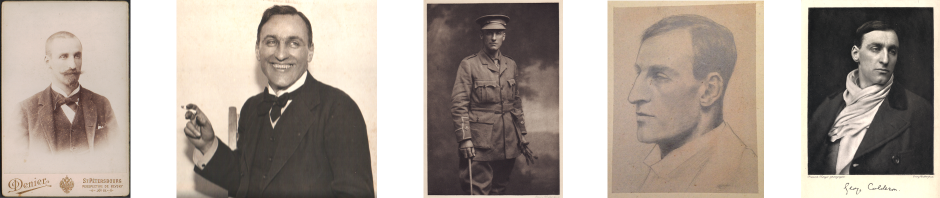
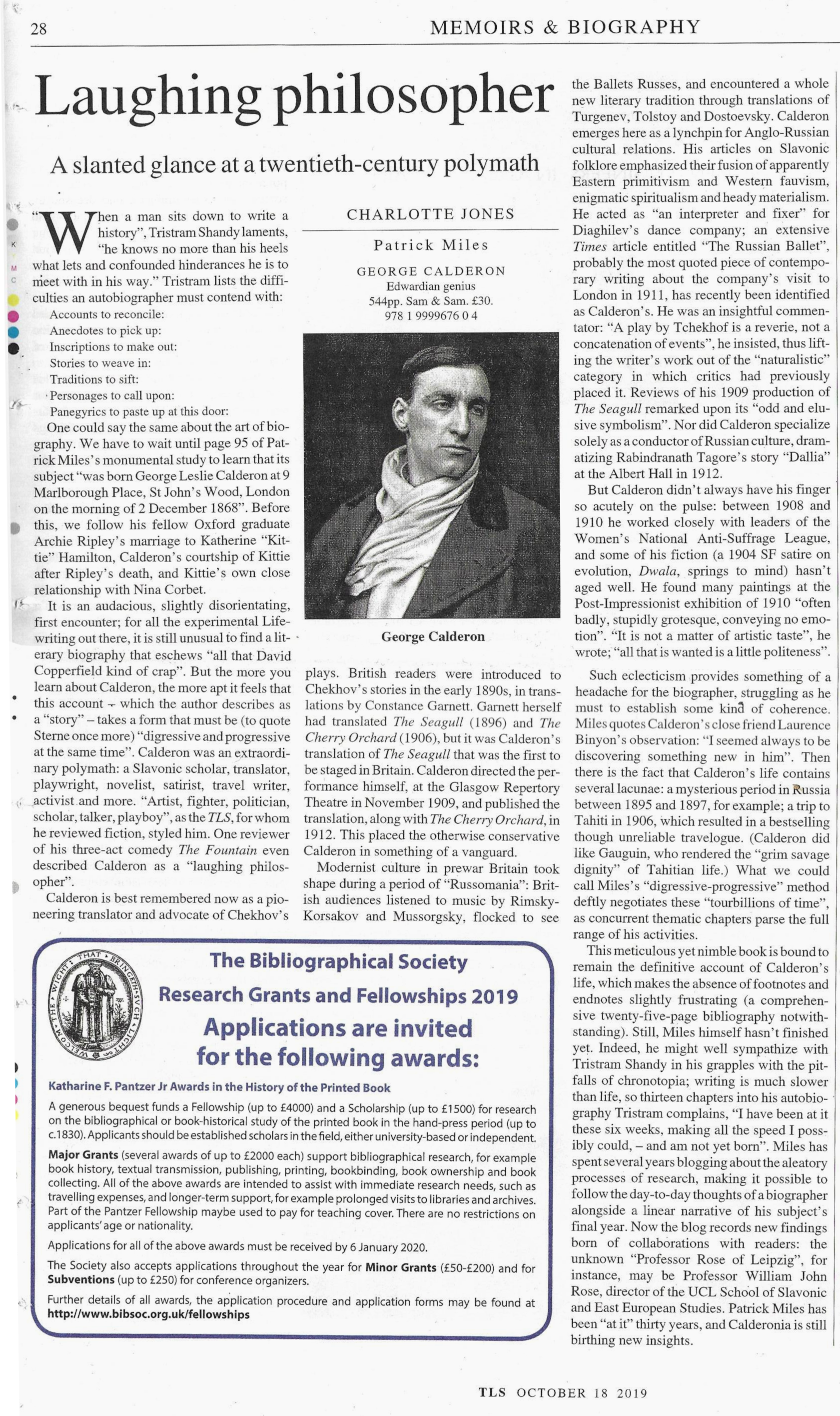
‘This meticulous yet nimble book is bound to remain the definitive account of Calderon’s life’ Charlotte Jones, The Times Literary Supplement
‘The effort of detection, it must be said, was worth it. The biography is a delight to read.’ Emeritus Professor Laurence Brockliss, The London Magazine
‘It is a masterly synthesis of your own approach with scholarship and very judicious discussion of the evidence.’ Emeritus Professor Catherine Andreyev, historian
‘This comprehensive, meticulously researched and highly readable biography, which the author describes as a “story” rather than an academic biography…’ Michael Pursglove, East-West Review
‘A monumental scholarly masterpiece that gives real insight into how the Edwardians viewed the world.’Arch Tait, Translator of Natalya Rzhevskaya’s Memoirs of a Wartime Interpreter
‘The book is written with great assurance and the reader always feels in safe hands. I liked the idea of it being a story and I read it the same way I would read a novel.’ Harvey Pitcher, writer
‘Presents the Edwardian age, and Calderon in particular, as new and forward-looking.’ Emeritus Professor Michael Alexander, in Trinity College, Oxford, Report 2017-18
A review by DAMIAN GRANT appears in the comments to Calderonia’s 7 September post.
A review by JOHN DEWEY appears on Amazon UK.


From the diary of a writer-publisher: 23
16 May 2023
The suspense about the Ukrainian ‘counter-offensive’ is terrible. I hope it will last. It winds the Russians up and keeps them guessing. Moreover, except at Bakhmut, Russian forces have been in deep defensive positions for months now, enabling the Ukrainians slowly but inexorably to build up their military punch, and the longer that goes on the better. Of course if a peace could be signed that withdrew all Russian forces from the East and submitted the Crimean question to international law it would be better. Meanwhile, the Ukrainian battle plan has to be as clever and unexpected as possible, and their attack devastating enough to be decisive. Many people think that Putin is finished if he fails in Ukraine, and especially if Kyiv retakes Crimea, but perhaps the days of palace revolution are over in Russia: the new bosses will attempt to keep him as some ailing figurehead to whom they give a state funeral, so as not to rock the boat too much. However, I have always believed that the Russian military hate Putin for dropping them unprepared in this mess and destroying their unity of command, so if they are defeated in Ukraine they will make him the scapegoat. There will be a disabling move against him by top army and security figures, but they will be too wary of his remaining popularity to do a Beria on him.
24 May
We have been in the Lake District, amongst other things looking for the rare butterfly the Duke of Burgundy Fritillary (Hamearis lucina, Linnaeus 1758). It’s not a true Fritillary butterfly at all, but the only European member of the large family Riodinidae (‘Metalmarks’, referring to the white spots underneath which superficially resemble the silver spangles on the underside of true Fritillaries). And I’m glad to say we found it:
Photograph by Will Miles, May 2023
It’s an exquisite little butterfly, which is recovering its numbers at certain U.K. sites. The males are intensely aggressive: whilst they wait for a female to come along, they position themselves on a perch known as a lek from which they will aerially attack other males, as well as insects much bigger than themselves. It’s often said that no-one knows why the butterfly was given its English name (in French it is known simply as la Lucine), but it could have been by analogy with aristocratic butterflies like the Queen of Spain Fritillary — and no-one really knows how that got its name, either.
8 June
It is now almost impossible to buy a foreign newspaper in Cambridge. W.H. Smith, who only a year ago sold French, German, Spanish, Russian and Polish ‘papers, might have a copy of Le Monde Diplomatique if you are lucky. Sainsbury’s have stopped selling European newspapers, the shop opposite King’s College that used to sell a good range no longer sells newspapers at all, and a general store run by some young Arab men which sold newspapers in European languages, Arabic and Russian, did not survive the pandemic.
Is it something to do with Brexit and an assumption by newsagents that it’s not ‘necessary’ now for anyone to read foreign newspapers? Is it the result of a national attack of insularity? Or is it that everyone is supposed to read newspapers online? (Mind and sight destroying for me, at least.) Hypotheses are invited in the Comments column.
13 June
I have received three new creations by my old friend and collaborator, mature writer Harvey Pitcher: two short pieces of non-fiction with a Chekhovian connection, and a four-act play with, I think, undertones of The Cherry Orchard. Harvey is seeking what one might call a professional amateur production of the play, but meanwhile he has kindly allowed me to feature one of his prose pieces, entitled ‘Melikhovo 2004’, as a guest post on 15 July, which will be the 119th anniversary of Chekhov’s death at Badenweiler.
Melikhovo was the estate south of Moscow where Chekhov lived from 1892 to 1899; today it is a museum. A big conference was held there on the centenary of Chekhov’s death, at which Harvey acquainted Russians with the circumstantial memoir of an émigré Russian, Leo Rabeneck, who as a young man was present when Chekhov died. In his guest post Harvey speculates on an aspect of his experience at the conference and shares with us his thoughts about those ‘good times in Anglo-Russian relations that we enjoyed around the turn of the century’ and whether they will ever return.
Sam2 and I are hoping to be able to put into Harvey’s post a link to the full PDF text of his published translation of Rabeneck’s memoir. I felt it would look morbid if I added to the post itself an image of the very photograph of the dead man that Leo and his brother took the following day after the corpse had been washed and dressed, so I decided to embed it in the PDF. I know the photograph well (as Rabeneck says, it was published throughout the Russian press). However, when I went onto the Web to find it, I discovered that the second image offered was the following one, which I first saw in The Times of 5 January 2018 illustrating — presumably in good faith — an article about tests recently carried out on a blood spot on the shirt Chekhov was wearing at the moment of death:
‘Chekhov on the death bed in Badenweiler 1904’
I believe this image is what in common English parlance is called a fake. My reasons:
— It purports to be before the corpse was washed and dressed, yet Chekhov’s face is not skewed to one side, as it was in death and remained, noticeably, even after Dr Schwörer and Leo Rabeneck had turned the body onto its back next morning. In Rabeneck’s photo (taken after the body was washed and dressed) you can still see the tilt of Chekhov’s head resulting from him having died on his side and rigor mortis having set in.
— Chekhov’s face is too pale. He was suntanned at the time of his death, as Rabeneck remarks and his own photograph shows, and his face was not as long as above.
— I know of no mention in the literature of a photo being taken between Chekhov’s death at 3 a.m. on 15 July and Rabeneck’s return to the hotel room with Olga Leonardovna at about 5 p.m. that day, by which time the undertakers had done their work; although the latter could, of course, have taken their own photo after Chekhov was turned on his back but before they washed and dressed him. It seems that Rabeneck was partly in attendance whilst the undertakers were there, so his and his brother’s photograph could have been taken either before or after Leo returned with Olga Leonardovna to view the body, ‘surrounded by flowers’; most likely, surely, after.
The quasi-byline on the Pinterest version of the above image reads in Russian: ‘Poets, Rare photographs, Conceptual photograph’ (sic). ‘Conceptual photography’, I discover from the Web, ‘uses images to transmit abstract ideas […] bringing a new meaning to photography that transcends its use for portraiture, landscapes and snapshots.’ Is the image a ‘conceptual photograph’, then? I think we should be told, before too many people follow The Times and believe it is an historical document.
Incidentally, the tall object on the bedside table in this image might be thought to be the bottle of champagne from which Chekhov drank his final glass, and which was indeed placed on the bedside table; but closer inspection shows it is a candlestick with something square, looking perhaps like a label, at its base.
17 June
The advance at Zaporizhzhia is bitter and bloody… I cannot help feeling the Ukrainians have massive blows in reserve, but their commanders’ biggest asset is flexibility, their ability to adapt tactics, think outside the box, and surprise. The Russian army, created by stultifying autocracy, can never compete with that.
In 1992 the then liberal newspaper Moskovskii komsomolets published a Russian poem written by me in Moscow in 1970 and called me ‘a great friend of Russia’. So I am: of all that is good in the life and culture of the Russian people. Laughably, Putin and his accomplices accuse the West of ‘wanting to destroy Russia as a country’. No, it is they who are destroying the Russia I am talking about and believe in.
ADVERTISEMENT
SOME RESPONSES TO GEORGE CALDERON: EDWARDIAN GENIUS
‘This meticulous yet nimble book is bound to remain the definitive account of Calderon’s life’ Charlotte Jones, The Times Literary Supplement
‘The effort of detection, it must be said, was worth it. The biography is a delight to read.’ Emeritus Professor Laurence Brockliss, The London Magazine
‘It is a masterly synthesis of your own approach with scholarship and very judicious discussion of the evidence.’ Emeritus Professor Catherine Andreyev, historian
‘This comprehensive, meticulously researched and highly readable biography, which the author describes as a “story” rather than an academic biography…’ Michael Pursglove, East-West Review
‘A monumental scholarly masterpiece that gives real insight into how the Edwardians viewed the world.’Arch Tait, Translator of Natalya Rzhevskaya’s Memoirs of a Wartime Interpreter
‘The book is written with great assurance and the reader always feels in safe hands. I liked the idea of it being a story and I read it the same way I would read a novel.’ Harvey Pitcher, writer
‘Presents the Edwardian age, and Calderon in particular, as new and forward-looking.’ Emeritus Professor Michael Alexander, in Trinity College, Oxford, Report 2017-18
A review by DAMIAN GRANT appears in the comments to Calderonia’s 7 September post.
A review by JOHN DEWEY appears on Amazon UK.