
III
Back home in Moscow, everything already felt like winter: the stoves had been lit, and
when the children were getting ready for school and drinking tea in the morning, it was
dark and Nanny lit the lamp for a short time. The frosts had begun. On the first day of
snow, when sledges come out for the first time, it is pleasant to see the white ground and
white roofs, the air you breathe is gloriously soft, and you’re reminded then of days when
you were young. The old limes and birches, white with hoar frost, have a kindly
expression, they are closer to one’s heart than palms and cypresses, and when you are near
them, you have no wish to go on thinking about mountains and the sea.
Gurov was a Muscovite, he arrived back in Moscow on a fine frosty day, and when he
put on his fur coat and warm gloves and strolled along the Petrovka, and when he heard
the sound of the church bells on Saturday evening, his recent trip and the places he had
visited lost all their attraction for him. He gradually immersed himself in Moscow life,
before long he was greedily devouring three newspapers a day and saying he didn’t read
the Moscow papers on principle. Already he felt drawn to clubs and restaurants, to dinner
parties and jubilee celebrations, and felt flattered to be entertaining well-known lawyers
and artists at his house, and to be playing cards with a Professor at the Doctors’ Club.
Already he could polish off a whole portion of Moscow hotpot from the pan…
A month or so would pass, he thought, and Anna Sergeyevna would cloud over in his
memory, and only occasionally would he dream of her and her touching smile, just as he
dreamed of the others. But more than a month went by, they were deep into winter, and
he remembered everything as clearly as if he had parted from Anna Sergeyevna only
yesterday. And his memories became more and more vivid. If the sound of the children’s
voices preparing their lessons reached him in his study in the quiet of an evening, or he
heard a love song, or an organ playing in a restaurant, or a snowstorm started whining in
the chimney – then suddenly everything would come alive in his memory: that time on the
pier… early morning mist over the mountains… the steamer from Theodosia… and the
kisses. He would walk for a long time round his room, remembering and smiling, then his
memories would turn into daydreams, and in his imagination what had happened mingled
with what lay ahead. Anna Sergeyevna did not appear in his dreams, she was behind him
everywhere like a shadow following him around. When he closed his eyes, he could see her
for real, and she seemed more beautiful, younger and more tender than she had been; and
he himself seemed better to himself than he had been back then in Yalta. In the evenings
she was looking at him from the bookcase, from the fireplace, from the corner of the room,
he could hear her breathing, the soft rustle of her dress. In the street he stared after
women to see if any of them looked like her…
And he was tormented now by a strong desire to share his recollections with someone.
But he couldn’t talk to anyone at home about his love, and outside there was no one.
Certainly not with his tenants and not at the bank. And what would he say? Had he really
felt love then? Had there really been anything beautiful, poetic, or instructive, or simply
interesting, about his relations with Anna Sergeyevna? And he had to speak vaguely about
love and women, and no one guessed what it was all about, and his wife would simply
twitch her dark eyebrows and say: ‘The role of lady’s man doesn’t suit you at all,
Demetrius.’
One night, coming out of the Doctors’ Club with his partner at cards, a civil servant, he
could not restrain himself and said: ‘You can’t imagine what an enchanting woman I got to
know in Yalta’.
The civil servant climbed into his sledge and drove off, but suddenly turned round and
shouted: ‘Dmitrii Dmitrych!’
‘Yes?’
‘You were right just now about the sturgeon: it was a bit off!’
For some reason these everyday words suddenly made Gurov feel indignant, they
struck him as coarse and degrading. What barbaric ways of behaving, what people!
Meaningless nights, boring, uneventful days! Frantic card-playing, eating and drinking too
much, repeated conversations on the same old topics. These useless activities and
conversations monopolise the best part of our time, our best energies, and what we’re
finally left with is a stunted, barren kind of life, some kind of garbage, and you can’t get
away and escape, it’s like being in a madhouse or a forced labour squad!
Gurov lay awake all night feeling worked up and all next day he had a headache. On
the following nights he also slept badly, sitting up in bed all the time thinking, or walking
from corner to corner of the room. He was bored with his children, with the bank, he
didn’t want to go anywhere or talk about anything.
In December during the holiday period he made preparations for a trip, telling his wife
he was going to St Petersburg to lobby on behalf of a certain young man – and left for the
town of S. For what reason? He himself did not really know. He wanted to see Anna
Sergeyevna and have a talk with her, arrange a meeting if possible.
He arrived in S. in the morning and took the best room in the hotel. The floor was
completely covered with grey military cloth and on the table stood an inkwell, grey with
dust, which showed a man on horseback, holding his hat aloft but with his head broken
off. The porter gave him the information he needed: von Diederitz lives on Old
Goncharnaya Street, in his own house, it’s not far from the hotel, he lives in grand style,
has his own horses, everyone in town knows him. The porter pronounced the name
Dreedyritz.
Gurov took his time walking along to Old Goncharnaya Street and located the house. A
long grey fence topped with nails ran the whole length of its front. ‘You’d want to run away
from a fence like that,’ thought Gurov, glancing up at the windows, then at the fence.
As government offices were closed that day, he reasoned that the husband would
probably be at home. In any case it would be tactless to go into the house and cause an
upset. If he sent a note, it might fall into the husband’s hands and that could spoil
everything. The best thing would be to rely on chance. He kept walking up and down the
street and by the fence waiting for such a chance to arise. He watched a beggar enter the
gates and be set upon by the dogs, then, an hour later, the sounds of someone playing the
piano reached him, faint and unclear. That must be Anna Sergeyevna. The front door
suddenly opened and an old woman came out, with the familiar white Pom running
behind her. Gurov wanted to call the dog, but his heart suddenly began thumping and in
his agitation he couldn’t remember the Pom’s name.
He walked up and down, hating the grey fence more and more, and feeling annoyed by
the thought that Anna Sergeyevna had forgotten him and might already be amusing
herself with someone else, and this would be only too natural if you were a young woman
forced to look at that damned fence from morning to evening. He went back to his hotel
room and sat for a long time on the sofa, not knowing what to do, then had a meal, then a
long sleep.
‘How stupid and disturbing all this is,’ he thought, on waking up and seeing the dark
windows: it was already evening. ‘Now for some reason I’ve gone and overslept. So what
am I going to do when night comes?’ Sitting on the bed, which was covered by a cheap grey
blanket like one in a hospital, he taunted himself in his vexation: ‘You and your lady with a
little dog… You and your adventure… Now look where you’ve landed yourself.’
At the station that morning his attention had been caught by a poster advertising in
huge capitals the opening night of The Geisha. He remembered this and set off for the
theatre. ‘More than likely,’ he thought, ‘she attends first nights.’
The theatre was full. And here, as in all provincial theatres generally, there was fog
above the chandelier, and a noisy hubbub coming from the gallery; before the performance
began the local dandies were standing in the front row, hands clasped behind their backs;
and over there in the Governor’s box, the Governor’s daughter was sitting in the front
seat wearing a boa, while the Governor himself was modestly concealed behind the
portiere, and only his hands were visible; the curtain kept swaying, and the orchestra
spent a long time tuning up. As the audience was coming in and occupying their seats,
Gurov eagerly studied every face.
In came Anna Sergeyevna. She sat down in the third row, and when Gurov looked at
her, his heart missed a beat, and he understood clearly that she was the nearest, dearest,
and most important person in the world for him now; this little woman, lost in the
provincial crowd, not remarkable in any way, holding a cheap lorgnette, now filled his
whole life, was his joy and sorrow and the one happiness that he now longed for; and to
the sounds of this bad orchestra, of these dreadful provincial violins, he thought how
beautiful she was. Thought and dreamed.
A young man had come in with Anna Sergeyevna and sat down next to her. He had
short side whiskers, and was very tall and stooping; with each step he took he nodded his
head and seemed to be forever bowing. This was probably the husband she had referred to,
in a bitter outburst back in Yalta, as a ‘lackey’. And indeed, his tall figure, his side whiskers
and his small bald patch all suggested a lackey’s modest bearing, he had a sugary smile,
and the badge of some kind of learned society gleaming in his buttonhole looked like a
lackey’s hotel number.
In the first interval the husband went out for a smoke, while she remained in her seat.
Gurov, who was also sitting in the stalls, went up to her and said in a shaky voice, forcing a
smile:
‘Good evening.’
She looked at him and turned pale, then looked at him again in horror, unable to
believe her eyes, and seized tight hold of her fan and lorgnette, clearly struggling not to
faint. Neither of them spoke. She was sitting, he standing, scared by her confusion and
unsure whether or not to sit down next to her. The violins and the flute began tuning up,
there was a sudden sense of panic, it felt as if they were being watched from every box. But
now she got to her feet and made quickly for the exit; he followed, and they walked along
corridors and up staircases at random, now up, now down, various people flashing before
their eyes, in the uniforms of lawyers or teachers or crown employees, and all with their
insignia; ladies flashed past, fur coats were hanging on pegs, a draught brought the smell
of cigarette ends. And Gurov, whose heart was beating fast, thought: ‘Oh Lord, why are all
these people here, this orchestra…’
At that moment he suddenly recalled that evening at the station when he’d said
goodbye to Anna Sergeyevna and had said to himself that everything was over and they
would not see each other again. But the end was still such a long way off!
On a gloomy narrow staircase saying ‘Circle’ she stopped.
‘What a fright you gave me!’ she said, breathing heavily and still pale and shaken. ‘I
nearly died. Why did you come? Why?’
‘Understand me, Anna, understand me…’ he said hastily in a low voice. ‘Understand
me, I beg you…’
She was looking at him fearfully, pleadingly, lovingly, looking at him intently, so as to
fix his features more firmly in her memory.
‘Oh how I’m suffering!’ she went on, not listening to him. ‘All this time I’ve done
nothing but think about you, thinking about you kept me alive. And I wanted to forget,
forget, but why did you come, why?’
On a landing up above two schoolboys were smoking and looking down, but Gurov
didn’t care, he drew Anna Sergeyevna towards him, and began kissing her face, her cheeks,
her hands.
‘What are you doing, what are you doing!’ she said in horror, pushing him away from
her. ‘You and I have gone mad. You must go away today, go away now… By all that’s holy, I
beseech you, I beg you… There’s someone coming!’
Someone was coming up the staircase from down below.
‘You must go,’ Anna Sergeyevna went on in a whisper. ‘Do you hear, Dmitrii Dmitrich?
I’ll come to see you in Moscow. I’ve never been happy, I’m unhappy now, and I’m never
going to be happy, never! Don’t make me suffer even more! I’ll come to Moscow, I swear it.
But now we must part! My good kind dear one, we must part!’
She pressed his hand and began going swiftly downstairs, all the time looking round at
him, and her eyes showed how unhappy she really was. Gurov stood there briefly, listened
until everything had gone quiet, then found his peg and left the theatre.
© Harvey Pitcher, 2024
(To be concluded)


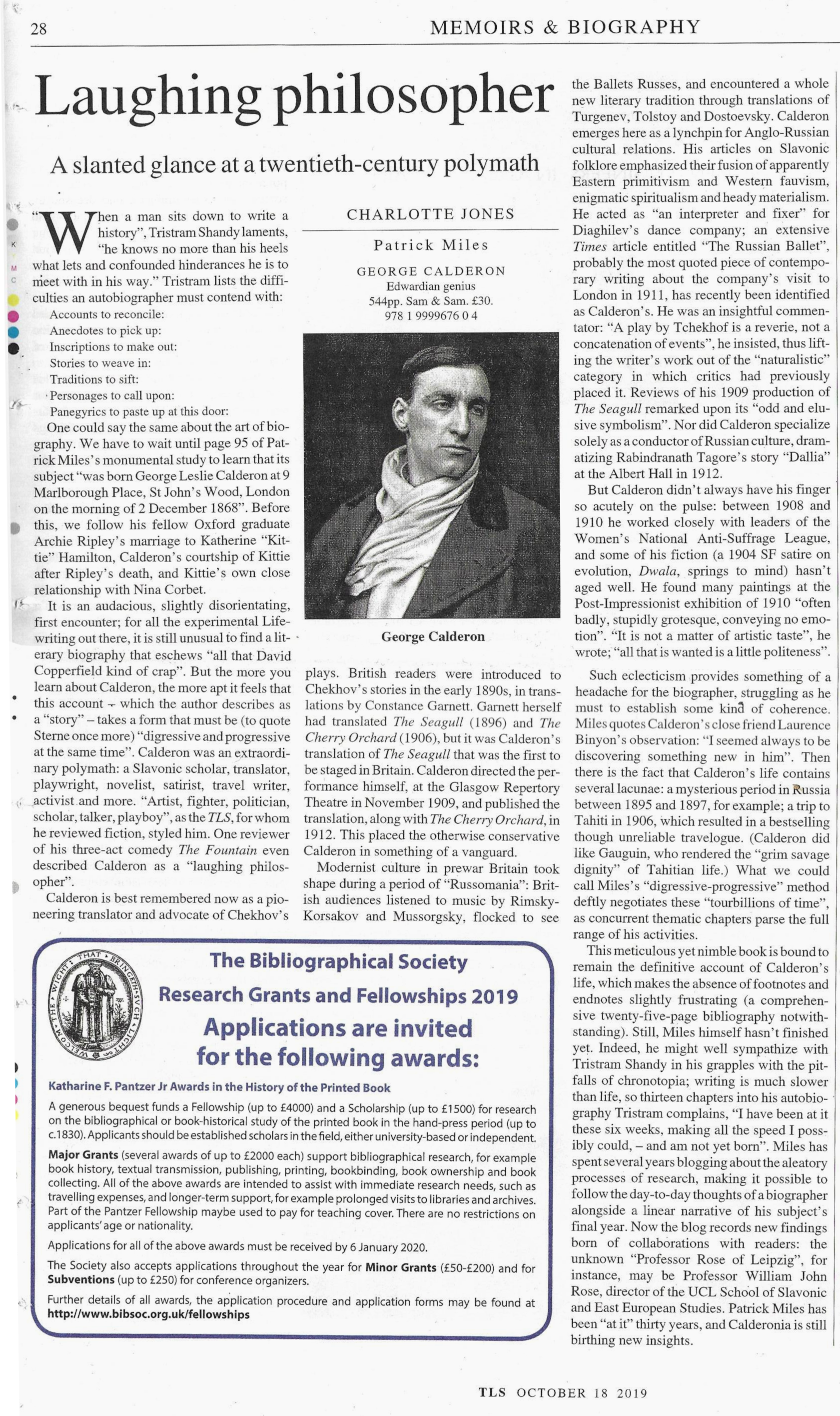
Happy Christmas from Calderonia / Sam&Sam!
ADVERTISEMENT

SOME RESPONSES TO GEORGE CALDERON: EDWARDIAN GENIUS
‘This meticulous yet nimble book is bound to remain the definitive account of Calderon’s life’ Charlotte Jones, The Times Literary Supplement
‘The effort of detection, it must be said, was worth it. The biography is a delight to read.’ Emeritus Professor Laurence Brockliss, The London Magazine
‘It is a masterly synthesis of your own approach with scholarship and very judicious discussion of the evidence.’ Emeritus Professor Catherine Andreyev, historian
‘This comprehensive, meticulously researched and highly readable biography, which the author describes as a “story” rather than an academic biography…’ Michael Pursglove, East-West Review
‘A monumental scholarly masterpiece that gives real insight into how the Edwardians viewed the world.’Arch Tait, Translator of Natalya Rzhevskaya’s Memoirs of a Wartime Interpreter
‘The book is written with great assurance and the reader always feels in safe hands. I liked the idea of it being a story and I read it the same way I would read a novel.’ Harvey Pitcher, writer
‘Presents the Edwardian age, and Calderon in particular, as new and forward-looking.’ Emeritus Professor Michael Alexander, in Trinity College, Oxford, Report 2017-18
A review by DAMIAN GRANT appears in the comments to Calderonia’s 7 September post.
A review by JOHN DEWEY appears on Amazon UK.


‘Lady with a Little Dog’ (Concluded)
Waves breaking on the rocks at Yalta, c. 1900, from a tourist brochure
IV
And Anna Sergeyevna began coming to see him in Moscow. Every two or three months she
would leave S., telling her husband she was going to consult a professor about her female
complaint – and her husband believed her and did not believe her. On her arrival in
Moscow, she put up at the ‘Slavyansky Bazaar’ hotel, and immediately sent a messenger in
a red cap round to Gurov. Gurov walked round to see her, and no one in Moscow knew
anything about it.
On one such occasion he was walking round one winter morning, the messenger
having called the previous evening and not found him in. With him was his daughter, as he
wanted to drop her off at school, it was on his way. Snow was falling heavily, in thick wet
flakes.
‘The temperature is three degrees above freezing,’ Gurov was saying to his daughter,
‘and yet it’s snowing. That’s because the warmth is only on the earth’s surface, in the upper
layers of the atmosphere the temperature is quite different.’
‘Papa, why isn’t there any thunder in winter?’
He explained that, too. As he talked, he was thinking that here he was on his way to an
assignation, and not a single living soul knew about it, and probably ever would know. He
had two lives: one that was out in the open, and everyone who needed to could see it and
knew about it, a life full of conventional truth and conventional deceit, a life that was
indistinguishable from the lives of his friends and acquaintances, and another life, running
its course in secret. And by some strange, perhaps chance, combination of circumstances,
everything that was important, interesting, and essential to him, in which he was sincere
and did not deceive himself, that constituted the core of his life, was taking place in secret
from other people – whereas everything that was false, a façade he hid behind so as to
conceal the truth, like his work at the bank, for example, the arguments in the club, his
‘lower breed’ talk, attending jubilee celebrations with his wife, all that was out in the open.
And he judged other people by himself, did not believe what he saw, and always assumed
that each person’s real, most interesting, life was taking place under a veil of secrecy, like
the veil of night. Each private existence rests on a secret, and it may partly be for this
reason that a cultivated man is so nervously anxious that his private secret should be
respected.
After seeing his daughter off at school, Gurov made his way to the ‘Slavyansky Bazaar’.
He took his coat off downstairs, walked up and knocked quietly on the door. Anna
Sergeyevna, wearing his favourite grey dress, was tired by the journey and by waiting, as
she’d been expecting him from the previous evening; she was pale, looked at him without
smiling, and as soon as he came in, threw herself onto his breast. Their kiss was long and
lingering, as if they’d not seen each other for a couple of years.
‘Well, how’s life with you?’ he asked. ‘Any news?’
‘Wait, I’ll tell you in a moment… I can’t now.’
She could not speak for crying. She turned away from him and pressed a handkerchief
to her eyes.
‘Let her have a little cry, I’ll sit down for a while,’ he thought and sat down in an
armchair.
Then he rang the bell and ordered tea for himself, and while he was drinking, she still
went on standing by the window with her back to him… She was crying from emotion,
from the miserable realisation of how sadly their lives had worked out; they could only
meet in secret, hiding from people like thieves! Hadn’t their lives been ruined?
‘Do stop crying now!’ he said.
It was obvious to him that the end of this love of theirs was still very distant, and who
knew when that end might be. Anna Sergeyevna had become attached to him more and
more strongly, she worshipped him, and it would be unthinkable to say to her that at some
time all this would have to come to an end; and she wouldn’t have believed it in any case.
He went up to her and took her by the shoulders, so as to caress her and have a little
joke, and at that moment he caught sight of himself in the mirror.
His hair was already beginning to turn grey. And it struck him as strange that in the
last few years he’d become so old and lost his good looks. The shoulders on which his
hands rested were warm and trembling. He felt compassion for this life, so warm and
beautiful now, but which was probably close to the point when it would begin to fade and
wither like his own. What makes her love him as she does? He had always appeared to
women other than he was and it was not him they loved, but an imaginary person they’d
created and been eagerly searching for all their lives; and then, when they noticed their
mistake, they went on loving him just the same. And not one of them had been happy with
him. Time went on, he struck up an acquaintance, became intimate, parted, but not once
had he loved; there was everything you might want, only not love.
And it was only now when his hair had turned grey that he had fallen well and truly in
love – for the first time in his life.
Anna Sergeyevna and he loved each other like very close relatives, like husband and
wife, like bosom friends; fate itself, it seemed, had predestined them for each other, and it
did not make sense that he should have a wife and she a husband; and they were like two
migratory birds, male and female, which had been caught and forced to live in separate
cages. They had forgiven each other for what they were ashamed of in their past lives, they
forgave each other for everything in the present, and they felt that this love of theirs had
changed them both.
At sad moments earlier he had calmed himself down with whatever rational
considerations came into his head, but he was in no mood now for such considerations, he
felt a deep sense of compassion, he wanted to be sincere and tender…
‘Please don’t cry, my darling,’ he said, ‘you’ve had a little cry – and that’s enough…
Now let’s have a talk, we’ll think of something.’
Then they had a long discussion, talking of how to escape from the need to hide, to
deceive, to live in different towns and not see each other for long periods. How could they
free themselves from these intolerable chains?
‘How? How?’ he kept asking, clutching his head. ‘How?’
And it seemed that in a short time the solution would be found and then a beautiful
new life would begin, and it was clear to both of them that the end was still a very long way
off, and that the most complicated and difficult part was only just beginning.
© Harvey Pitcher, 2024
ADVERTISEMENT
SOME RESPONSES TO GEORGE CALDERON: EDWARDIAN GENIUS
‘This meticulous yet nimble book is bound to remain the definitive account of Calderon’s life’ Charlotte Jones, The Times Literary Supplement
‘The effort of detection, it must be said, was worth it. The biography is a delight to read.’ Emeritus Professor Laurence Brockliss, The London Magazine
‘It is a masterly synthesis of your own approach with scholarship and very judicious discussion of the evidence.’ Emeritus Professor Catherine Andreyev, historian
‘This comprehensive, meticulously researched and highly readable biography, which the author describes as a “story” rather than an academic biography…’ Michael Pursglove, East-West Review
‘A monumental scholarly masterpiece that gives real insight into how the Edwardians viewed the world.’Arch Tait, Translator of Natalya Rzhevskaya’s Memoirs of a Wartime Interpreter
‘The book is written with great assurance and the reader always feels in safe hands. I liked the idea of it being a story and I read it the same way I would read a novel.’ Harvey Pitcher, writer
‘Presents the Edwardian age, and Calderon in particular, as new and forward-looking.’ Emeritus Professor Michael Alexander, in Trinity College, Oxford, Report 2017-18
A review by DAMIAN GRANT appears in the comments to Calderonia’s 7 September post.
A review by JOHN DEWEY appears on Amazon UK.