
Common Brimstone Butterfly by Charles J Sharp
22 March
A very sunny day and I saw the first Brimstone butterfly flying in the garden; in fact two at once, both males (the females are a greenish white). This is something of a relief, as a local insect spotter emailed me ten days ago to say he had seen a Peacock and Comma in his garden ‘but still no Brimstone’, and in the old days you usually saw a Brimstone long before Nymphalids like the Peacock, Small Tortoiseshell and Comma. My theory is that Brimstones actually need bright sunlight, as their colour perhaps suggests, but all that the brown and furry jobs need is a certain warmth. The spotter saw his Peacock and Comma on a day when the air temperature was high (I saw a Small Tortoiseshell flying on the same day), but the sun was not bright. Also, I remember some discussion on Autumn Watch last year of reports that Peacocks and Small Tortoiseshells were now going into hibernation a month earlier than before.
Last year there was a male Brimstone flying around on 22 February:
february sun
everyone’s talking of
the brimstone they’ve seen
(An example of the difficulty of writing haikus in English: you are supposed not to use capitals any more, but ‘brimstone’ suggests a local volcano eruption or a daytrip to Hell.)
26 March
I went to deliver John Polkinghorne’s post at the care home he went into for respite before Black Crow came over all the land. I discovered the home was self-isolating and all I could do was hand the package over at Reception. As always, there were a few ladies sitting at the tables in the foyer chatting, knitting or reading the paper. I say ‘ladies’ because although perhaps in their early nineties they are all immaculately turned out and have impeccable manners. It seemed only polite to say good morning to them and remark on the beautiful indoor temperature of the home. They all turned their heads and smiled radiantly as they returned the greeting. They looked like zinnias:

Image from plantsofdistinction.co.uk
The mystery, though, is why you never see any men partaking of the communality of this foyer. I invite explanations in the Comments column. Obviously, there are men in the home. John is waiting for delivery of a motorised wheelchair before he can get about.
30 March
A journalist has written that during times of plague Shakespeare’s theatre was closed down and ‘he could not write his plays’. Au absolute contraire, surely: if he had any sense, which he did, he must have used every moment of self-isolation to get ahead of the dramatic game for when the theatres reopened. Not only that, tied to his desk during the plague of 1593 he wrote his first long poem, Venus and Adonis, which became a best seller and must have considerably made up for loss of earnings.
I have decided to try to follow his intimidating but very inspiring example. In 2008 I started a poem (‘Making Icons’) that is in two parts of seventeen stanzas each and each stanza has twelve lines. I see from the pencil manuscript that I finished stanza 22 on 3 August 2011…eight years later I had got as far as stanza 26…in the last ten days I have written two more… Great William, stand over me and urge me on.
It’s a tricky subject and taxing stanza form. For reasons best known to the poem, it’s both alliterative and rhymed (assonantal). The only sample I can think of that may be comprehensible out of its context is:
18
The rage-raked branches by the sea
lie still, like cerebrums of coral,
their wiry line seems hardly leaves,
so punched and packed by weather’s worry,
a fierce frisure, not fioritura,
the sheer survivance of a tree,
while ‘watercolour sky’ of Norfolk
clouds out the curlew and the seal.
Brandish and bray what you may feel,
time like the tempest, rain and sun
transmutes it into topiary:
something has died, some thing lives on.
Having just read that again, I can’t help thinking the last line describes the state of the country (‘some thing’ is meant to be two words). And I had intended to keep this post as bright and springtime as its images!


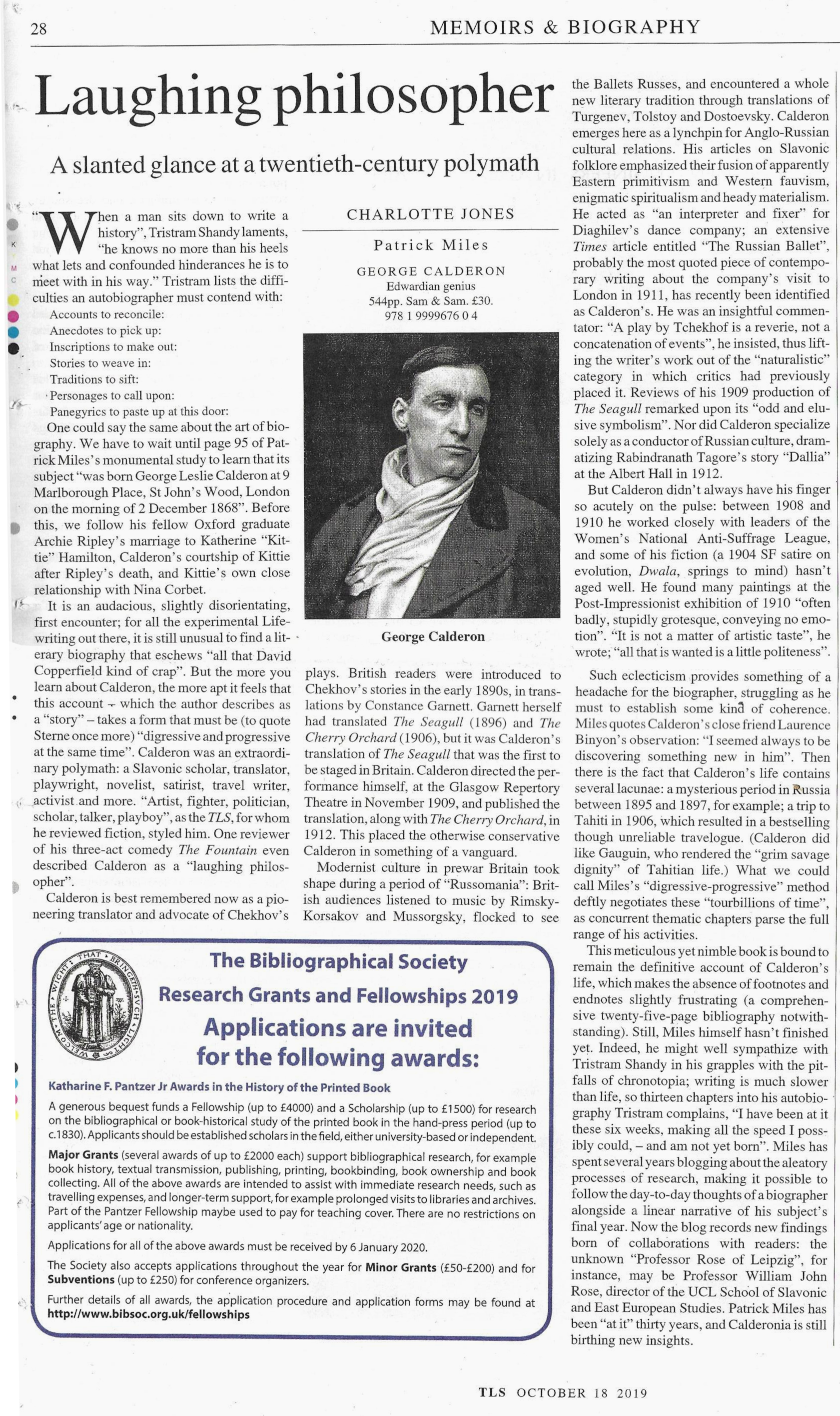
SOME RESPONSES TO GEORGE CALDERON: EDWARDIAN GENIUS
‘This meticulous yet nimble book is bound to remain the definitive account of Calderon’s life’ Charlotte Jones, The Times Literary Supplement
‘The effort of detection, it must be said, was worth it. The biography is a delight to read.’ Emeritus Professor Laurence Brockliss, The London Magazine
‘It is a masterly synthesis of your own approach with scholarship and very judicious discussion of the evidence.’ Emeritus Professor Catherine Andreyev, historian
‘This comprehensive, meticulously researched and highly readable biography, which the author describes as a “story” rather than an academic biography…’ Michael Pursglove, East-West Review
‘A monumental scholarly masterpiece that gives real insight into how the Edwardians viewed the world.’Arch Tait, Translator of Natalya Rzhevskaya’s Memoirs of a Wartime Interpreter
‘The book is written with great assurance and the reader always feels in safe hands. I liked the idea of it being a story and I read it the same way I would read a novel.’ Harvey Pitcher, writer
‘Presents the Edwardian age, and Calderon in particular, as new and forward-looking.’ Emeritus Professor Michael Alexander, in Trinity College, Oxford, Report 2017-18
A review by DAMIAN GRANT appears in the comments to Calderonia’s 7 September post.
A review by JOHN DEWEY appears on Amazon UK.


_male_in_flight.jpg)
Weighty Calderonian matters
The above is described in an auction catalogue of 2001 as ‘A Victorian set of jockey scales by Youngs of Bear Street, London WC on oak stand with spiral-turned supports. Width 3ft’. The auction in question was of ‘The Residual Contents of Foxwold, Brasted Chart, Westerham, Kent’.
For fans of Merchant Ivory’s 1985 film of E.M. Forster’s A Room with a View — and there are very many — Foxwold is better known as ‘Windy Corner’, the Surrey residence of Lucy Honeychurch (Helena Bonham Carter), her mother (Rosemary Leach) and Tiggerish brother Freddy (Rupert Graves):
But to followers of this blog Foxwold is dear as practically Kittie and George’s second home. For most of the time covered by my biography of them Foxwold was owned by Charles ‘Evey’ Pym, who was married to Kittie’s niece by her first marriage, Violet née Lubbock, to whom Kittie was devoted. The Calderons regularly spent weekends or parts of their holidays at Foxwold, most memorably George’s last Christmas (1914).
Violet and Evey’s grandson, the film critic John Pym, to whom the whole Calderon project owes so much, has emailed me to say that he was recently ‘glancing through The Foxwold Weigh-in Book’ when he discovered:
and:
Sensational! There is a wealth of explicit and implicit biographical detail in these two pages! In fact, they are probably the most interesting new Calderon documents to have come to light since my biography was published in 2018! I am deeply beholden to Mr Pym for alerting me to them, allowing me to post images of them, lending me the catalogue of the 2001 auction, and providing me with his family gloss below.
The explicit detail, of course, is George and Kittie’s weights during this 1904-05 period, which help me picture more accurately what they looked like at the time. I don’t know whether this matters to all biographers, but it was always very important for me to ‘see’ George and Kittie, hear their voices, know their facial skin texture, as it were, and almost smell them. I laboriously calculated from a 1901 photograph of George standing in a doorframe of standard dimensions that his height was five foot ten; I subsequently discovered from his enlistment form of 1914 that he gave it himself as five foot nine and a half. Altogether, I had got the impression that he was on the slim side, even underweight, as in her memoirs Kittie said that he hadn’t the physique for sustained manual work.
But on 30 September 1904 we see that he weighed in at twelve stone, which on the height/mass chart given me by my G.P. places George just short of the ‘You are beginning to get fat’ area. Put that together with the Army’s note in 1914 that his ‘general physical development’ was ‘good’ and that he had a four-inch chest expansion, and he doesn’t seem so slight after all. He is the third heaviest of the seven men whose weights feature on these two pages. Mind you, we don’t know the others’ heights and they all seem remarkably light by today’s standards.
I have never found a record of Kittie’s height, but from photographs of her standing next to George I estimate she was at most five foot five. According to my weight-watcher’s chart, this would mean that at ten stone twelve she was just inside the ‘beginning to get fat’ boundary. This may explain why there are no further records of her weight in the book!
At the end of September 1904 George was lingering at Boulogne with his doctor, Albert Tebb, and the latter’s son, Christopher, on a recuperative holiday. He was desperately missing Kittie, who had been with him earlier but was now staying at Emmetts, the Lubbocks’ home near Foxwold. He felt he could not leave the others, as they were both ‘sickly’, but he hoped to join Kittie at Emmetts before she returned to London. In my biography (p. 192) I wrote that it seemed unlikely the party left early enough for George to join Kittie at the Lubbocks’. There is no extant Visitors Book for Emmetts, but ‘The Foxwold Weigh-in Book’ proves that he did get there in time.
The next two entries for George look alarming. Three months later, on 31 December 1904, he had lost three pounds. Five months after that, on 21 May 1905, he had lost another four pounds and was down to eleven and a half stone. However, on 30 December 1905 he weighed in at eleven stone thirteen, meaning that he lost seven pounds in eight months but put six of them back again within eight months. Clearly he had some reason for weighing himself each time he visited Foxwold over these fifteen months, and one assumes it wasn’t that he was slimming. The decline in his weight perhaps corroborates the course of his nervous breakdown 1904-06 that I suggested in my biography. Incidentally, Kittie and George shared Christmas 1905 at Foxwold with the Punch contributor Anstey Guthrie, whose couplet was inscribed by Evey in the front of ‘The Foxwold Weigh-in Book’:
A better, aye, a bulkier man, this earth has hardly seen:
He was the first that ever burst a ‘Try your Weight Machine’!
Why, though, did these Edwardians use the machine and religiously enter their weights in ‘The Foxwold Weigh-in Book’?
It seems that the custom came in during the eighteenth century, when you could weigh yourself at a coffee house or wine merchant’s, for instance, but many homes possessed stand-on scales anyway for verifying the weight of produce. Given the number of ‘wasting’ diseases about, I take it that monitoring your weight, and particularly your children’s, could be important. Where the jockey scales at Foxwold are concerned, John Pym gives the following explanation:
I think Horace Pym (1844-1896) acquired the scales because he (like many Victorians) was fanatical about weights and measures and keeping properly scientific records. Horace was the first to make an entry: 16st 11lbs in June 1886, and 17st 9lbs in September 1887. The man who was always rumoured almost to have burst this ‘Try Your Weight Machine’ was Horace’s cousin R. Ruthven Pym, who recorded 19st 12lbs…
Patrick mentions the film A Room with a View. Many of the objects, books and pictures that were used as set-dressing at Windy Corner would have been familiar to George and Kittie — and had they seen the movie they might have smiled ruefully at the scene, shot at the foot of the main staircase at Foxwold, in which Lucy breaks off her engagement with Cecil Vyse (Daniel Day Lewis). After he has received the bad news, Cecil sits on the stairs and puts on his shoes. If he had then taken two steps forward (to the right) he could have sat on the jockey scales and been reassured that although he’d been rejected in love he was at least not overweight.
SOME RESPONSES TO GEORGE CALDERON: EDWARDIAN GENIUS
‘This meticulous yet nimble book is bound to remain the definitive account of Calderon’s life’ Charlotte Jones, The Times Literary Supplement
‘The effort of detection, it must be said, was worth it. The biography is a delight to read.’ Emeritus Professor Laurence Brockliss, The London Magazine
‘It is a masterly synthesis of your own approach with scholarship and very judicious discussion of the evidence.’ Emeritus Professor Catherine Andreyev, historian
‘This comprehensive, meticulously researched and highly readable biography, which the author describes as a “story” rather than an academic biography…’ Michael Pursglove, East-West Review
‘A monumental scholarly masterpiece that gives real insight into how the Edwardians viewed the world.’Arch Tait, Translator of Natalya Rzhevskaya’s Memoirs of a Wartime Interpreter
‘The book is written with great assurance and the reader always feels in safe hands. I liked the idea of it being a story and I read it the same way I would read a novel.’ Harvey Pitcher, writer
‘Presents the Edwardian age, and Calderon in particular, as new and forward-looking.’ Emeritus Professor Michael Alexander, in Trinity College, Oxford, Report 2017-18
A review by DAMIAN GRANT appears in the comments to Calderonia’s 7 September post.
A review by JOHN DEWEY appears on Amazon UK.