27 June
‘Why aren’t arts leaders banging the drum for Ukraine any more?’ asks Richard Morrison in the arts column of today’s Times. He recently heard that when a ‘distinguished American performer’ wanted to light the stage at his festival performance this summer in yellow and blue, his promoter said: ‘That’s a bit 2022, isn’t it?’ Morrison (who is usually spot on) ‘senses’ that this is ‘how a lot of people in the arts and entertainment world now feel about Russia’s invasion of Ukraine, though few would admit it’.
We should distinguish here between ‘arts leaders’ and ‘promoters’, i.e. publicists. The latter are of course principally concerned with what’s ‘next’, flashy and ephemeral. Moreover, as Morrison says, ‘the news cycle moves on relentlessly’. But I honestly do not get any sense that people in the arts, whether leaders or more humble practitioners, have changed their views on Ukraine and war criminal Putin by one jot. It is only the public projection of their views that has changed, for instance one hardly sees a Ukrainian flag in Cambridge these days or a poster for a concert in aid of the country fighting for its life.
People tire of advertising and repeating themselves. Belief in the justice of Ukraine’s cause and admiration for the Ukrainian people’s grit and war leader haven’t, in my experience, diminished in Britain. One has to admit, though, that projecting the belief and keeping its public profile high is important — not least for the message it sends Putin. I am therefore edging towards unfurling a twenty-foot Ukrainian flag down the front of our house:

7 July
Why, I don’t know, but I cannot stop thinking of Joseph Brodsky — what an amazing, real person he was, how formative it was for me reading his early poetry in Russia in samizdat, and meeting him there and subsequently in England. For the umpteenth time, certain lines of his keep going through my head and my brain compulsively tries to recreate them in English…so far to no avail, as with a Christmas poem of his that I annually tackle mentally. It is the music of the lines that obsesses one, of course…and that is unique to his Russian words. But there are all kinds of other obstacles to translating him.
For example, I have always been mesmerised by his 1962 poem (dedicated, apparently, to his then partner Marina Basmanova) that begins ‘I embraced these shoulders and glanced/at what was behind [her] back’. It’s mysterious; naturalistic but metaphysical. It’s a kind of 16-line sonnet, four abab quatrains fairly conventionally rhymed, yet ends (so musically in the original) with a hint at a Shakespearian couplet: ‘And if a ghost ever lived here, /it has left this house. Left it.’ But one of the problems about translating the poem is that the original is a five-stress line, which is too long in English for what is being said, but is a four-stress line in English long enough? Another is that it works in the original Russian through a perfect command of regular iambs, which would be too dull in English. And rhyming it would be too heavy. Or if one didn’t use pure rhymes but assonances, split rhymes etc, that would be a distraction from the simplicity of the poem; pretentious.

Epigram by Joseph Brodsky written out in Leningrad on 11 January 1970
The 1971 ten-line poem ‘Song in October’ seems to me rare in Brodsky’s poetry for its sheer imagism (almost a couple of tanka) — although, as always, there is the deep music that is irresistible. We have a stuffed quail on a mantelpiece…the ticking of an old clock…the dull roar of the sea against its wall…no need to light a lamp because a woman’s gold hair glows in the corner… I see no problems with any of that, the rhymes or the varied line-lengths, but have never been able to read Otlozhi svoiu knigu, voz’mi iglu;/shtopai moe bel’ë without bursting out laughing, as it seems to me the natural translation would be: ‘Put your book aside, take up the needle;/darn [mend] my pants’! And I would say from experience that in 1971 the notion of one’s girl friend, partner or even wife darning one’s socks or other garments was already anachronistic. The word bel’ë means ‘linen’ in the collective sense, ‘underclothes’ today, but asks to be translated by something more specific like vest or pants, yet this would be bathos of the first order. Joseph knew English extremely well; it’s such a pity he can’t settle this for us. And why underclothes?
15 July
We have just been on a car trip to Wiltshire, Somerset, Dorset, Hampshire and Kent in search of butterflies that we had never seen before, and the rare reptiles Sand Lizard and Smooth Snake. The weather was perfect, of course, though perhaps too hot for the Smooth Snakes and Adders that we failed to see. The Sand Lizard was obliging, however:

Photograph by Will Miles 2025
The number of species of butterfly we saw was flabbergasting: 35 out of Britain’s total 59. This was far larger than we were expecting and because hatches have been almost a month earlier this year we did not think we would see the rarities Large Blue, Purple Emperor, Silver-Studded Blue, Lulworth Skipper and Heath Fritillary; but we did. The Large Blue became extinct in the UK in 1979 owing to agricultural changes and myxomatosis that affected its ant hosts. An extremely clever programme of introduction of the Swedish form has now been crowned with success and some years they can be seen in their scores at highly protected sites. We had to comb a meadow with binoculars before we saw one, as it really was the end of their season, but I think this photograph of the newly hatched female in flight conveys the butterfly’s full loveliness:

Photograph by Will Miles 2025
After this, it is difficult to believe there is much wrong with butterfly conservation in Britain. Alas, though, for the once common Small Tortoiseshell!
1 August
Since April, large but not deep white bookcases have appeared in Heffers containing all 90 of the new Penguin Archive series of paperbacks brought out to commemorate the ninetieth anniversary of Penguin’s foundation. The books are white with ‘typographical’ covers only and contain one work by great authors, or several works, amounting to about 130 pages. They cost £5.99 each. The series seems a good idea that will encourage people to read, say, Katherine Mansfield’s ‘A Dill Pickle’ or George Orwell’s ‘Can Socialists Be Happy?’, who would not otherwise have bought collections in which these works appear. I chose this one, because I had never read a short story by Woolf before, only novels:

Click the cover to find this book on Amazon.
I’ve now read the book twice and some of the stories more times than that. A revelation. The plots are very simple but the common subject is of the dire essence: people in Edwardian/Georgian Britain who are determinedly living out their mauvaise foi and amongst them individuals who are at various stages of tearing themselves free from it. It’s as humanly true now as when the stories were written (1917-44). I particularly recommend ‘A Woman’s College from Outside’, ‘The Lady in the Looking-Glass: A Reflection’, and ‘The New Dress’ itself. The so-called ‘stream of consciousness’ is very controlled and the stories’ most powerful dimension. But what amazed me most was seeing the First World War break into these stories in a discreet but devastating fashion. We once in Calderonia debated the presence of the War in Lawrence’s Women in Love and Lady Chatterley’s Lover, but I must confess that I had never expected to see it so clearly in Woolf.

ADVERTISEMENT

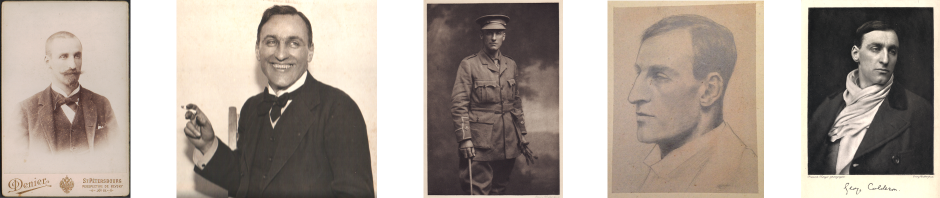
SOME RESPONSES TO GEORGE CALDERON: EDWARDIAN GENIUS
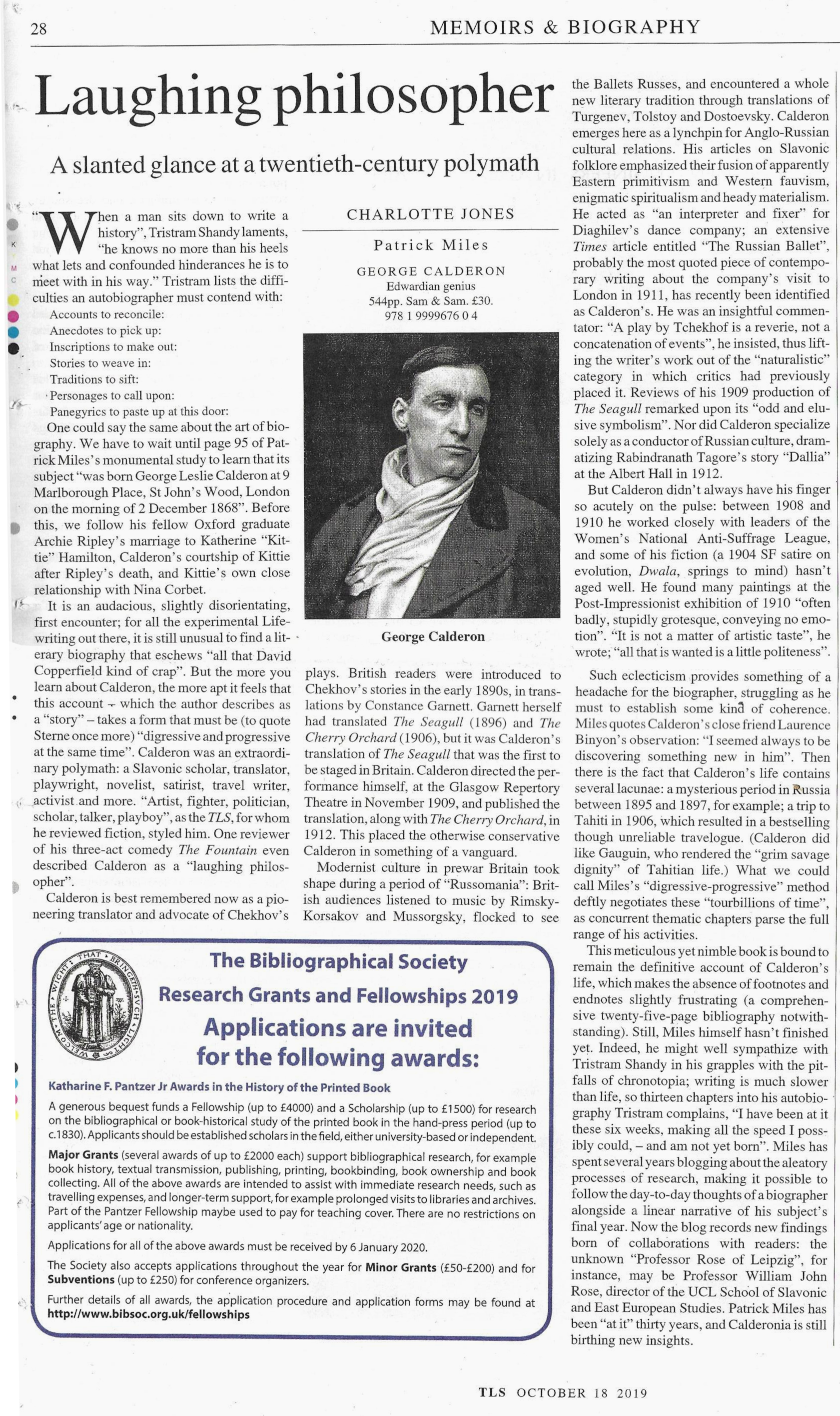
‘This meticulous yet nimble book is bound to remain the definitive account of Calderon’s life’ Charlotte Jones, The Times Literary Supplement
‘The effort of detection, it must be said, was worth it. The biography is a delight to read.’ Emeritus Professor Laurence Brockliss, The London Magazine
‘It is a masterly synthesis of your own approach with scholarship and very judicious discussion of the evidence.’ Emeritus Professor Catherine Andreyev, historian
‘This comprehensive, meticulously researched and highly readable biography, which the author describes as a “story” rather than an academic biography…’ Michael Pursglove, East-West Review
‘A monumental scholarly masterpiece that gives real insight into how the Edwardians viewed the world.’Arch Tait, Translator of Natalya Rzhevskaya’s Memoirs of a Wartime Interpreter
‘The book is written with great assurance and the reader always feels in safe hands. I liked the idea of it being a story and I read it the same way I would read a novel.’ Harvey Pitcher, writer
‘Presents the Edwardian age, and Calderon in particular, as new and forward-looking.’ Emeritus Professor Michael Alexander, in Trinity College, Oxford, Report 2017-18
A review by DAMIAN GRANT appears in the comments to Calderonia’s 7 September post.
A review by JOHN DEWEY appears on Amazon UK.


Patrick Miles recommends three stories from the recent Penguin Archive reprint of a short-story collection titled The New Dress by Virginia Woolf. Let me suggest a fourth, ‘Solid Objects’ (written in 1918 and first published in The Athenaeum in 1920), which may be of particular interest to Calderonians for its opening thumbnail sketch of two argumentative Edwardian gentlemen taking a morning stroll along the shoreline of a sandy beach of a wide semicircular English bay.
We first glimpse the young men as an isolated black dot – an amoeba, one might say – that, as it approaches, grows larger and then sprouts four legs before dividing in two: ‘there was an unmistakable vitality in them; an indescribable vigour in the approach and withdrawal of their bodies’. One of the men, Charles, appears to be asserting his case chiefly with his walking-stick by cutting ‘long straight stripes in the sand’. (No Edwardian country gentleman was wholly complete without his unadorned ash walking-stick, useful for slashing at bracken and brambles – and soon, in 1914, one may surmise, to be replaced by an equally theatrical swagger stick.)
‘Politics be dammed!’ declares John, the other man. And, ‘as these words were uttered, the mouths, noses, chins, little moustaches, tweed caps, rough boots, shooting coats, and check stockings of the two speakers became clearer and clearer; the smoke from their pipes went up into the air; nothing was so solid, so hard, red, hirsute and virile as those two bodies for miles and miles of sea and sandhill’.
But that assurance, that hard red hirsute virility is an illusion as the author reminds us when the men fling themselves down by the six ribs and black spine of a stranded pilchard boat to eat their sandwiches. The two parts of that black speck are about to separate irrevocably. John burrows his fingers in the sand and comes up with an opaque smoothed piece of green sea glass. At which point the author floods the story with her imaginative speculation on the history of the glass. ‘Perhaps after all it was really a gem; something worn by a dark Princess trailing her finger in the water as she sat in the stern of the boat and listened to the slaves singing as they rowed her across the Bay.’
Politics be damned, indeed! The dark Princess’s barge, unlike her gem, will last no longer than the stranded pilchard boat. (The latter a plausible omen of the coming War.) All of which sparks something in John, the hard virile pipe-smoking Edwardian, and sets him on a tormented lifelong quest, abandoning the law and the glories of the House of Commons, for, it might be said, a more honest life (that Bloomsbury ambition) and for things more permanent – unique ‘solid objects’ – which will cause him to speculate about the nature of being – and above all perhaps to exercise his imagination: undertaking a voyage into the nature of real being rather than, like his friend Charles, resigning himself to becoming dead-calmed in the issues and ideas of the moment.
Thank you, Johnnie, for the extremely pleasant surprise of this genuine literary appreciation. One can truthfully say there is something for everyone in this collection of Woolf’s stories, and I am very interested that you singled out ‘Solid Objects’. I had not seen that it sits full square in the land of Calderonia, but you are right and I thank you very much for pointing it out. Your Comment has made me think more about the story…
The two young Edwardians (even though the story was published in 1918 I think their dress and style are quintessentially Edwardian) in the opening scene could have been any of George’s Trinity friends arguing the political issues of the day — indeed George himself and Archie Ripley! It reminds me so much of Percy Lubbock’s masterly description of the pipe-smoking evenings of ‘slashing, swooping opinions’ hosted by Archie at 17 Golden Square in the 1890s (George Calderon: A Sketch from Memory, p. 47).
A really subtle aspect of the story on Woolf’s part, I feel, is that on the surface she presents John as merely an instance of that other Edwardian phenomenon, the ‘eccentric’. It is difficult to deny, I think, that by the end of the story his ‘hobby’ has become an obsession that makes him look dotty; sadly or perhaps even comically so. But what is John referring to when he firmly tells Charles ‘I’ve not given it up’? Woolf does not tell us, she shows us that ‘it’ is things that really matter in life (compared with Charles’s political mania). For instance, the green glass becomes the seed of John’s philokalia (sense/love of beauty) that henceforth spreads through his whole life. The found meteorite intrudes a vivid sense of the cosmic, of life sub specie aeternitatis. Then there is the theme of weird symmetry in disparate substances (very Woolfian, very modern). Not to mention John’s apprehension of the contingency of real life, its fortuitousness compared with the everyday Edwardian certainties.
I agree with you wholeheartedly that the story is ‘a voyage into the nature of real being’. It reminds me of the scene in Sartre’s La Nausée where Roquentin is staring at a root in the park: ‘He realised there was no halfway house between non-existence and this rapturous abundance. If you existed, you had to exist to that extent, to the point of mildew, blisters, obscenity.’ Yet in her story Woolf opens tantalising perspectives beyond that, of course.
Anyone who reads my biography of George (!) may feel that he resembled Charles the man of ideas and politics, rather than John the thoughtful apprehender of beauty and patterns. But that would be to overlook the impact that mathematics, music, Tahiti and Ballets Russes, for example, had on him.