‘The Godfather in War’

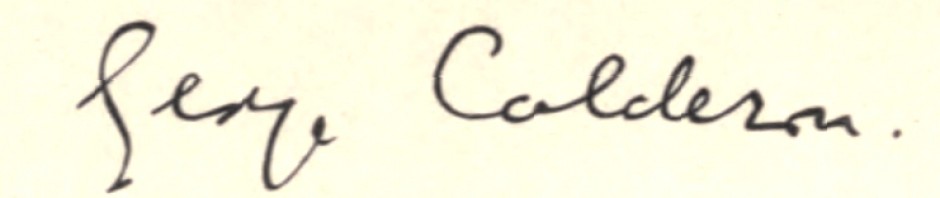
About now 1914, George Calderon went again to see his golfing acquaintance Coote Hedley. He turned up at his house at 9.30 in the evening, wearing his O.T.C. ‘reach-me-down’. However, as Hedley told Mrs Hedley, ‘even in that awful old Inns of Court private’s uniform […] he managed to look such a soldier.’

It seems very likely that Calderon did not know how high in the war machine Coote Hedley really stood.  Hedley was made a General Staff Officer, Grade 1, at the War Office in 1911 and was in command of the Geographical Section, which had to provide the British Army with the best possible maps of every area of the world other than the UK.  (In 1916 this Section became part of Military Intelligence.)

Colonel Sir Walter Coote Hedley, c. 1920

Colonel Sir Walter Coote Hedley
c. 1920

As Hedley wrote in 1920, Calderon made it clear that his ‘heart’s desire’ was to ‘get to the front as soon as possible’.  Applying his intimate knowledge of the military mind, Hedley now advised George that at his age ‘the most feasible way of doing this appeared to be to go as an interpreter, for he was an accomplished linguist’.  Calderon took this on board.  He then asked if there was anything else he could do to ‘get out’.

I said, ‘An interpreter should be able to ride.  Can you ride?’  ‘Not very well,’ he said, ‘but I can learn.’  I said, ‘Have you any riding breeches?’  He said, ‘No.’  I lent him a pair of these necessary articles and he was in the riding school of the ‘Blues’ at 7.30 a.m. the next morning.

Between themselves, George and Kittie dubbed Hedley ‘The Godfather in War’.

Next entry: Confusion, or subtlety?

Posted in Edwardian character | Tagged , , , , , , , , , , | 1 Comment

25 August 1914

On this day the first accounts of the Battle of Mons started appearing in British newspapers.  The Times headed its main report ‘Namur Lost, German Success in Belgium’ and led off: ‘The battle is joined and has so far gone ill for the Allies.’  Elsewhere an editorial entitled ‘The Germans Strike Hard’ admitted: ‘Yesterday [when the B.E.F. had retreated further southwards] was a day of bad news, and we fear that more must follow.’

However, after it came another editorial headed ‘England’s Call’, which appealed to men to join a ‘new army’ that Kitchener was assembling: ‘We shall want every man who is able and willing to do his duty by his country in this crisis of England’s fate.  It would be rank folly to reject such men.’  Interestingly, it made no reference to age.  The numbers of men volunteering now rocketed.

Next entry: ‘The Godfather in War’

Posted in Edwardian character, Heroism and Adventure | Tagged , , , , , , , | Leave a comment

23 August 1914

At about 7 a.m. today the Germans began to attack British positions around Mons.  It was the British Expeditionary Force’s first action of the war.  At first the German surges were mown down by rifle-fire.  Gradually, however, von Kluck’s troops gained a foothold south of the canal and advanced in overwhelming numbers.  The B.E.F. lost about 1600 men (including prisoners) and fell back a few miles.  By nightfall the Germans had taken Mons.

Next entry: 25 August 1914

Posted in Uncategorized | Tagged , , , , , , | Leave a comment

…and impatient!

Calderon had not by now heard whether he had been given a commission, so he went to see his golfing acquaintance Lieutenant-Colonel Coote Hedley, who lived not far away in Belsize Avenue, to ask what he, George, could do to hasten becoming ‘combatant’.

‘My dear fellow, unless it comes to a case of the nation in arms you’ll never be accepted as a combatant,’ Hedley told him straight.

Events were to show that this was not accurate: before long the territorials were being drafted into France.  But Calderon could not wait till then.

Next entry: 23 August 1914

Posted in Uncategorized | Tagged , , , , , , , | Leave a comment

Determined

Calderon’s approach to issues of the day (Russia, suffragism, unionism) was to study them in depth, analyse them, then decide what was the right course of action for him and stick to it through thick and thin.  This was why many of his friends called him the most honest man they knew.  He always did what he believed.

During the Coal Strike of 1912, which brought Edwardian Britain to its knees, he came to the conclusion that the miners deserved more pay and better working conditions but ‘making war on the Community’ to achieve them was not right; therefore ordinary citizens should go to work in the mines to show that the Community would not be bullied. When he took his curtain call after the first night of his play The Fountain in Oxford on 4 March 1912, he made a passionate speech calling on undergraduates to meet him next day to form a Strike Emergency Committee and go down the mines.  However, he had not told Kittie that he was going to do this and as she listened to him she was ‘simply cold with terror’, as she wrote later.  He spent the next five months raising volunteers to work in the mines and as stevedores during the London Dock Strike.

The third and last time I was up against that sense of finality in him  was when the War came.

I couldn’t say any exact moment when I grasped that it meant going to any of the Fronts.  It was home defence that was in my mind at the very beginning of things. […] but certainly well before August was over I was up against the other quite definitely.

He had decided what he should do.

Next entry: …and impatient!

Posted in Edwardian character, Edwardian marriage, Heroism and Adventure | Tagged , , , , , , , , , , | Leave a comment

Writer’s self-block?

There is no evidence that Calderon wrote anything new in 1914 after signing up.  Yet the previous seven months had been packed with literary-theatrical work: he had written or assembled most of his posthumous best-seller Tahiti, finished a pantomime The Brave Little Tailor with William Caine (music by Martin Shaw), translated the international sensation Reminiscences of Tolstoy (by Il’ia Tolstoi), worked as interpreter/fixer for Ballets Russes during their London visit, and written two libretti for Michel Fokine, Diaghilev’s choreographer.  The aborted trip to the Isle of Wight at the end of July seems to have been the first break he had.

Now, judging by his letter to his mother yesterday, a day’s military training left him with no time or energy to write.  However, he had always been so ruthless at prioritising that some of his friends felt he just ‘dropped’ projects and causes when he got tired of them. Perhaps he had simply lost the inclination to write?  Although he did not share with many people his reasons for joining up, his overriding personal priority seems to have become to contribute to defeating the Kaiserreich’s attack on freedom and decency.

Calderon’s lifelong friend Laurence Binyon remembered how at a dinner party around this time George ‘startled the company by maintaining that England never fought a war except for an idea’.

Next entry: Determined

Posted in Edwardian literature, Personal commentary | Tagged , , , , , , , , , , , , , , , , | Leave a comment

14 August 1914

The British Expeditionary Force was still moving up to join the French Fifth Army near the Belgian border, and in London today the weather was ‘grilling hot’ (Mark Bostridge, The Fateful Year).  That evening George Calderon wrote to Clara Calderon in Hampshire:

My dear Mother,

Just a line before I go to bed, which I shall be doing about half-past nine.  Not much time for anything, and pretty tired of a night.  Get up about 5.30, read military books; breakfast at 8; go off early, usually with a bit of shopping to do, a knife or a compass or something to buy.  Drill all the morning in the beautiful garden of Lincoln’s Inn, among the Chancery lawyers: the rest of the battalion in the Temple Garden and Gray’s Inn.

In the afternoon, more drill, and lectures on the grass under the trees.  Tea, and then signalling, and back home for dinner; a little bit of reading and then bed.

Waiting for news from the War Office; our Colonel has recommended me for a commission, and in a few days I hope to know the result.  Till then, rather unsettled.

We had expected to be sent to a camp; but nothing is heard of it.  No uniform even yet; we go about in knickerbockers or flannel suits and leather belts.

Last Sunday we had a capital day prancing like goats among the bracken in Richmond Park, attacking a hill.

I wonder you don’t all want to be up in London, when history is being made at such a pace — to keep level with the latest news.

Kittie sits patching me shirts and sewing blankets, meditating Red Cross and what not…

Clearly Calderon was training hard.  He had probably ‘cultivated’ the Colonel, who may have been not much younger than himself and certainly his social equal, as this was his method of getting what he wanted in subsequent regiments.  But the military reality of the situation in the Inns of Court O.T.C. seems indicated by what they were wearing (Kittie called it ‘a reach-me-down out of the general pile!’).

Next Entry: Writer’s self-block?

Posted in Uncategorized | Tagged , , , , , , , , | Leave a comment

A biographer worries…

A big challenge for the biographer when his subject died in the trenches is, frankly, stylistic: should he/she go with the deepening muffled drums, the lugubrious blanket that descends on your prose as the end draws closer?

No, in my opinion.  The biographer must carry on as though he/she does not know the end. He/she must always write ‘in the present’ and not give way to culturally approved, even ‘ritualised’, ways of  narrating World War I death.  Leave it to your subject to say when he/she was becoming depressed by it all.

About three years ago, the last sentence of the last chapter of George Calderon’s life ‘came’ to me.  I filed it in memory and lived with it for two years.   Then it struck me as too portentous and another came to me.  Since then I have binned about six ‘last sentences’. Now I understand that I have to live with no last sentences at all.  The story of his last ten months has to be made present to the reader as I write it, and that is all.  Where the last sentence is concerned, what will be will be.

Tomorrow, then, back to the ‘present’ (August 1914).

Next Entry: 14 August 1914

Posted in Personal commentary | Tagged , , , , , , , , , , | Leave a comment

A biographer dreads…


A very successful biographer asked me how George Calderon died.  I replied that he disappeared in the smoke of battle.  ‘Ah,’ he said, ‘that’s lucky for you: you’ve got a clean ending, not long years of decline, dementia etc.’  As a technical observation, I suppose, that’s true.  But I have to say I’ve long dreaded reaching that ending.  I didn’t like Calderon much when I first encountered him thirty years ago, but over the last three years of researching and writing his biography I’ve got closer and closer to him.  I feel I understand him and deeply sympathise with him.  Knowing how his life ended before getting to it (in a way, before he knew) is depressing; of course I baulk at parting from him. Yet I know that the aftermath of his death is inspiring, and the thirty-five years by which Kittie survived him were filled with love and a kind of heroism. So actually there will be two chapters beyond Calderon’s death; the book itself will end in 1950.

Next Entry: A biographer worries…

Posted in Edwardian marriage, Heroism and Adventure, Personal commentary | Tagged , , , , , , | Leave a comment

A biographer writes…

The main object of ‘Calderonia’ is to post events and documents in a kind of ‘real time’ ; exactly a hundred years after they happened.  And judging by the emails I have received, that’s what people appreciate.  This timeline approach is a great help to me as I piece together the narrative of the last chapter of my biography of Calderon (not the last chapter of the book), which I shall start writing next week.  I also know that I can go into more detail, and quote far more, in the blog than I’ll be able to in the chapter.

Unfortunately, although probably more is known about the last ten months of Calderon’s life than any period of similar length, we don’t know something specific or have a document about every day of it.  In those gaps, then, I shall post personal commentary on odd days. Sorry if this isn’t as interesting!  But, of course, I’m always keen to get your comments and reactions back.  The next actual document, a letter of Calderon’s to his mother, will be posted on 14 August and is, I think you’ll agree, a gem.

Next Entry: A biographer dreads…

Posted in Personal commentary | Tagged , , , , , , , , , | Leave a comment

Training and War Games

Then we lived in an atmosphere of drill – I don’t only mean the drills etc and general training that he was going through, but at home: books on drill, books on everything, Morse codes, other codes, German military handbooks of all sorts and so on. Also great books on War – German and English. It was a characteristic touch that an entirely unknown man in the Regiment whom he found was living some way out of London and who could not find a good shakedown after late drill anywhere was brought home to sleep here.

The sham fights [i.e. exercises.] and things of that sort in Richmond Park he really enjoyed…

(Kittie Calderon’s memoirs)

Next Entry: A biographer writes…

Posted in Edwardian character, Edwardian marriage | Tagged , , , , , , , | Leave a comment

5 August 1914

Note that George Calderon’s ‘Attestation’ simply meant that he had joined the ‘Territorial Force’ and this committed him to ‘Four Years Service in the United Kingdom’.  In his excellent The British Soldier of the First World War (Shire Books, 2010) Peter Doyle explains that men joining up as territorials ‘did so on the understanding that they would serve as part-timers engaged on home-defence, with no overseas commitment’.

Kittie Calderon therefore imagined ‘two little figures which were George and Reggie Astley [second husband of her lifelong intimate friend Nina Stewart] standing by two immense guns somewhere up near John O’Groats House waiting for the German invasion’.  As soon as war was declared, however, the ‘terriers’ would be liable for full-time service, and the implication was that the ‘terriers’ would serve at home and the regulars overseas.

But is this what George Calderon wanted?

Next Entry: Training and War Games

Posted in Uncategorized | Tagged , , , , , , , , , , | Leave a comment

4 August 1914

At 8 a.m. German troops crossed the Belgian border. In the morning, presumably by telephone, Calderon made an appointment to see the Colonel of the Inns of Court Regiment, who was previously unknown to him. This time George did deploy all his persuasive skills. At first the Colonel rejected him on the same grounds as the Adjutant had, but in Kittie’s words ‘as he talked I suppose [he] grasped that here was a man who would be an asset, 45 though he might be’. In fact the Colonel may have had an inkling of how short of officers the British Army would soon become. Within a few weeks, the famous Kitchener recruitment posters were saying in their smaller print that ‘Ex-Soldiers up to 45 years of age’ were wanted.

In the afternoon, the King’s proclamation of mobilisation was read to the House of Commons and the Regiment was rushed back to London. By the end of the afternoon, George Calderon had achieved his objective: he had passed a medical examination at Lincoln’s Inn, taken the oath of allegiance, and been accepted for four years service in the Inns of Court Officer Training Corps.

040814 Attestation

As Big Ben struck the first note of 11 this evening a hundred years ago, Britain was at war with Germany.

Next Entry: 5 August 1914

Posted in Uncategorized | Tagged , , , , , , , , , | Leave a comment

3 August 1914

Of course the Adjutant turned him down – saying he was far too old.

It must have been a bitter blow to Calderon, yet it is very unlikely that he showed it. He may have tried to reason, perhaps he employed some of his inimitable humour and charm, but in the words of a friend he always displayed ‘truly Spanish courtesy’, so he probably appeared to accept the Adjutant’s rejection.

He was not the only man being refused. In Manchester the Guardian’s theatre critic C.E. Montague, who had reviewed George’s play Revolt so perceptively and at such length in 1912, tried twice to enlist at the age of 47 and succeeded only after dyeing his white hair black, prompting a colleague to remark that ‘Montague is the only man I know whose white hair in a single night turned dark through courage’. There may well have been other over-age ex-barristers trying to join the colours on that station platform as the Inns of Court Regiment entrained for Camp.

Rejecting Calderon was a mistake. The afternoon before, Germany had invaded Luxembourg and was demanding unhindered passage through Belgium, obviously to attack France. George Calderon was a man who spoke ten European languages, loved sport, had five years military training in his past, and was fearless. Moreover, as his interventions in the Coal Strike and London Dock Strike of 1912 had shown, he had a ‘propensity to act’ that left most people standing. But he was ‘too old’…

Wearing the uniform he and Kittie had improvised, he returned to Hampstead, where the annual Cockney Carnival was in progress (it was August Bank Holiday, a ‘St Lubbock’s Day’). But according to the local paper, this was ‘a dismal affair […] the true holiday spirit as only was to be expected was absent’. Mobilisation orders were now being sent out. That afternoon, Sir Edward Grey addressed the House of Commons on what he saw as the country’s moral obligations. Bank Holiday crowds gathered in Whitehall and outside Buckingham Palace. Back at the Foreign Office, Grey worked on the ultimatum to Germany demanding it respect Belgium’s neutrality, and this evening a hundred years ago Germany declared war on France.

In Hampstead, George Calderon was conferring with military friends and planning his own campaign for the following day.

Next Entry: 4 August 1914

Posted in Edwardian character, Heroism and Adventure | Tagged , , , , , , , , , , | Leave a comment

2 August 1914

Suddenly (he had no time to let Kittie know he was coming), George Calderon returned to London. On 1 August Germany and France mobilised, and the party holidaying on the Isle of Wight soon heard the news. Evey (Captain Pym) may also have received a telegram ordering him to report for duty; or he decided that the Pym family must go home to Kent next day and George left with them. Calderon’s conversation with Evey, a regular soldier whom he knew well, may well have influenced what he decided to do next.

Instead of going straight home to Hampstead, he made for the HQ of the Inns of Court Officer Training Corps. 2 August was a Sunday, but he guessed somebody would be there. His intention was to enlist with this regiment by appealing to his experience from almost two decades before in the Artists Volunteers and the Inns of Court Volunteers. Unfortunately, there was no-one present who could tell him whether it was possible to ‘rejoin’ the Inns of Court Regiment at the age of 45 years and 7 months. But he did learn that the regiment was leaving for camp the next day.

Continuing in Kittie Calderon’s words:

We spent the rest of that day rummaging and collecting the most suitable sorts of garments for Camp – and most of the night stitching hard – as most of them were very ancient – and he and his ruk-sak were on the platform of the station where the Regiment was to entrain at I think it was 6 a.m. next morning…

Next Entry: 3 August 1914

Posted in Heroism and Adventure | Tagged , , , , , , , | Leave a comment

1 August 1914

It gives me much pleasure, from a personal acquaintance of a good many years, to be able to speak with confidence and very favourably indeed of the capacity of Mrs Calderon to undertake almost any or all of the duties usually performed by a General Nurse.

It has fallen to her lot to an unusual degree, to be intimately mixed up with cases of illness, both surgical and medical, often for long periods of time at a stretch. To name but one instance that I know of personally, that of her mother, chronically ill for 4 or 5 years…

She has also nursed and helped to nurse several important surgical cases, and has undergone at least one operation herself, which in my opinion is a most important adjunct and experience in the training of any nurse.

I can confidently state therefore that most of the duties and manoeuvres which fall to the lot of a nurse to perform and carry out are perfectly familiar to Mrs Calderon.

Finally, and most important of all, she possesses all the best of the mental qualities which go towards, and are absolutely necessary for, the making of an efficient nurse, viz. careful observation, watchful intelligence, tact, and strict obedience to instructions, together with the ability to form a judgment in the absence of them, and to act promptly on it.

She is very bright and cheerful, and very kind – and usually enjoys good health.

Albert Tebb
M.D. & B.Sc. (Lond.)
M.R.C.S, L.R.C.P.

Whilst George Calderon was sailing, swimming, and possibly writing a chapter of his travel book Tahiti, at Bembridge on the Isle of Wight, back in London Kittie was evidently planning to volunteer as a nurse in the Red Cross’s VAD organisation, founded in 1909. Above is Dr Albert Tebb’s reference for her, written on Saturday 1 August 1914. Tebb had been the Calderons’ G.P. since 1901. He was also doctor to their Hampstead friends William Rothenstein and Joseph Conrad, as well as to Ford Maddox Ford. He specialised in treating ‘nervous prostration’ in artistic people.

Next Entry: 2 August 1914

Posted in Edwardian marriage | Tagged , , , , , , , , , | Leave a comment