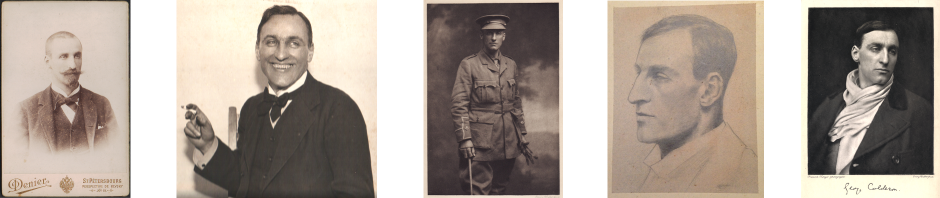
3 August 1914

Of course the Adjutant turned him down – saying he was far too old.

It must have been a bitter blow to Calderon, yet it is very unlikely that he showed it. He may have tried to reason, perhaps he employed some of his inimitable humour and charm, but in the words of a friend he always displayed ‘truly Spanish courtesy’, so he probably appeared to accept the Adjutant’s rejection.

He was not the only man being refused. In Manchester the Guardian’s theatre critic C.E. Montague, who had reviewed George’s play Revolt so perceptively and at such length in 1912, tried twice to enlist at the age of 47 and succeeded only after dyeing his white hair black, prompting a colleague to remark that ‘Montague is the only man I know whose white hair in a single night turned dark through courage’. There may well have been other over-age ex-barristers trying to join the colours on that station platform as the Inns of Court Regiment entrained for Camp.

Rejecting Calderon was a mistake. The afternoon before, Germany had invaded Luxembourg and was demanding unhindered passage through Belgium, obviously to attack France. George Calderon was a man who spoke ten European languages, loved sport, had five years military training in his past, and was fearless. Moreover, as his interventions in the Coal Strike and London Dock Strike of 1912 had shown, he had a ‘propensity to act’ that left most people standing. But he was ‘too old’…

Wearing the uniform he and Kittie had improvised, he returned to Hampstead, where the annual Cockney Carnival was in progress (it was August Bank Holiday, a ‘St Lubbock’s Day’). But according to the local paper, this was ‘a dismal affair […] the true holiday spirit as only was to be expected was absent’. Mobilisation orders were now being sent out. That afternoon, Sir Edward Grey addressed the House of Commons on what he saw as the country’s moral obligations. Bank Holiday crowds gathered in Whitehall and outside Buckingham Palace. Back at the Foreign Office, Grey worked on the ultimatum to Germany demanding it respect Belgium’s neutrality, and this evening a hundred years ago Germany declared war on France.

In Hampstead, George Calderon was conferring with military friends and planning his own campaign for the following day.

Next Entry: 4 August 1914

Posted in Edwardian character, Heroism and Adventure | Tagged , , , , , , , , , , | Leave a comment

2 August 1914

Suddenly (he had no time to let Kittie know he was coming), George Calderon returned to London. On 1 August Germany and France mobilised, and the party holidaying on the Isle of Wight soon heard the news. Evey (Captain Pym) may also have received a telegram ordering him to report for duty; or he decided that the Pym family must go home to Kent next day and George left with them. Calderon’s conversation with Evey, a regular soldier whom he knew well, may well have influenced what he decided to do next.

Instead of going straight home to Hampstead, he made for the HQ of the Inns of Court Officer Training Corps. 2 August was a Sunday, but he guessed somebody would be there. His intention was to enlist with this regiment by appealing to his experience from almost two decades before in the Artists Volunteers and the Inns of Court Volunteers. Unfortunately, there was no-one present who could tell him whether it was possible to ‘rejoin’ the Inns of Court Regiment at the age of 45 years and 7 months. But he did learn that the regiment was leaving for camp the next day.

Continuing in Kittie Calderon’s words:

We spent the rest of that day rummaging and collecting the most suitable sorts of garments for Camp – and most of the night stitching hard – as most of them were very ancient – and he and his ruk-sak were on the platform of the station where the Regiment was to entrain at I think it was 6 a.m. next morning…

Next Entry: 3 August 1914

Posted in Heroism and Adventure | Tagged , , , , , , , | Leave a comment

1 August 1914

It gives me much pleasure, from a personal acquaintance of a good many years, to be able to speak with confidence and very favourably indeed of the capacity of Mrs Calderon to undertake almost any or all of the duties usually performed by a General Nurse.

It has fallen to her lot to an unusual degree, to be intimately mixed up with cases of illness, both surgical and medical, often for long periods of time at a stretch. To name but one instance that I know of personally, that of her mother, chronically ill for 4 or 5 years…

She has also nursed and helped to nurse several important surgical cases, and has undergone at least one operation herself, which in my opinion is a most important adjunct and experience in the training of any nurse.

I can confidently state therefore that most of the duties and manoeuvres which fall to the lot of a nurse to perform and carry out are perfectly familiar to Mrs Calderon.

Finally, and most important of all, she possesses all the best of the mental qualities which go towards, and are absolutely necessary for, the making of an efficient nurse, viz. careful observation, watchful intelligence, tact, and strict obedience to instructions, together with the ability to form a judgment in the absence of them, and to act promptly on it.

She is very bright and cheerful, and very kind – and usually enjoys good health.

Albert Tebb
M.D. & B.Sc. (Lond.)
M.R.C.S, L.R.C.P.

Whilst George Calderon was sailing, swimming, and possibly writing a chapter of his travel book Tahiti, at Bembridge on the Isle of Wight, back in London Kittie was evidently planning to volunteer as a nurse in the Red Cross’s VAD organisation, founded in 1909. Above is Dr Albert Tebb’s reference for her, written on Saturday 1 August 1914. Tebb had been the Calderons’ G.P. since 1901. He was also doctor to their Hampstead friends William Rothenstein and Joseph Conrad, as well as to Ford Maddox Ford. He specialised in treating ‘nervous prostration’ in artistic people.

Next Entry: 2 August 1914

Posted in Edwardian marriage | Tagged , , , , , , , , , | Leave a comment

30 July 1914

I got a porter and was making for the boat at Portsmouth Harbour station when I met Evey on the platform, with a nice dry man Bland, Ipswich branch of Barclay’s bank: he had a motor launch and we came back [to Bembridge] by that, an hour and a half what with going in to Southsea.

Trains full of sailors all recalled by early telegram this morning. Soldiers moving everywhere. Men at all the guns along the shore on the mainland and in Isle of Wight. Groups of soldiers in marching order posted on watch at improvised telephone stations on the beach. It looked as if the Germans were expected at any moment. Strict regulations about all unofficial craft; no one to move on sea after sunset, or to approach men of war at any time.

The first fleet went out 2 days ago no one knows where.

The children good and hearty, still whooping; they came running over to greet me at my room in the villa opposite…

A hundred years ago today, George Calderon left 42 Well Walk, Hampstead, for a working holiday at Bembridge on the Isle of Wight. He would be living close to his friends the Pym family, who were already there. ‘Evey’ is Captain Charles Evelyn Pym (1879-1971) of the Suffolk Yeomanry. He was married to Violet, née Lubbock (1882-1927), sister of Percy Lubbock and niece to George’s wife, Kittie. The Calderons had no children themselves and were very close to this family: the two children who ran to meet George were Jack (aged six) and Roly (aged four), who had recently both had whooping cough. Violet was seven months pregnant.

I think this previously unpublished letter to his wife suggests that George and Kittie were following military developments closely and had probably already discussed what their contribution would be if Britain went to war. On 28 July Austria-Hungary had declared war on Serbia, and the first shots of World War I were fired next day. Captain Pym must have been expecting to be recalled to his regiment at any moment. He and George undoubtedly discussed the international situation from day to day. This letter was posted to Kittie on Friday 31 July 1914, the same day that Russia mobilised and Germany sent ultimatums to St Petersburg and Paris.

When would the Pyms have to cut short their holiday, and what would George do?

Next Entry: 1 August 1914

Posted in Edwardian marriage | Tagged , , , , | Leave a comment

Calderonia – A Writer Goes to War

Weep, you may weep, for you may touch them not.
—Wilfred Owen

George Calderon was killed on 4 June 1915 at the murderous ‘Battle of Achi Baba’ on the Gallipoli Peninsula. When his death was officially confirmed in 1919 The Times wrote: ‘one is inclined to say that Calderon’s loss was the heaviest blow which struck the English drama during the war.’

This was no exaggeration. In 1909 Calderon’s comedy The Fountain was a hit with the Stage Society and taken up by all the new repertory companies. It was felt to be superior to Shaw. Calderon’s ‘combination of laughter and earnestness, of shrewdness and enthusiasm, give him a place alone among modern dramatists’ wrote The Times again.

The same year, Calderon successfully directed The Seagull in his own translation for Glasgow Repertory Theatre — the first time Chekhov had been staged in Britain. He wrote eight one-act plays ranging from farce to Symbolist drama, completed his friend St John Hankin’s last play, Thompson, and collaborated with Michel Fokine on a number of ballet libretti. Most of Calderon’s plays went on to be broadcast on radio for decades and his version of The Seagull was last broadcast in 2010.

I have been writing the first full length biography of George Calderon for the past three years and it’s due to come out in 2015. We shall never entirely know what made him sign up in 1914, when his literary career was at full throttle and there was no ‘need’ for him to. But it seems to me that a day-for-day blog of his 1914-15 story can bring us close to his experience of the War and show us what kind of man this was, who sacrificed everything for what he called ‘the people’.

Patrick Miles

Next Entry: 30 July 1914

Posted in Edwardian character | Tagged , , , , , , , , | Leave a comment