The Press tries to help

Now that George was officially ‘missing’, Kittie could draw on George’s and her contacts in the world of print to publicise the fact and appeal nationwide for any information about him. She was extremely energetic about this. She first wrote to The Times, as this was the newspaper George was most associated with:

Times notice of "missing" status

The same text was printed in yesterday’s Evening Standard — one of the newspapers for which George had written whilst in Russia as a young man. Today, Friday 16 July 1915, the Evening Standard produced its own new item (immediately below), and at least ten other national publications followed suit right through to August. The item in the Daily Mirror below is notable for describing George for the first time as ‘severely’ wounded, and the last item, from London Opinion, is evidently by someone who knew him. From this time until 1926 Kittie subscribed to two press cutting agencies. The images in this post are taken from her collection.

Evening Standard notice of "missing" status

Daily Mirror notice of "missing" status

London Opinion notice of "missing" status

Next entry: Katy’s hat trick

Posted in Edwardian marriage | Tagged , , , , , , , , , , , , , | Leave a comment

15 July 1915

Today Kittie received another letter from Gertrude Bell, who was managing the Enquiry Department for Wounded and Missing at 20 Arlington Street, London S.W. on behalf of the British Red Cross and Order of St John:

Dear Mrs Calderon,

Sir Louis Mallet has written a personal letter to the Red Crescent and sent to them Mr Calderon’s name. I do hope we may hear of him.

Believe me yours sincerely

Gertrude Bell

For the context of this letter, see my post of yesterday.

At about this time, Kittie also heard from Arthur Maxwell Labouchere, the Adjutant of the 9th Oxfordshire and Buckinghamshire Light Infantry, to whom George had been close when he was training with this regiment at Fort Brockhurst:

Dear Mrs Calderon,

I cannot tell you how sorry I was to read Captain Hogan’s letter, as we had no idea that George was missing. Now we must hope that he is among the prisoners and that news will soon come through about him. There must be an Association for making all enquiries possible about prisoners and wounded in Turkey, as there is for France and the War Office should be able to put you at once in communication with it. Onslow Ford tells me that he knows Ian Hamilton and can write to him on the chances of his being able to make special enquiries out there. I will try to find someone who has some business connections with Turkey; for the moment I know of nobody, but will at once write to friends who might know. I feel sure that the best method will be to get in touch with the Association that must exist for this very purpose — they may be able to work through the American Embassy. I will ask the Chaplain to pray for him, and please God we shall soon hear the news we all hope for.

Yours very sincerely

Maxwell Labouchere

Hogan is Captain Hogan, who makes several positive appearances in George’s letters after leaving for Gallipoli, but about whom nothing more seems ascertainable, as we do not know his forenames and the name was very common in the British Army. His name does not appear in the official history of the K.O.S.B. (possibly because like George he was merely attached to them from the Ox and Bucks), nor amongst the named buried at Twelve Tree Copse cemetery, nor on the Helles Memorial for those whose graves are unknown. Let us hope he survived Gallipoli and even the War, as seems possible. His letter to Kittie is unfortunately lost. The letter of Labouchere’s above, however, would suggest that Hogan wrote to her directly, told her that George was ‘missing’, and held out the hope that he might be in Turkish captivity.

Onslow Ford was a fellow officer of George’s at Brockhurst; presumably a son of Edward Onslow Ford, the Victorian sculptor. Sir Ian Hamilton, Commander in Chief of the Mediterranean Expeditionary Force at the Dardanelles, was probably a distant relation of Kittie’s through her father, John Hamilton of Brownhall and St Ernan’s, Donegal.

Obviously, Kittie and Gertrude Bell were already well ahead in doing what Labouchere sketches out here. In a letter from him to Kittie dated 2 October 1915 he is still encouraging the view that George is a prisoner: ‘I am sure that any Turkish lists must be incomplete and that many names have not yet been published.’

Next entry: The Press tries to help

Posted in Edwardian marriage | Tagged , , , , , , , , , , , , , , | Leave a comment

14 July 1915: Very great concern

The War Office, working with the Red Cross, had established that George was not amongst the wounded or deceased at any point along their lines of medical communication between Gallipoli and Alexandria-Malta-Blighty, hence their telegram to Kittie of 12 July declaring him officially missing.

Kittie immediately wrote to a number of her and George’s closest friends informing them of this development, and one can also be sure that the news spread rapidly through Nina Corbet’s circle and literary networks. Previously, the idea that George was ‘wounded’, as he had been once before, was not that unsettling for them. But the new status of ‘missing’ was deeply worrying. They instantly communicated to Kittie their concern.

Today she received a long letter from William Rothenstein in Gloucestershire (I cannot quote it all as it is still in copyright). ‘My dear Mrs Calderon,’ it began, ‘it never entered my head that George was anything but lightly wounded or that there was any doubt about your ultimately hearing from him.’  He was ‘very much shaken’ by the news. ‘I love George as a brother and the thought of him lying untended and alone I cannot easily bear.’ Clearly, though, Kittie had expressed to him her hope that George had been taken prisoner. ‘Our dear, brave, witty and lovable George without you by him […] in that strange hostile place and none of us able to get near him’ undoubtedly refers to Turkey itself, as Rothenstein goes on to name friends who he knows once had contacts in Turkey. He is writing to them himself about ‘means of communicating’ with George in a Turkish hospital or prison camp.

Letters followed from Violet Pym and Constance Sutton (Astley). Somebody had told Violet ‘the other day that George could not be missing, or it would have been reported. That they always report that promptly. So I had been hoping that he might still be with his regiment fighting (they report the smallest scratch as ‘wounded’) and that they were too far forward perhaps to send letters. […] Darling Kittie, I just can’t say what I am feeling about you.’ ‘All my love is with you’, Constance Sutton wrote. ‘I simply ache for your awful time of heartrending anxiety — GOD bless and help you, my Dear One.’

Kittie also received a scribbled letter today from the indefatigable Gertrude Bell. She told Kittie she had heard that Sir Louis Mallet (Ambassador to Turkey 1913-14) was back from France, she planned to meet him tomorrow, and would ask him whether ‘as private people’ they could submit an inquiry about George in Constantinople. She ended her letter:

The American Ambassador has not as yet been able to do very much for us, though we do get lists of prisoners from their embassy here from time to time. Everything we can do shall be done for you.

Believe me yours sincerely

Gertrude Bell

Next entry: 15 July 1915

Posted in Edwardian character, Edwardian marriage | Tagged , , , , , , , , , , , , | Leave a comment

13 July 1915: A witness is found

Suddenly, at Alexandria Percy Lubbock heard of the arrival in one of the city’s hospitals of a Sergeant-Major Allen from the 1st King’s Own Scottish Borderers (KOSB), the battalion George had been attached to at the Third Battle of Krithia on 4 June. Percy found him and talked to him yesterday. Today, Tuesday 13 July, he typed up his interview and sent it off with the briefest of notes to Kittie: ‘Kitty dear I hope & hope & hope you may have had news. Mustn’t write — my eyes have given out. Your PL.’ As a family intimate, he could use the spelling ‘Kitty’. He was visually impaired and later in life completely blind. Shortly after sending Kittie his report, he left for Cairo on Red Cross business.

The Sergeant-Major whom Percy interviewed said he remembered George, but Percy was ‘not sure he really did’. This KOSB sergeant-major talked of 6 June being the day of the battle, he was not in the same Company as George, and because the KOSB were ‘consolidating gains’ that day, he could not see why ‘anybody should be missing on that day’. ‘I have not as yet been able to find any Officer of the 1st KOSB’, Percy concluded his report. ‘The difficulty with the men is that as G. had only so lately been attached to the Battalion they none of them knew him by name.’ Percy was absolutely right not to give credence to this sergeant-major’s testimony.

However, unbeknown to Percy, a VAD called Mrs Ludolf at another Alexandria Hospital met today a Sergeant-Major Allan of the 1st KOSB, realised his possible importance, and interviewed him. Like Percy, she typed up her interview. Then she sent it to Gertrude Bell, rather than Kittie. The top copy made its way into George’s War Office file. It reads:

Witness stated that in an advance made by the Regiment in two lines, Lt. Calderon was in the 2nd line, and was seen to fall. The Regt. took a trench as the result of this advance and never retreated. It is, therefore, impossible that Lt. Calderon should be a prisoner. It is probable that he was killed outright, and the body left on the open ground.

Before this action Lt. Calderon spoke to witness, and gave him a drink of brandy. He picked the leaf of a certain shrub, and told the men to do the same and chew the leaves, as these were said by the Turks to give vigour. All the men near picked leaves and chewed them.

Reference: St-Major Allan
1 K.O.S.B. (B. Coy)
15 Gen. Hosp. Alexandria

Mrs Ludolf
July 13, 1915

Now this Sergeant-Major Allan was a genuine witness. Not only was he in the same Company as George, and would therefore have known him as the lieutenant in charge of 8 Platoon, he also told Mrs Ludolf that ‘the officer he meant had been an Interpreter in Belgium, and was elderly for a lieutenant’, as Percy wrote to Kittie on 20 July.

Even so, there is some confusion or compression of the facts in the first paragraph. By ‘two lines’ Allan must have meant the first wave comprised of two companies, A and B, rather than two waves, as George was definitely in the first wave but B Company. As all official sources agree, this first wave was slaughtered and did not get anywhere near capturing the first Turkish trench H9a. Survivors taking cover, the dead, dying and wounded, were therefore stuck in no-man’s land until the second wave advanced half an hour later, did take the trench, and ‘never retreated’ (see my post for 4 June). Allan’s conclusion, therefore, that George was probably ‘killed outright, and the body left on the open ground’, is in my view indisputable.

It was a great stroke of luck that Mrs Ludolf questioned Allan and sent off her report. Before Percy had returned from Cairo three days later, Allan had left for home.

*                    *                    *

There were many possible reasons for these two 1st KOSB sergeant-majors being evacuated by hospital-ship to Alexandria. The most likely is that they had been wounded in the Action of Gully Ravine 28 June-5 July (see my post of 30 June), in which the 1st KOSB played a very distinguished part. The official history of the KOSB in World War I does not say how many casualties they sustained, but I would be surprised if they were half-strength by the time they were sent to Lemnos for rest around 8 July.

Meanwhile, yesterday and today the 1/4th and 1/5th Battalions of the KOSB, who were Territorials, suffered terrible losses in the Action of Achi-Baba Nullah, which was an attempt by the British and French to conform the centre of the Helles front with the advances made earlier on the flanks. The battle was the all too familiar combination of excessive staff cleverness and downright incompetence. As a result, hundreds of the 1/4th KOSB over-ran their objective and headed up the lower slopes of Achi Baba, where they were mown down. Of the approximately 700 men of the 1/4th KOSB who had been in the action, only seventy answered the first roll call on 15 July.

All three battalions of George’s ‘old’ regiment — the 1st KOSB, 1/4th KOSB and 1/5th KOSB, who had been the very backbone of the 29th and 52nd Divisions at Gallipoli — were now shredded. They never reached full strength on the peninsula again.

Next entry: 14 July 1915: Very great concern

Posted in Edwardian marriage | Tagged , , , , , , , , , , , , , | Leave a comment

12 July 1915

Sometime today, Monday 12 July 1915, Kittie received the following telegram:

O.H.M.S. I certify that this telegram is sent on the service of the WAR OFFICE [Signature]

In reply to special enquiry it is stated that Lt. G. Calderon Ox & Bucks LI previously reported wounded is now reported missing

FROM: Secretary, War Office

The letter she had recently (we assume) received from Captain Hogan of the 9th Ox & Bucks, who like George had at first been reported ‘wounded’ but had indeed survived, raised her hopes that George was either in the same condition or had been taken prisoner. Obviously, this latest telegram from the War Office could still mean that he had been taken prisoner, wounded or not; but everyone knew it often meant something else. The ‘special enquiry’ was presumably Coote Hedley’s internal War Office letter of 14 June to Casualties on Kittie’s behalf (see post of 13 June).

Next entry: 13 July 1915: A witness is found

Posted in Edwardian marriage | Tagged , , , , , , , , | Leave a comment

10 July 1915

POST OFFICE TELEGRAPHS

Office Stamp: Hampstead 10 July 1915

Office of Origin and Service Instructions: Wickham Berks

Handed in at 8 a.m. Received here at 9.31 a.m.

TO: Calderon 42 Well Walk Hampstead

Still a fighting chance shall I come to you if no answer shall understand prefer be alone your welcome here always ready

Dina

The ‘Office of Origin’ of this telegram proves that it was sent by Nina Astley (Corbet) from her retreat at the Cottage at the Crossways, Hoe Benham, Newbury, where Kittie had stayed with her roughly 16-30 June (see my post of 19 June).

Next entry: 12 July 1915

Posted in Edwardian marriage | Tagged , , , , , , , , | Leave a comment

9 July 1915


Ronald Ross Letter to Kittie

Letter to Kittie Calderon from Sir Ronald Ross, probably received 9 July 1915

Sir Ronald Ross (1857-1932) was an expert in tropical medicine who had been awarded a Nobel Prize in 1902 for establishing the life cycle of the malarial parasite in mosquitoes, which led to the successful combating of the disease. ‘Next Thursday’ is 15 July 1915. Ross was being sent to Alexandria for four months to investigate the epidemic of dysenteric diarrhoea in the Mediterranean Expeditionary Force at the Dardanelles.

Ross had a reputation for egocentricity and acerbity, so the tone and sensitivity of his letter to Kittie come as something of a surprise. It is possible that he was related to George’s great friend from St Petersburg times, the naval engineer Archibald Ross (1867-1931), and that Kittie had approached him through that connection, having been tipped off about Ross’s mission to Alexandria by Gertrude Bell.

It would be interesting to know what the ‘Encl.’ was that came with Ross’s letter. Clearly, Kittie had written to him presuming that George was now ‘missing’ and possibly a prisoner. The only other communication from Ross in Kittie’s archive is a handwritten letter from Alexandria dated 22 August 1915. In this, Ross relates that at Alexandria he could discover only that George was ‘missing’, but wrote to the CO of the 1st KOSB, Major G.B. Stoney, who replied that, in Ross’s words, ‘there is very little hope of your husband being alive’. With his August letter to Kittie, Ross enclosed Stoney’s letter and one from Captain Hogan (see my post of 5 July), neither of which has survived.

Ross’s son Ronald Campbell, described by him as ‘missing since last August’, had in fact been killed at Le Cateau in the retreat from Mons on 26 August 1914.

Next entry: 10 July 1915

Posted in Edwardian marriage | Tagged , , , , , , , , , , , , , | Leave a comment

8 July 1915

British Red Cross
St Mark’s Buildings
Alexandria

June 30. 1915

Kitty dear — A line in the middle of a long day — not to say what I think & feel — which can’t be now.

I sent to the Military Record Office once more this morning, to ask if they knew anything more about George — thinking they might perhaps now know where he had been sent. (Of course I had long known he was not in Egypt.) The answer was that he was now reported missing June 4. The Record Office is always so behind hand (as far as I can make out) with its information, that I think it possible you may already know more than this — and I hope and hope and trust something better than this. But on this all our machinery has been set to work — and enquiries will at once be started in all the hospitals in Egypt (i.e. here, at Cairo, or in the towns of the Delta, where there are 6 or 7 provincial hospitals with British wounded). If from any of these sources I can hear of anyone who has knowledge of him or of the circumstances, I shall go and interview him — & of course I shall let you know at once of any result. If you yourself have any certain knowledge, will you get Miss Bell (or her successor, if she has left) at 20 Arlington St., to cable out to me. Meanwhile we are cabling to Malta, to make certain that full enquiries are started there.

Kitty dear, I am with you hourly. I never felt so far from England — & yet for the first time I am glad to be here. You will have started enquiries in England (through 20 Arlington St). A certain number of wounded seem now to go straight home, without pausing here or at Malta. (This is intended, at any rate — it may not actually be so yet.) Bless you. I would give anything to get you good news — who wouldn’t? I can’t help hoping and thinking you may know more there than we here.

Your always loving

Percy

Note that Percy Lubbock is not scouring all the hospitals in Egypt for George himself, but for any wounded who were at the Third Battle of Krithia on 4 June and may know what happened to George.

‘Miss Bell’ is the famous Arabist and public servant Gertrude Bell, who was still running the ‘Enquiry Department for Wounded and Missing’ at the British Red Cross and Order of St John in Arlington Street, London S.W. (see my posts of 13 and 14 June).

Next entry: 9 July 1915

Posted in Edwardian marriage | Tagged , , , , , , , , , , , | Leave a comment

A friend’s published tribute

As I explained in my post of 25 June, after George’s death was officially accepted in the spring of 1919 Kittie invited his friends to write their memoirs of him, which of course included tributes, but none of these was published in its entirety. Rather, they provided grist to Percy Lubbock’s mill in writing the book about George that Kittie commissioned from him, Percy quoted from them but as requested did not usually attribute them, and Kittie published an extract from G.F. Bradby’s memoir after her Preface to Tahiti (1921).

A close literary and card-playing friend of George’s who does not appear to have written a memoir of George for Kittie was the humorist and fishing-writer William Caine (1873-1925). It may be remembered (see my post of 25 February 2015) that George and Caine collaborated on the pantomine The Brave Little Tailor, with music by Martin Shaw, which was not staged in 1914 probably because its sources in a German fairy tale would have been commercial death. However, Caine did write a tribute to George in the spring of 1919. It was published in the Manchester Guardian on 12 May, and since it is little known I think it should be reproduced here:

Sir,

The recent notice in the ‘Times’ of George Calderon’s death in battle on Gallipoli tells his friends that they may hope no longer. To us the loss is inexpressible. That which the theatre has suffered cannot, of course, be estimated, but that it is a heavy one is certain. Calderon died before his work had won the recognition it deserves. Had he lived he must soon have been among the first of our playwrights. He died at the very moment when his powers were ripe for the fulfilment of their promise. The war has robbed the world of so much beauty that upon the loss of this one splendid brain, this one warm and gallant heart, this one delicious wit, I need not dwell. It is part of the price that his generation has had to pay for the madness of its forerunners; part of the price of a world’s salvation from a very dreadful danger; part of the price, let us hope, of a saner and more noble life for the men that are to come.

We remain behind to grieve; yet we may be sure that Calderon and his like know no regret, as they knew no hesitation when their call came. His patriotism was a very pure flame; it never blinded him to the merits of other countries. He had real sympathy for all men, of whatever nation they might be, was at home with all, and indeed spoke most of their languages, for his gift of tongues was prodigious. When he went out to war in 1914 it was not against Germany, but against that for which Germany then stood. This he loathed, and when it reared its head to threaten the liberty of the mankind he loved he had but one thought — to share to the utmost in the work of destroying this menace. Though he was long past the then military age, nothing could keep him out of the army. First as an interpreter in the Royal Horse Guards and then given a combatant commission in a line regiment, he went through the earliest of the Flanders fighting, until a wound brought him back to England. The moment he was healed he applied anew to be sent on foreign service, and very soon he was on his way to Gallipoli. 

It would have been very easy for him to stay in England. I am certain the thought never so much as occurred to him. This war, for him, was a crusade; in this cause no sacrifice — not the last — could be other than a joy. It is to this spirit in Calderon — and in how many others! — that England owes her life. He is content — and they. May England, realising what she has lost, use worthily this life that they have given her. — Yours, &c.,

WILLIAM CAINE.
Hampstead, May 10

The ‘recent notice’ in The Times is Percy Lubbock’s obituary of George, published on 5 May 1919. The reason Caine sent his tribute to the Manchester Guardian was probably that he knew George was well known and liked there. Annie Horniman’s Manchester Repertory Company had staged and toured George’s most popular plays, The Fountain and The Little Stone House, and premiered his Revolt in 1912. It is particularly interesting that Caine uses the trope ‘a crusade’. Many writers about George, including Lubbock and Kittie herself, described George subsequently as a (Spanish) Crusader, but there is no documentary evidence that George saw himself that way.

(It is not known where in Hampstead Caine lived; Kittie’s address book from this period has survived, but his name is not in it.)

Next entry: 8 July 1915

Posted in Edwardian character, Edwardian literature, Personal commentary | Tagged , , , , , , , , , , , , , | Leave a comment

The last blurt

I thought I had got everything out about the completion of my biography of George Calderon in my post of 18 June, but no: there is something I forgot to say and have been meaning to put on record for days…

In that extended blurt, I placed the blame for not having written the last two, very short chapters, on ‘chronotopia’, the task (which I find very difficult) of juggling two different times in my brain — the ‘real time’ of this blog-biography of George’s war-year, and the ‘extended time’ of a full-length biography. Particularly absorbed by the blog-biography in May and June, I concluded that I should not start writing the last two chapters of the biography proper (for which all the research is done) until the blog finishes on 30 July 1915/2015, and I denied that I had ever suffered from writer’s block.

In fact, I see now, it is partly the need to decide the style of these last two chapters, which cover thirty-five years of Kittie’s life after George’s death, that is making me baulk at starting to write them. As I have mentioned before, everyone from publishers to reviewers (but possibly not readers) will tell me I was wrong to enclose George’s biography chronologically in Kittie’s, but I’m sure I am right…

However, there’s no doubt that to tell in about ten printed pages the last thirty-five years of her life after 4 June 1915 requires a different, and, er, highly engaging, style of writing, otherwise people will think I should have taken the advice of my successful biographer friend and finished the book with George ‘vanishing in the smoke of battle’. It requires a complete change of gear.

Just to recap, the reason the biography of George Calderon starts with Archie Ripley, George’s friendship with him, Kittie’s marriage to him, and her relationship with Nina Corbet, and ends with Kittie vanishing in the smoke of a crematorium (the location of her ashes is unknown), is that I believe George’s life makes sense best when he is seen in the ‘set’ of his and Kittie’s Edwardian friends.

I have to admit, then, that pondering for weeks how I am going to write these last two chapters, i.e. how to cast them and choose my words, probably is a form of writer’s block. This is my last blurt on the process of completing this book, however: to discover how it is going, please log on after 30 July to the permanent post entitled ‘Watch this Space’.

Next entry: A friend’s published tribute

Posted in Edwardian marriage, Personal commentary | Tagged , , , , , , , , , , , , , | Leave a comment

Letter from Alexandria


Percy Lubbock sketch by Adrian Graham

Percy Lubbock, by Adrian Graham, 1923

BRITISH RED CROSS and ORDER OF ST. JOHN.

Alexandria
June 27.

Dear Kitty

Your letter of June 16 just reaches me. I scrawl one line to go to you at once.

I think it certain that you must know by this time where and how George is. He is not in Egypt. If he is at Malta you will have heard — if very slightly wounded he was probably kept at Lemnos. The only other alternative, so far as I know, would be sending him home.

Anyhow you must know now.

If he is very slightly wounded and may be going back soon, don’t think of coming here. It is only one of several chances that he would be sent here if wounded. If he were, I should instantly telegraph to you. If he were sent to Malta you might find yourself hung up here for days before you could get there — boats are so uncertain.

It is magnanimous of me to say don’t come here — it wd be so joyful to see you. But you command the whole field best from home.

Kitty dear I think of you daily and long to hear more. I wish I could write as I feel — life is a scramble here — this must go — Dear love to you and wishes

from PL

Assuming letters took on average eight days to get from Alexandria to an address in England, Kittie may have received this letter from Percy Lubbock today, 5 July 1915. There is circumstantial evidence that she had returned home to Well Walk, Hampstead, from staying with Nina Astley at Hoe Benham by 1 July, and this letter of Percy’s was not redirected from Well Walk.

Clearly, Percy has concentrated on finding George in the hospitals of Alexandria; presumably he has not yet met or heard of anyone from the 1st KOSB who was with George on 4 June 1915. Given that Percy has not found George, and still assumes he is ‘wounded’, the reasoning of the rest of his letter is surely impeccable.

However, Kittie did not know ‘where and how George is’. But by now she may have received a letter from Captain Hogan, who had been with George at Brockhurst and commanded D Company of the 1st KOSB on 4 June. This is a vital document that we know she received, but it is not in her archive. It proved that Hogan, who had been in the successful second wave on 4 June and was reported ‘wounded’ (see my post of 16 June), survived and had been evacuated from Gallipoli. It seems likely that Hogan’s letter encouraged Kittie to believe George had been taken prisoner.

Next entry: The last blurt

Posted in Edwardian marriage | Tagged , , , , , , , , , , , , , , , , | 1 Comment

Commemoration (concluded)

Since this blog started in July last year, I have taken part in many conversations, both viva voce and online, about followers’ responses to George Calderon’s war experience, to the War as it has been unfolding, and to what I can only call the process of commemoration of World War I as we are experiencing it in Britain. With less than a month to the closing of the blog, it is perhaps appropriate to present some of those responses (without attributing them), and some of my thoughts about them. The subject is, of course, complex, perhaps unsurveyable in depth and breadth. I would like to be able to give a reasoned, joined up argument about it, but I have attempted to do this over several hours and failed, so I must ask you to be indulgent to these fragments.

*                    *                    *

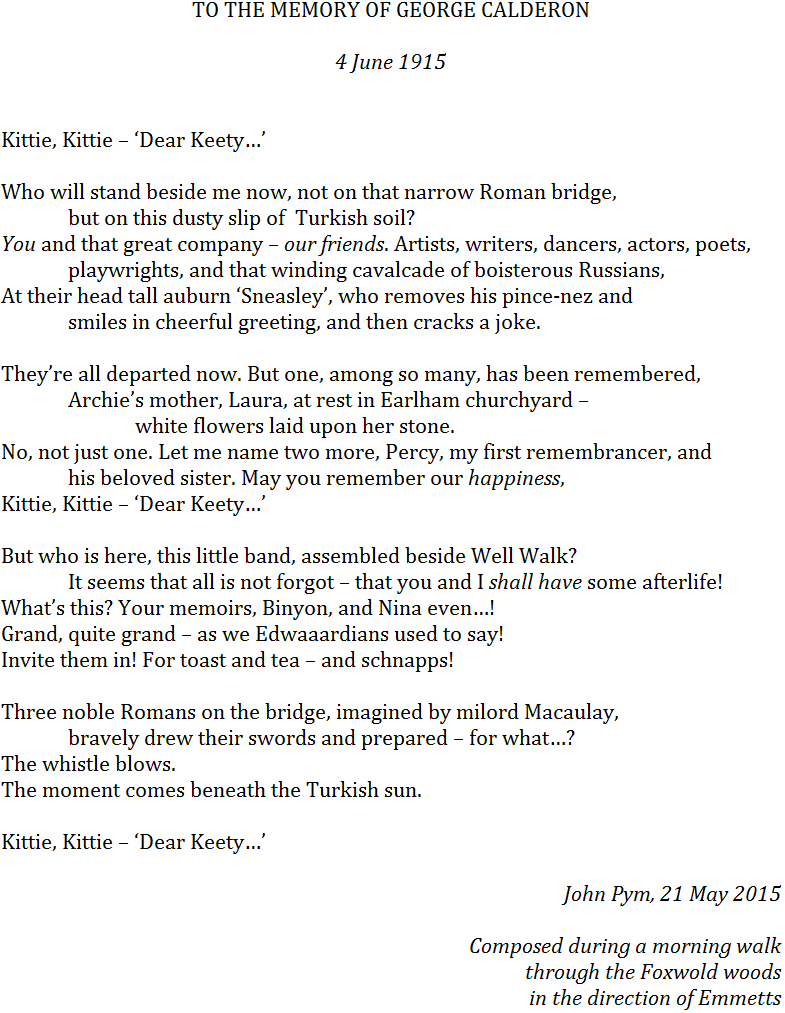
I was moved by John Pym’s poem ‘To the Memory of George Calderon’, which I posted yesterday, and I imagine followers were too. In a sense, Mr Pym has known George Calderon longer than I have. He heard about him and Kittie from his own grandfather, Evey Pym, who features from day one of this blog, and the Calderons’ spirits, so to speak, still hung in the air when Mr Pym’s father Jack, his uncle Roly, and aunt Elizabeth (George’s god-daughter), lived at or visited Foxwold as adults. Mr Pym is also, of course, familiar with the literature about George, starting with his great-uncle Percy Lubbock’s 1921 Sketch from Memory. Thus, although John Hussey (Finding Margaret: The Elusive Margaret Bernardine Hall, 2011) can speak of George’s ‘legendary sangfroid’, I know that George’s emotional openness in Mr Pym’s poem is based on both knowledge and understanding of the man, and personally I find it convincing.

John Pym’s poem is a marvellous example of empathy; an empathetic act doubtless facilitated by the spirit of the place in which it was composed.

But it is not all empathy. The quotes around ‘Dear Keety’ indicate that although these two words are George’s in origin, they are being uttered by the author; the author, Mr Pym, is (barely perceptibly) intruding himself here. The refrain is in a double voice. George’s words ‘Kittie, Kittie’ have George’s sangfroid, Mr Pym’s ‘Dear Keety’ have a catch in them. And I venture to suggest that they produce that catch of emotion in the reader too.

It’s this ‘catch of emotion’ that all of us, surely, have experienced again and again since the commemoration of World War I began last year. The ‘re-lived’ emotion of the Declaration of War on 4 August gripped the nation. Millions felt the desire to put burning candles on their windowsills and snuff them out at midnight in commemoration of Sir Edward Grey’s famous words. Thousands upon thousands visited the sea of poppies at the Tower, and as far as I know every single flower was bought afterwards. A large photograph of the installation, with a sober caption, appeared in the German newspaper Die Zeit.

Above all, though, the commemoration of World War I, and this blog, produce catches of emotion that we cannot hold. We know too well those moments of shading the eyes, turning away, spluttering, weeping, sobbing. On 4 August I was overwhelmed by the tragic solemnity of the moment and, frankly, by the challenges of the journey ahead on the blog. In October, when Calderon was at Ypres, I was walking through Cambridge when I just thought of George and Kittie’s situation, penetrated it more empathetically I suppose, and burst into tears muttering their names. Followers have told me of similar moments, for instance 10 November 1914 when George was in hospital, learned of the death of his commanding officer, and himself ‘downright cried’, which Kittie said was ‘so unlike him’; and especially up to, on, and immediately after 4 June 1915. At our own commemoration in Hampstead on 4 June there were moments of ‘catch’ in all the readings, even though by then we had read the texts to ourselves several times.

*                    *                    *

I think it will be quickest to present the conversation we have had about these issues by resolving it into the key questions it has raised:

What triggers such intense emotions in us about the War or George and Kittie’s story? What are these actually emotions of? Is it a form of grief or bereavement? Have we as a nation suddenly become emotionally more ‘vulnerable’, indeed tearful, indeed maudlin? How often can one experience these emotions about the war dead before our feeling loses authenticity? Have we come to enjoy being moved in this way? Have we become addicted to it? Is there anything wrong about that? Is there any harm or danger in it? Can we sustain this emotional response to the War another four years? Will we expect ‘closure’ on our re-living and commemoration of this war? Do the British as a nation need ‘closure’ now on World War I? 

I cannot answer all these questions, but I shall attempt to allude to them all.

*                    *                    *

As Santanu Das’s book Touch and Intimacy in First World War Literature (2005) examines so admirably, the terrible, Apocalyptic worlds of the Western Front and Gallipoli were themselves almost unbearably ‘touchy and feely’. I suggest that we all ‘know’ this, by which I mean we have already ingested deep into our psyches not only the images of mud, corpses and no man’s land, but this context of human intimacy in extremis.

Perhaps this is why it is so often small, even trivial, personal details that can trigger in us such unwithstandable emotion. Archivists work in archives with papers covered in words, but as Das himself says, the stains of trench mud on a letter and ‘a bunch of blue and white flowers, the dried stalks still green pressed onto the letter’ — the ‘material tokens of memory’ — are almost too ‘intimate and unsettling’. The fact that ten-year-old Lesbia Corbet had already tried on her bridesmaid’s dress for her brother Jim’s wedding when he was killed at Givenchy (see my posts of 15 and 17 April) is of a similar order; or George’s arachnophobia as shells are flying overhead at Gallipoli. The Commonwealth War Graves Commission is currently tweeting inscriptions on gravestones: ‘I’m all right mother cheerio’ is a fair example of how overwhelming their brevity and authenticity can be.

These small things instantly transport us to the reality of the person and his/her predicament linked to the War; simultaneously they access all we know and feel about the tragedy of World War I; and it is often far too much to bear. I think initially, as one holds the letter with the pressed flowers, say, or reads the living inscription, one’s feelings are akin to grief and bereavement, because one momentarily feels one knows that person. But one also knows they were killed next day, or their women’s and families’ lives destroyed, and those are the ‘impossible’ facts that can engulf one. In a word, I think that what commemoration in 2015 does, whether in the form of a service, or heart-rending biographies of the fallen, or the reading of war poetry, or the viewing of personal items in glass cases at an exhibition, is make us re-experience to the full the pity of war.

Where the blog is concerned, I think it is also the pity of George and Kittie’s lives that followers, and I, sometimes find too much. There is no space here to define or analyse this ‘pity’, or what Wilfred Owen meant by ‘the pity of war’, but I do not think that is necessary.

*                    *                    *

I happen to believe it is our own empathy that enables us to be so moved by these small items or details, or aspects of commemoration, and I believe that there has been an enormous increase in the recognition, understanding and cultivation of empathy in Britain in the last thirty years or so. Europeans and North Americans remark on it. We increasingly believe that ‘feeling into’ a person’s situation is vital to our emotional understanding of them and to our own ’emotional intelligence’ (a phrase, incidentally, that George was one of the first to use in print, in 1911). Surely this is a good thing?

Kierkegaard wrote: ‘The majority of men are subjective towards themselves and objective towards all others, terribly objective at times — but the real task is in fact to be objective towards oneself and subjective towards all others.’ That is true empathy. But obviously, if our empathy is restricted to ‘putting ourselves in other people’s shoes’ and feeling and thinking what we would experience in those shoes, it risks being about ourselves rather than others. The possibility is always there that our pity is merely a rush of self-pity.

*                    *                    *

We certainly have become more ‘tearful’ as a nation, but I think one reason is that society has become theatricalised almost to saturation. Crimes, disasters, public inquiries, very recent political history, are instantly translated to the television screen, the computer screen, film or the stage. Bizarrely — to older generations — an historical event like Waterloo is no longer just commemorated, it has to be ‘enacted’ (not ‘re-enacted’), and the media even talk of ‘Napoleon’ or ‘Wellington’ when they mean the actors impersonating them. We are invited by the media to respond to real events as theatrical performances. Above all, we are an instantly self-imaging society. We are therefore more used than ever to responding to a third term: the imaged, quasi-dramatic representation of people and events, rather than the individuals and the events themselves. Within hours of a disaster anywhere in the world, we can watch ‘footage’ of it and emote about it. In May 1915 Britons had a newspaper with one archive photograph of the Lusitania on its front page.

If the paradigm of our twenty-first-century empathy is theatre, can we learn anything from the experience and tradition of audience empathy in the real theatre?

Possibly. I have said already that I think our powers of genuine empathy access the ‘tragedy’ of the War, and if by that we mean something complexly, unbearably ineluctable, then those feelings are akin to the fear and pity of the greatest tragic plays.

In that context, Aristotle’s concept of ‘catharsis’ might look applicable. Unfortunately, theatrical catharsis is most commonly thought of as ‘purifying’, ‘purging’, getting rid of the strongest emotions we are capable of through empathy in the theatre. It is true, I believe, that the notion of bowel evacuation or surgical bleeding is present in Aristotle’s original concept. But how can this help us in coming to terms with the tragedy of the fallen in World War I? It seems too much as though it is designed to produce anaesthesia; a ‘closure’ and ‘return to equanimity’ indistinguishable, perhaps, from indifference.

In truth I don’t believe theatrical catharsis is about an audience getting rid of visceral emotions, it is about these emotions enabling us to face what we are seeing on the stage and know exists in real life. In this sense, there can be comic as well as tragic catharsis. I believe a fragment of Mikhail Bakhtin’s expresses theatrical catharsis more accurately: ‘Tragedy and laughter look being in the eyes equally fearlessly, they do not construct any illusions, they are sober and exacting.’ Nadezhda Mandel’shtam also made a vital distinction, when she said that ‘genuine tragedy is rooted in an understanding of the nature of evil, and only that tragedy can bring us catharsis’.  If our empathetic response to the commemoration and ‘material tokens of memory’ of World War I helps us to look being and evil in the eyes fearlessly, to dispense with all illusion about this human tragedy, then perhaps catharsis is the right word for what we are going through in these four years.

*                    *                    *

It is interesting that psychologists use the word ‘catharsis’ in the sense of ‘the purging of the effects [my italics] of pent-up emotion and repressed thoughts, by bringing them to the surface of consciousness’ (Chambers). On ‘the surface of consciousness’, presumably, they are more likely to be cognitively, intellectually, rationally understood — and their sources faced. I therefore think that the identity with theatrical catharsis, if we accept Bakhtin’s and Nadezhda Mandel’shtam’s descriptions of it, may hold.

The point is, empathy is not an end in itself. I have always felt that the limits of empathy must be understanding. You ‘feel in’, you must attempt to be fully ‘subjective’ to others, but this is the beginning of a process. The process should be towards understanding, indeed ‘knowing’ — not knowing in a closed-off sense, but a rational knowing that is momentarily at rest and secure, that ‘looks being in the eyes fearlessly’, perhaps. It is a process that should lead to knowledge and intelligent action.

Are there people who are capable of great empathy but refuse to reach beyond it? I would say that the personal life of the late Princess of Wales, who is often credited with our ‘discovery’ of empathy as a nation, suggests there are. I have also had colleagues with superb powers of emotional understanding, but who felt no need to use them to help students actually solve their problems.

*                    *                    *

If the effect of an empathetic response is true cathartic understanding, I see no reason why there is anything wrong, harmful or dangerous about repeating the experience. We do not suggest that seeing one Agamemnon or King Lear is enough. All the time we have an authentic empathetic response to the ‘tokens of memory’ of the War, we are learning. I see no reason why we cannot sustain our emotional response to it for four years if that emotional response is always pure, ‘exacting’, committed to cathartic understanding, and does not degenerate into self-indulgence. I admit that empathy can be exhausting, but our gains in understanding of the tragedy that was the War can be immense.

The Sirens of sentiment, though, lie always in wait. The concept of ‘tragic pleasure’ has always been a dubious one, and we all know how easy it is to fall into enjoying strong feelings. The more they are repeated, the greater the temptation to become addicted to them. Again, I think the blanket theatricalisation of our lives encourages that: we are asked to respond physically to all the media spectacles around us and we end up always crying, or always demonstratively sweeping the (sometimes non-existent) tears from the corners of our eyes like, well, bad tragedians.

*                    *                    *

In fine, the conversation is about authentic empathy and its surrogate, sentiment. We associate sentimentality more with the Victorians than the Edwardians, so Laurence Binyon’s words to Kittie about his memorial ode to George (see my post of 25 June) are all the more interesting. Here is the author of the most quoted and, many would say, most emotionally churning poem to come out of the First World War, drawing back from emotionality because of what George was: ‘I wanted to be as exact as I could, and the thought of him cannot be anything but tonic, an astringent to sentiment.’ It is a salutary reminder, a warning against the pleasurable emotional response to the Last Post or ‘For the Fallen’; an astringent from George Calderon himself.

*                    *                    *

‘Closure’ has been defined as ‘the evolution of emotions to make them more stable and bearable’ and, less positively, as ‘a feeling of satisfaction or resignation when a particular episode has come to an end’ (Chambers).

It would be interesting indeed to hear the response of ‘professional’ psychologists, psychotherapists and bereavement counsellors to the conversation about this subject that we Calderonians and blog followers have had over the last year and which I have endeavoured to display above. However, I believe that we all have a right as ‘amateur’ psychologists yet full-time human beings, to present our take on it.

I have to say that I meet very few people in the theatre who believe in ‘closure’. This is probably because their life’s work is with empathy, emotions, and the expression of them. They rely on their emotional memory being open and accessible. They cannot just ‘close off’ those sources of their lives as actors or directors. It would be self-destructive. It would be to deny the existence, the goodness, of those sources.

Similarly, I feel that the tragedy of the First World War, for nations and for individuals, is so immense and so important to us that we should never seek ’emotional closure’ on it, just as a German president has said that for his nation there can never be ‘moral closure’. We always need our empathetic response to the fallen, and to the survivors, in order to relate to them fully as human beings. To remember them emotionally is the most human form of memory. We need to do this forever, in order to understand the lessons of this War and, I believe, to keep renewing ourselves as a nation.

I am especially grateful to Clare Hopkins, Archivist of Trinity College, Oxford, for her extended contributions over the past year to the conversation about Commemoration. (Click here for a comment by Clare with her thoughts on the subject.)

Next entry: Letter from Alexandria
Posted in Modern parallels, Personal commentary | Tagged , , , , , , , , , , , , , , , , , , , , , , , , , , , , , , , | 1 Comment

Commemoration (to be concluded)

To the Memory of George Calderon

© Poem, John Pym 2015

Mr Pym, who is the grandson of Violet and Evey Pym, of Foxwold, two of the Calderons’ closest friends, sent me this poem a fortnight before the anniversary of George Calderon’s death. He was not able to take part in the Commemoration itself at Hampstead on 4 June. Emmetts, the garden of which is now a National Trust property, was the home of Violet’s parents, Frederic and Catherine Lubbock, and is within walking distance of Foxwold.

The poem is voiced for George, but the refrain may be taken to be in a dual voice: ‘Kittie, Kittie’ is George speaking, but ‘Dear Keety’ is the author quoting George’s ‘Russianised’ version used, for instance, in his letter of 10 May 1915 as he left Devonport for Gallipoli (‘Good night and goodbye, dear Keety; your loving old spouse P.’).

‘that narrow bridge’: see Macaulay’s poem How Horatius Kept the Bridge. George Calderon was a classical scholar.

‘Sneasley’: Anton Chekhov, whose surname is derived from the Russian for sneeze.

‘Archie’s mother, Laura’: Archie Ripley (1866-98) was Kittie Calderon’s first husband; his mother Laura Ripley (Gurney by her first marriage) was a grandmother of Percy Lubbock and is John Pym’s great-great-grandmother. Flowers were laid on the Ripley family grave at Earlham in an act of remembrance on 2 May 2015.

‘Percy, my first remembrancer’ is Percy Lubbock, author of George Calderon: A Sketch from Memory (1921); ‘his beloved sister’ is Violet Pym.

‘Edwaaardians’: an older generation pronounced the ‘ward’ syllable to rhyme with ‘card’.

‘The whistle blows’: to go over the top.

Next entry: Commemoration (concluded)

Posted in Edwardian character, Edwardian English, Edwardian marriage, Heroism and Adventure, Modern parallels, Personal commentary | Tagged , , , , , , , , , , , , , , , , , , , , , , , , , | Leave a comment

Gallipoli: planning a disaster

The Third Battle of Krithia, in which George Calderon was killed on 4 June, may have been the bloodiest single battle fought by the Mediterranean Expeditionary Force at Gallipoli, i.e. in terms of its own losses. Enemy losses, both in the Allied attacks and Turkish counterattacks, were even greater. The British and French troops were exhausted, and ‘by the middle of June […] there was scarcely a man on the peninsula who was not a victim to the prevailing epidemic of dysenteric diarrhoea’ (Official History).

So where was the campaign to go now?

Ian Hamilton had decided this before 4 June: when he received the reinforcements he had requested, he would attempt to break out from Anzac across the narrowest part of the southern peninsula, capture Maidos and Kilid Bahr, and cut off the Turks’ southern communications. In absolute secrecy, General Birdwood had presented a scheme for the attack to Hamilton on 30 May. Four days after the Third Battle of Krithia, Hamilton received a cable from Kitchener saying that he was sending out three new divisions. These, of course, might take up to five weeks to arrive, but they were enough for Hamilton’s staff to start planning in detail what they hoped would be the ‘decisive blow’ of the campaign. In the last week of June, Kitchener even offered Hamilton two more divisions, which he accepted. The new government was hoping for a spectacular success.

Meanwhile, it was decided that the pressure must be maintained on the Turks at all costs. This time the attacks would be concentrated on the two flanks where they had failed on 4 June, and the biggest concentration of howitzers possible would be used before the infantry went in. On 21 June the French attempted to take the deadly Turkish fortifications on the crest of Kereves Spur, but captured only Haricot Redoubt. On 28 June the British tried the same tactics along Gully Spur and Gully Ravine. George’s old regiment, the 1st King’s Own Scottish Borderers, had been reattached to the 87th Brigade after 4 June, moved to the left of the line, and took part in these engagements. The Turks sustained huge losses in their counterattacks and feared the complete collapse of their right flank. But the British VIII Corps simply did not have enough howitzers at its disposal; as a result, in the very sector of Fir Tree Spur where George had fallen on 4 June the 156th Brigade (Royal Scots and Scottish Rifles) were massacred. Today, 30 June 1915, the French were able to take advantage of the Turks’ disarray on the British front to capture the rest of the Kereves Spur fortress (the ‘Quadrilateral’).

The new ‘bite and hold’ tactics looked to have been successful. But, yet again, they had come at a terrible cost to the attackers. The French had given their all but were under constant bombardment from the Asiatic shore. In Peter Hart’s words, ‘They would do little more for the rest of the campaign than hold their line’. The 156th Brigade were part of the 52nd (Lowland) Division that had started arriving two days after George’s death; Hamilton’s first reinforcement division, then, was already depleted. Moreover, knowing that the real thrust was to come at Anzac/Suvla, at least one member of the British higher command regarded all these attacks as ‘cruel and wasteful’.

It seems that Hamilton had resigned himself to a ‘no-win’ situation at Helles. Everything, therefore, now depended on the planning and execution of the ‘decisive blow’ to be launched from the north in August. If that failed, the disaster would be complete.

Next entry: Commemoration (to be concluded)

Posted in Edwardian character, Personal commentary | Tagged , , , , , , , , , , , , , , , , , , , , , , , | Leave a comment

Another Calderon signs up

At Edmonton, Alberta, on this day in 1915, George’s eldest brother, the architect Alfred Merigon Calderon (q.v.), applied to join the Canadian Overseas Expeditionary Force — as their youngest brother, Frederick Elwyn, had on 23 September 1914. It is not clear whether Fred (q.v.) was by now on the Western Front, or whether he was still a reservist in Britain and staying with his mother Clara in London on weekend leave. Had Fred, or Clara, telegrammed Alfred to tell him that George was ‘wounded’? Had this affected in any way his decision to sign up for active service?

A M Calderon's Enlistment Papers

Alfred Merigon Calderon’s application for active service

In fact, before they emigrated to Canada both Frederick and Alfred Calderon appear to have served many years in the Middlesex Rifles as cadets and by 1915 Alfred had been a commissioned officer with the 66th Canadian Battalion for about a decade.

There was a considerable difference in their ages, however: in 1915 Fred was 41 and Alfred Merigon 54… In other words, in the Attestation above Alfred had falsified his age by ten years! This is not the only interesting thing about the above form. It looks as though he completed it using a typewriter. In answer to the question ‘What is your religion?’ he had typed ‘Yes’, but had to correct it longhand to ‘Church of England’. Perhaps he was influenced here by his father’s flippant attitude to religion: in the 1881 census Philip Hermogenes Calderon, who was well known for his theatrical impersonations, had prefixed his name with ‘Bishop’.

Alfred Calderon fought on the Western Front for three years with the 1st Battalion, Edmonton Regiment, and seems to have returned to Canada in 1919 with a distinguished service medal and the rank of Captain.

Fred Calderon, who had visited George in hospital in London in November 1914, and to whom George was particularly close (see my post of 1 November 2014), was killed by a sniper at Ypres on 3 April 1916 and is buried at Zillebeke (q.v.), not more than a couple of miles from where George was wounded on 29 October 1914.

Both Alfred and Fred can be seen on the family photograph illustrating my post of 27 September 2014.

Next entry: Gallipoli: planning a disaster

Posted in Uncategorized | Tagged , , , , , , , , , , , , , , | Leave a comment

…then three come along at once

When I started my deeper research for this biography in 2010, one of the things I did was trawl the Web for manuscripts of George’s that were up for sale. I found only one item, which we bought for the archive. (It was two unpublished letters from George to the editor of the Cambridge Magazine in 1912 following his tumultuous public appearance in Cambridge during the Coal Strike and the tour of his play The Fountain.)

I have regularly searched the Web since, but never found anything. Then, as readers of the blog will know, in March the truly amazing Katy George in Kent found a letter of Kittie’s amongst some items in a charity shop (see Katy’s Comment of 15 March and my post of 23 March). As if that were not enough, at the end of May Katy spotted a copy of George’s 1904 Dwala for sale through Abebooks, inscribed by Kittie and with a letter from her preserved inside it! It arrived from Tasmania only six days later. The book itself is very rare, and turned out to be a gift from Kittie to Frederick O’Brien, an American writer on the South Seas who had sent her two copies of his long, laudatory article on George’s Tahiti in the New York Times Book Review of 5 March 1922. She wrote to thank him for this.

Finally, a fortnight ago, my blogmaster came across this item for sale on a website for theatrical memorabilia:

Christmas 1901 Cartoon

Click image to enlarge.

It is inscribed by Kittie on the back in pencil: A Christmas card drawn by G.C. to try and persuade my mother to come down to Christmas dinner — our first Christmas at Heathland Lodge 1901 Hampstead.

The dog greeting Mrs Hamilton on the red carpet is Jones (see the photograph of Kittie in the Calderonia biographies). The three minions on the left are carrying bowls of punch. The man with large raised right arm and left hand holding a giant glass is George, the woman with an exaggerated bun of hair is Kittie, and the short figure between them is perhaps George’s mother Clara. The couplet bottom right reads:

NONE BUT THE BRAVE DESERVE THE FARE:
BE BRAVE TODAY: COME DOWN THE STAIR.

Mary Hamilton and Kittie

Left: Mary Hamilton in 1891; Right: her daughter Kittie, c. 1910

This cartoon strikes me as one of the funniest George ever drew. Lest anyone think, in the aggrieved manner of 2015, that it is meant to be unkind or satirical, let me assure them at once that it is not. It is genuinely intended as an act of caring and humorous persuasion. Mrs Hamilton (1825-1906) got on extremely well with George, once her daughter was married to him and he had a job. He was the favoured person for lifting her in bed and making her laugh. Her health was very bad for the last five years of her life, and unfortunately she died whilst George was on his way back from Tahiti.

My guess is that this cartoon did persuade Mrs Hamilton to come downstairs for Kittie and George’s first Christmas dinner in their new home — and I’ll never complain about the Internet again!

Next entry: Another Calderon signs up

Posted in Edwardian literature, Edwardian marriage, Personal commentary | Tagged , , , , , , , , , , , | Leave a comment