
This nineteenth-century engraving of Florizel and Perdita does indeed make them look — to use Lady Chatterley/Connie’s dismissive phrase about the Elizabethans — somewhat ‘upholstered’.
In all the excitement — which has never quite subsided — about the sexual explicitness of Lady Chatterley’s Lover, it has often been overlooked that it is a very literary novel: a product deeply implicated in the high culture it makes a point of traducing. (And the fact that the narrative visits Berlin, London, Paris and Venice makes it almost as cosmopolitan as Eliot’s The Waste Land, published six years previously.) One aspect of this literariness is not even paradoxical, when we realize that Lawrence systematically uses modern culture — especially in its literary aspect — as a sounding-board against which to play out the (re)discovery of sexual reality and fulfilment by Connie and Mellors in the wood. Sir Clifford himself writes commercially successful short stories; Connie’s first lover at Wragby, Michaelis, is a well-received playwright; and conversation among the guests is inevitably intellectual. Lawrence’s narrator even uses other novelists as a kind of shorthand: Mrs Bolton’s conversation is described at one point as being ‘more than gossip. It was Mrs Gaskell and George Eliot and Miss Mitford all rolled in one, with a great deal more, that these women left out’ (third version of the novel, edited by Michael Squires, Penguin Classics, 1994, p. 100).
It is the first sign of her liberation from this world that Connie starts to react against what she sees as the deadness of this culture, which has atrophied language: words themselves.
Connie went slowly home to Wragby. ‘Home!’ it was a warm word to use for that great weary warren. But then it was a word that had had its day. It was, somehow, cancelled. All the great words, it seemed to Connie, were cancelled for her generation: love, joy, happiness, home, mother, father, husband, all these great dynamic words were half-dead now, and dying from day to day […] As for sex, the last of the great words, it was just a cocktail term for an excitement that bucked you up for a while, then left you more raggy than ever. (62)
Part of this logic makes gamekeeper Mellors, though perfectly able to speak in the educated language of the time, prefer to use dialect with her; especially in their most intimate moments. And so the symbolic scheme seems to be simple: Wragby = writing, high culture = degeneracy, death; the woodland = nature, spontaneity, in the service of life itself.
But closer reading proves that the system as it works in the novel is not simple at all. The cultural alignment turns out to be far more interesting, far more complex and contradictory. What we have to conclude is that Lawrence the practised writer and passionate apologist manages to have his cake and eat it. It is thanks to Shakespeare, and especially The Winter’s Tale, that the woodland — backdrop to sexual fulfilment — enjoys a win-win situation, as the best of culture comes to the aid of the best of nature, in a convenient realignment.
In chapter 8 of the novel the wood first comes alive for Lady Chatterley, or she herself becomes alive: ‘Connie was strangely excited in the wood, and the colour flew in her cheeks and burned blue in her eyes’ (86). Interestingly, she first has to evade — as it were, to sidestep — two literary quotations, negative contradicting impressions from both Milton and Swinburne (85). But then more positive Biblical references take over (‘Ye must be born again — I believe in the resurrection of the body!’) before Lawrence offers this reassuring summary: ‘In the wind of March, endless phrases swept through her consciousness’ (85). Words are already playing a double game, some shutting out and others leading on. Connie is entranced by the ‘first violets’ in the wood and the daffodils, ‘so bright and alive […] So strong in their frailty’, and she enthuses to Clifford about these on her return to the house, ‘to Wragby and its walls’ (86); walls also made of words, as we have previously seen.

She goes to the wood again next day, and it is on this occasion that she follows the narrow track leading to the clearing and the gamekeeper’s hut, where she meets and talks briefly to a surprised and slightly resentful Mellors (87-90). Another conversation with Clifford ensues, in which as she is putting the violets she has gathered into a vase he exclaims: ‘Sweeter than the lids of Juno’s eyes.’

Connie reacts negatively to this: ‘I don’t see a bit of connection, with the actual violets’ (91), also showing that she knows her Shakespeare: ‘The Elizabethans are rather upholstered’ (91). Next day, when Clifford himself ventures with her into the wood in his bath-chair, there is another negative reaction to verbal culture when as she gives him some wood-anemones she has picked, he quotes Keats (from the ‘Ode on a Grecian Urn’), ‘Thou still unravished bride of quietness’.
She was angry with him, turning everything into words. Violets were Juno’s eyelids and windflowers were unravished brides. How she hated words, always coming between her and life! (93)
The following day, on her third visit to the wood, she sits at the hut and inwardly rejects the word ‘ravished’ and all the ideas it stands for. ‘Ravished! How ravished one could be without being touched! Ravished by dead words become obscene, and dead ideas become obsessions’ (94). This before an edgy conversation with Mellors, who comes upon her there, which sends her home at the end of the chapter ‘in a confusion, not knowing what she thought or felt’ (96).

Here one must pause to point out that of course Lawrence knew his Shakespeare too, and had remembered Perdita’s celebrated speech to Florizel in Act IV, scene iv of The Winter’s Tale; remembered it at the roots of him, rather like the poems that are ‘woven into a man’s consciousness,’ and ‘which after all give the ultimate shape to one’s life’ (‘Hymns in a Man’s Life’, Phoenix II edited by Warren Roberts and Harry T. Moore, London, Heinemann, 1968, p. 597). If we turn back to this speech ourselves, we will recognize that something interesting has been happening in this eighth chapter of Lawrence’s own pastoral romance. Perdita addresses Florizel and the young girls:
Now, my fair’st friend,
I would I had some flowers o’th’spring that might
Become your time of day; and yours and yours,
That wear upon your virgin branches yet
Your maidenheads growing: O Proserpina,
For the flowers now, that frighted thou let’st fall
From Dis’s waggon! Daffodils,
That come before the swallow dares, and take
The winds of March with beauty; violets, (dim,
But sweeter than the lids of Juno’s eyes
Or Cytherea’s breath); pale primroses,
That die unmarried, ere they can behold
Bright Phoebus in his strength […] (lines 112-24).
Proserpina (as Persephone), the winds of March, the daffodils, the violets, the pale primroses, the breath of Cytherea (Aphrodite): all of these are reproduced within one page at the start of this chapter, where Lawrence is working to establish Connie’s intimacy with the wood and all it represents. What we can observe here, then, is the intriguing example of Lawrence rejecting the cultural with one hand — Clifford’s ill-judged quotation from Shakespeare — and embracing it with the other, in the author’s probably unconscious use of the very same passage to convey Connie’s palpably physical experience of the wood. The ‘endless phrases’ that ‘sweep through her consciousness’ in ‘the winds of March’ are as much a part of that experience as the sense impressions themselves — and the only way that Lawrence can convey these to us. In effect, Perdita’s speech acts as a kind of spell, an incantation, to allow Connie’s entry to the wood.

One could even argue that this passage permeates the novel more extensively. The first paragraph of chapter 12 (165) repeats the incantation, when Connie goes to the wood hoping to meet Mellors. ‘It was really a lovely day, the first dandelions making suns, the first daisies so white’; hazel catkins and crowds of yellow celandines greet her, with ‘the triumphant powerful yellow of early summer’. Then we have this sentence: ‘And primroses were broad and full of pale abandon, thick-clustered primroses no longer shy.’ Lawrence’s idea here can only be understood as in dialogue with Perdita’s ‘pale primroses, / That die unmarried’, to emphasize by contrast Connie’s own imminent ecstatic coupling with ‘Bright Phoebus in his strength’. This spell-like, motif-laden paragraph also contains the image ‘The lush dark green of hyacinths [bluebell leaves] was a sea’, which anticipates the powerful sea imagery used a few pages later to describe Connie’s full orgasmic experience (‘it seemed she was like a sea, nothing but dark waves rising and heaving’ (174)), and it is impossible not to relate this motif, again, to the same passage in the play, when Florizel replies to Perdita ‘when you do dance, I wish you / A wave o’th’sea’ (ll. 140-1). The sea returns a third time — like the tide — in the sentence that ends the chapter: ‘As she ran home in the twilight the world seemed a dream; the trees in the park seemed bulging and surging at anchor on a tide, and the heave of the slope to the house was alive’ (178).
We may conclude that the passage from The Winter’s Tale is used by Lawrence in contradictory ways, like a Janus face. At one level in direct quotation, to let Connie make a negative statement about language and culture; but at another more pervasive level it filters back to the water-table of Lawrence’s verbal imagination to inform and generate his own profoundly felt formulations. We can identify two contrary currents, poetic invocation running under rhetorical positioning.
More generally, one needs hardly to be reminded of the extended passage in chapter 15 where Connie and Mellors decorate each other’s pubic hair with flowers (pp. 220-229) to realize that flower imagery is central to the novel: with the creative fragility of the flower, like sexual life itself, perceived in contrast to the death-dealing mechanization all around. Here, the ground-note is sounded by the moving image from Shakespeare’s sonnet 65: ‘How with this rage shall beauty find a plea, / Whose action is no stronger than a flower?’ And is it too fanciful to suggest that the concluding couplet (‘O none, unless this miracle have might, / That in black ink my love may still shine bright’) could have prompted the image that concludes the novel, when Mellors writes to Connie that if he ‘could sleep with my arm round you, the ink could stay in the bottle’ (301)? Though admittedly the ink has a different function in each case.

Top row, left to right: wood forget-me-not, columbine. Bottom row, left to right: red campion, creeping jenny. The lovers wind them and other wild flowers onto each other’s bodies.
What we have in this novel is the most substantial and developed instance of a paradox we find underlying much of Lawrence’s work, which reacts against mental activity on behalf of the body — but in a medium which is inevitably the finest product of the mind. Consider the poem ‘Snake’, where Lawrence repents in one line for his action in throwing a log at the snake — ‘I despised myself and the voices of my accursed human education’ — and makes the gesture as of a deference to nature in the next: ‘I thought of the albatross’ (Poems, edited by Keith Sagar, Harmondsworth, Penguin, 1986, p. 137). But of course the albatross is Coleridge’s albatross, is Baudelaire’s albatross; is a cultivated bird no less than Keats’s nightingale, one of Audubon’s famous prints, or even Yeats’s bird of changeless metal from ‘Byzantium’.
I am not suggesting that the wood in Lady Chatterley’s Lover isn’t a wood, any more than the Forest of Arden isn’t a forest. It is (they are), with all the reality that may be conferred by verbal representation. But we have to acknowledge that it is a magic wood; and part of the magic is, that it also provides a roof-top protest on the prison-house of language.
© Damian Grant, 2021


SOME RESPONSES TO GEORGE CALDERON: EDWARDIAN GENIUS
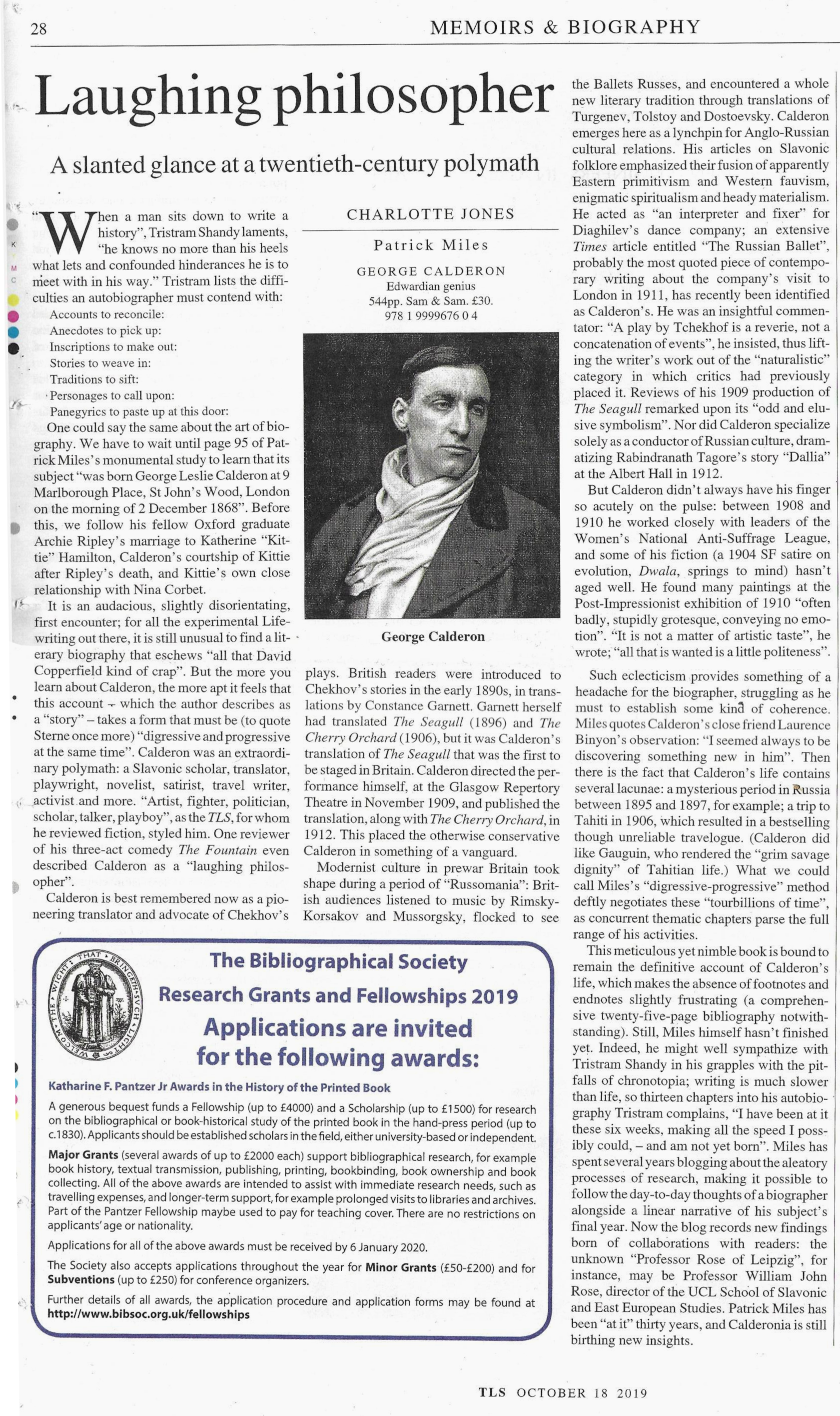
‘This meticulous yet nimble book is bound to remain the definitive account of Calderon’s life’ Charlotte Jones, The Times Literary Supplement
‘The effort of detection, it must be said, was worth it. The biography is a delight to read.’ Emeritus Professor Laurence Brockliss, The London Magazine
‘It is a masterly synthesis of your own approach with scholarship and very judicious discussion of the evidence.’ Emeritus Professor Catherine Andreyev, historian
‘This comprehensive, meticulously researched and highly readable biography, which the author describes as a “story” rather than an academic biography…’ Michael Pursglove, East-West Review
‘A monumental scholarly masterpiece that gives real insight into how the Edwardians viewed the world.’Arch Tait, Translator of Natalya Rzhevskaya’s Memoirs of a Wartime Interpreter
‘The book is written with great assurance and the reader always feels in safe hands. I liked the idea of it being a story and I read it the same way I would read a novel.’ Harvey Pitcher, writer
‘Presents the Edwardian age, and Calderon in particular, as new and forward-looking.’ Emeritus Professor Michael Alexander, in Trinity College, Oxford, Report 2017-18
A review by DAMIAN GRANT appears in the comments to Calderonia’s 7 September post.
A review by JOHN DEWEY appears on Amazon UK.



From the diary of a writer-publisher: 16
17 November 2021
Today at 9.54 a.m. I emailed my 408-line poem Making Icons to the excellent Long Poem Magazine, the only organ in Britain that publishes poems at least 75 lines long. The magazine appears twice a year and November is the submission window for the Spring issue. After taking twelve years to write the poem, I suppose I should not be surprised that I spent almost a week getting it into the exact format needed for submission, with a short preamble and detailed notes, and that the whole process was rather emotional.
Frankly, I don’t expect them to take it, as it’s too ‘forthright’ for the younger modern taste. In consideration of that, I suggested that the words ‘tear off your Tar-Baby’ in stanza 4, line 11, could be replaced by ‘tear through your thornbush’ (I trust the reason is clear). I found the required preamble (113 words) took almost as much effort to write as a stanza of the poem, and thought it wise to begin with: ‘This is not a religious poem.’
26 November
The ‘late’ chrysanths in the garden are coming to an end, to be replaced next month by Christmas-flowering ones, but there are still enough to help fill a vase…
The spotted laurel leaves come from a seven-foot high bush that I grew from a cutting I was given in 1970 by the warden of Chekhov’s house in Yalta from a laurel planted in the garden by the great man himself.
3 December
I am reading the third set of proofs of my Anton Chekhov: A Short Life, which Sam&Sam are publishing at the end of next month. As I read, I stop to check facts for which I can’t remember the source off the top of my head (I wrote the first edition, published by Hesperus Press, in 2007). I’m glad to say there aren’t many such, but this afternoon I had to verify my statement in chapter 11, ‘Chekhov, Anti-Semitism, and Democracy’, that ‘It was probably between 1897 and 1899 that the so-called Protocols of the Elders of Zion were fabricated in France by the Tsarist secret police, with incalculable consequences for Russian and European Jews in the twentieth century’. I knew that there is a recent school of thought that the Russian secret police (Okhranka) was not involved in the fabrication. However, after consulting Sam1’s Russian translation of Norman Cohn’s Warrant for Genocide: The Myth of the Jewish World-Conspiracy and the Protocols of the Elders of Zion (Scholars Press, 1981) I concluded as before that the Okhranka was.
On page 117 my eye was caught by Hitler’s statement (1924) that ‘Jesus was not, of course, a Jew, but an Aryan’. A bell rang. At the Third International Congress for the History of Religions, held at Oxford in September 1908, a German professor read a ‘sensational’ paper ‘The Ethnology of Galilee; or, Was Jesus a Jew by race?’. Clearly, in restrospect this was part of the campaign of anti-semitism that gathered head across Europe following the Dreyfus Affair and helped make Nazism possible. For some reason, I felt a flush of ‘pride’ in George Calderon, when I recalled that he stood up after the German paper and according to the Manchester Guardian stated that ‘there was no Aryan race, and Jesus was undoubtedly a Jew by religion and nationality’.
15 December
Today calls for a double celebration! Jim (Sam2) brilliantly completes my series of posts on Japan — from the point of view of someone who has actually lived there — and we have met our deadline of submitting the text and cover of Anton Chekhov: A Short Life to Amazon. We might receive the first proof from Amazon by Christmas, but I doubt it. It won’t matter, because there should still be plenty of time to receive two proofs in the New Year and get the book out there by publication day, 29 January, Chekhov’s birthday. Here’s a preview of the back cover:
Click to enlarge.
21 December
‘Getting in the holy and the ivy’. I am clearing the bottom of the garden in order to sow it with the mixture of grasses that the caterpillars of the Speckled Wood, Hedge Brown, Meadow Brown and Ringlet butterflies feed on. They have bred in other, small areas of wild grass in the garden, but need encouraging. This project enables me to cut back a large branch of ivy for decorating the house together with sprigs from a holly:
We live in what a postgraduate student of mine called ‘suburbia’, twenty minutes walk from the centre of Cambridge, yet holly and ivy can spring up here in any part of the garden if you leave it long enough. It’s almost mysterious. As though the quintessentials of a medieval English Christmas will always reassert themselves. With the inevitable robin, of course — where does that bird always spring from?
6 January 2022
Twelfth Night, as we reckon it at least. It always feels more definitely the end of a year than 31 December itself. Not only do I now resume the years-long quest through Lent to reduce my weight to a healthier 12 stone, but we have completed a Kon-Tiki of projects and there is to be a real break.
First, Sam&Sam will be publishing no more books for at least a year. (By 29 January we shall have published two in seven months.) I shall be concentrating on marketing and selling all our English- and Russian-language books.
As part of that, between now and the end of March I shall be working on the preparations for our appearance at the annual conference of the British Association for Slavonic and East European Studies (BASEES) 8-10 April at Robinson College, Cambridge. There’s not really any way of telling, but I hope we shall sell a lot of books, and especially copies of George Calderon: Edwardian Genius at the reduced price for delegates of £20.
I am also trying something new on the blog. Between 15 January and 14 March I shall be posting four ‘Cambridge Tales’. They come from the book of twenty short stories I am working on (slowly) at the moment, to be entitled Ghoune/White Bow. I don’t think it would be reasonable to post any story longer than about five pages. After the Conference, I shall probably post another four. They all derive from notes and drafts from the late 1970s/early 1980s…but most were only ‘written down’ last year, thanks to Black Crow. I shall be interested in any response. It will be rapidly apparent that they are set in an academic world that has gone forever; but I don’t think the essence has changed.
ADVERTISEMENT
SOME RESPONSES TO GEORGE CALDERON: EDWARDIAN GENIUS
‘This meticulous yet nimble book is bound to remain the definitive account of Calderon’s life’ Charlotte Jones, The Times Literary Supplement
‘The effort of detection, it must be said, was worth it. The biography is a delight to read.’ Emeritus Professor Laurence Brockliss, The London Magazine
‘It is a masterly synthesis of your own approach with scholarship and very judicious discussion of the evidence.’ Emeritus Professor Catherine Andreyev, historian
‘This comprehensive, meticulously researched and highly readable biography, which the author describes as a “story” rather than an academic biography…’ Michael Pursglove, East-West Review
‘A monumental scholarly masterpiece that gives real insight into how the Edwardians viewed the world.’Arch Tait, Translator of Natalya Rzhevskaya’s Memoirs of a Wartime Interpreter
‘The book is written with great assurance and the reader always feels in safe hands. I liked the idea of it being a story and I read it the same way I would read a novel.’ Harvey Pitcher, writer
‘Presents the Edwardian age, and Calderon in particular, as new and forward-looking.’ Emeritus Professor Michael Alexander, in Trinity College, Oxford, Report 2017-18
A review by DAMIAN GRANT appears in the comments to Calderonia’s 7 September post.
A review by JOHN DEWEY appears on Amazon UK.