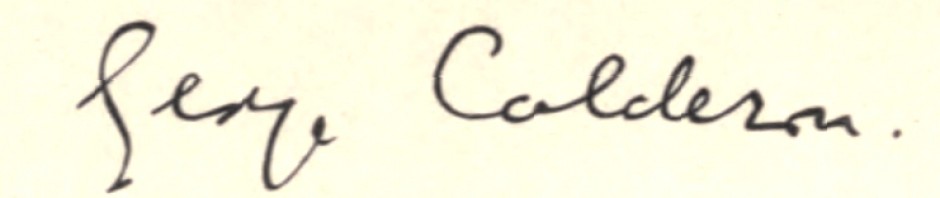
 George Calderon, 1912
 Unpublished watercolour by George Calderon, Tahiti 1906
 Colonel Sir Walter Coote Hedley c. 1920
 K.N. Das Gupta and Margaret Mitchell in an Indian Dramatic Society production of The Maharani of Arakan, 1913?
 Michel and Vera Fokine in “Scheherazade”, 1914 (The Music And Theatre Library of Sweden, creative commons)
 Frontis piece by Frank Calderon
 Christmas 1901 Cartoon by George Calderon
 The entrance to Fort Brockhurst (picture from Britain’s Past)
 Monarch Butterfly Madeira
 Jean Ryckaert, May 1916.
 Sir Richard Vincent Sutton c. 1913
 Figure from Gauguin’s 1899 painting ‘Tahitian Women with Mango Blossoms’ (left); George Calderon’s pencil sketch ‘Manu’ (right)
 George Calderon c.1901
 George and Kittie Calderon 1905
 Book sent to George Calderon in Russia by his mother, Christmas 1895.
 Captain of the 11
 A happy memory of Trinity College: undergraduates breakfast together in Downy V. Green, p. 77.
 Basic form of the Calderon coat of arms
 Patrick Miles in his summer house, 11 December 2016
Recent Comments
- Catherine Brown on The diary of a writer-publisher: 38 Thank you so much for this wonderful recollection of Mr Prynne. In case of interest, my own, which concerns Prynne in the 1990s, is here:... (May 21, 2026 at 11:20 am)
- harvey pitcher on The diary of a writer-publisher: 37 well, i had a shock when you said you'd acquired a dog but then i saw it wasn't. i have nothing against dogs though i prefer cats but fiona is very opposed to dogs or rather... (April 15, 2026 at 4:35 pm)
- Laurence Brockliss on A new story by John Melmoth: ‘Snowballs’ What a pitch perfect short story: crisp, graphic, nostalgic, evocative and mischievous. The injustice of schoolboy punishments comes in many forms, is never forgotten and is... (March 10, 2026 at 10:09 am)
- Patrick Miles on The diary of a writer-publisher: 36 Wonderful, Andrew! Thank you very much. I will borrow that title, if you don't object... I hope you will allow Calderonia to feature your own next magnum opus after the Great... (February 28, 2026 at 8:18 am)
- Andrew Tatham on The diary of a writer-publisher: 36 A brilliantly evocative and thought-provoking medley of observations that would not be out of place in 'The collected life of a flat-cap penguin' (your words, only slightly... (February 27, 2026 at 9:48 am)
Tag Archives: Anton Chekhov
A terrible anniversary
George Calderon is presumed to have died just after noon at the Third Battle of Krithia on 4 June 1915. Obviously, I refer first-time blog-visitors to my posts for that and subsequent days last year, the actual centenary of the … Continue reading
Posted in Edwardian character, Edwardian English, Edwardian marriage, Heroism and Adventure, Personal commentary
Tagged 'real time', Anton Chekhov, biographies, biography, Brigadier-General Napier, Clare Hopkins, comments, Dardanelles, Gallipoli, George Calderon, Helles, King's Own Scottish Borderers, Kittie Calderon, Major G.B. Stoney, River Clyde, Stanley Spencer, Søren Kierkegaard, The Cherry Orchard, The Great War, Third Battle of Krithia, William Rothenstein, World War I
5 Comments
Watch this Space
Calderonia is an experiment in biography through a blog. It tells the story of George and Kittie Calderon’s lives from 30 July 1914 to 30 July 1915 from day to day as it happened, but exactly 100 years afterwards. It therefore … Continue reading
Posted in Personal commentary
Tagged 'real time', Anton Chekhov, biographies, biography, Calderonia, comments, Constance Garnett, Dardanelles, deadlines, Gallipoli, George Calderon, Jenny Hands, political parties, Taoism, The Great War, The Stage Society, trade unionism, World War I, Ypres
Leave a comment
Watch this Space
16/11/15. I have been reading the copy of The Sayings of Lao Tsŭ (John Murray, 1905) that George Calderon gave his wife Kittie on her birthday, 5 March 1905. I had always known that George was interested in Taoism, but the signs … Continue reading
Posted in Personal commentary
Tagged Agincourt, Anton Chekhov, Basil Dean, Battle of Britain, Benedict Cumberbatch, biographies, biography, commemoration, comments, David Reynolds, George Calderon, Kittie Calderon, Lao Tsu, Lionel Giles, Liverpool Repertory Company, National Coal Strike, New Theatre Cambridge, New Theatre Oxford, Spanish Armada, Taoism, The Fountain, The Great War, Trinity College Oxford, William Rothenstein, World War I
Leave a comment
30 July 1915: ‘Ends’
It does not seem exactly a year since the small boys Jack and Roly Pym ran across from their holiday home at Seaview on the Isle of Wight to greet George Calderon, a kind of uncle to them, who had … Continue reading
Posted in Edwardian marriage, Personal commentary
Tagged 'real time', Anton Chekhov, Ashford, biographies, biography, Captain Charles Evelyn Pym, Carl Jung, Clare Hopkins, comments, Dardanelles, Derwent May, Elizabeth Ellis, Gallipoli, George Calderon, Harvey Pitcher, Isle of Wight, Jack Pym, James Muckle, John Dewey, John Pym, Johnnie Pym, King's Own Scottish Borderers, Kittie Calderon, Louisa Scherchen, Michael Welch, Nina Astley, Nina Corbet, Oxfordshire and Buckinghamshire Light Infantry, Percy Lubbock, Peter Hart, Roly Pym, Sam Evans, Seaview, Sheet, Tahiti, The Great War, Third Battle of Krithia, Violet Pym, White Raven, World War I, Ypres
8 Comments
Commemoration (to be concluded)
Mr Pym, who is the grandson of Violet and Evey Pym, of Foxwold, two of the Calderons’ closest friends, sent me this poem a fortnight before the anniversary of George Calderon’s death. He was not able to take part in … Continue reading
Posted in Edwardian character, Edwardian English, Edwardian marriage, Heroism and Adventure, Modern parallels, Personal commentary
Tagged Anton Chekhov, Archie Ripley, Captain Charles Evelyn Pym, Catherine Lubbock, comments, Dardanelles, Devonport, Earlham, Emmetts, Foxwold, Frederic Lubbock, Gallipoli, George Calderon, Hampstead, Horatius, John Pym, King's Own Scottish Borderers, Kittie Calderon, Laura Ripley, Percy Lubbock, The Great War, Third Battle of Krithia, Thomas Babington Macaulay, Violet Pym, Well Walk, World War I
Leave a comment
Hypothesis, or conspiracy theory?
Whilst writing Crime and Punishment Dostoevsky reminded himself in his notebook that he must ‘establish why Raskol’nikov killed the old woman’; although he had already suggested several reasons in the novel. The question ‘why George Calderon insisted on signing up at the … Continue reading
Ruth Scurr’s exhilarating experiment
In my post of 6 March I discussed an essay by Ruth Scurr about biography that had just appeared in the Guardian Review. Her essay stirred up a whole hive of issues that the modern biographer should be aware of and needs … Continue reading
‘The Maharani’: A postscript
Read The Maharani of Arakan yourself to decide whether it is (just) ‘A Romantic Comedy’, as George playfully subtitled it, or a ‘Symbolist Mystery Play’ (allegory)! Having re-read it over the weekend, I increasingly feel it’s the latter. If it is … Continue reading
What is ‘The Lamp’ about? (2)
Presumably George was home again at 42 Well Walk, Hampstead, for the long weekend of 9-12 April 1915, so he may have done more work on leaving various literary projects in a publishable state in case he did not come … Continue reading
Posted in Edwardian literature, Personal commentary
Tagged Anton Chekhov, comments, Ernst Zermelo, Feofan Zatvornik, Geminae, Georg Cantor, George Calderon, La Sainte Courtisane, Lenin, mathematics, Oscar Wilde, Rugby Scool, Russell's Paradox, set theory, The Fountain, The Great War, The Lamp, The Little Stone House, The Two Talismans, World War I
Leave a comment
10 April 1915: A professional soldier
Today the 9th Battalion Ox and Bucks at Fort Brockhurst near Portsmouth was converted from a Service Battalion to a Reserve Battalion. It comes as a shock: George Calderon’s training as a lieutenant was over, and he could volunteer or … Continue reading
‘Phantom flies in amber’ (Concluded)
In my post of 5 January I described what I assume is a bugbear of all biographers: ‘facts’ that you have acquired from somewhere, that stick in your mind like flies in amber, but when you want to use them … Continue reading
Posted in Personal commentary
Tagged Anton Chekhov, Ashford, Aunt Lottie, beetles, biography, comments, George Calderon, Kennington, Kittie Calderon, memory, Russia, Uncle Tom
Leave a comment
Weekend work: ‘The Lamp’
If, as I have suggested, George used his long weekend leave to put his literary manuscripts in order, then as well as working on a detailed synopsis of Tahiti (see my posts of 14 and 21 March) he must have done something … Continue reading
Who was George Calderon (again)?
I first posted on this subject last year, 13 September. The reason I am touching on it again now is that a follower has very kindly sent me a cutting from the International New York Times of 23 January which is … Continue reading
Posted in Edwardian character, Personal commentary
Tagged Albert Murray, Anton Chekhov, Ayana Mathis, biographies, biography, Charles Dickens, Donald Rayfield, Edward Thomas, Ernest J. Simmons, George Calderon, Jane Austen, John Aubrey, Patrick Miles, Ronald Hingley, Rupert Brooke, Ruth Scurr, Siegfried Sassoon, Thomas Mallon, Tom Wolfe, Vita Sackville-West, Wilfred Owen, William Shakespeare
2 Comments


More Chekhovian than Anton
For an extreme example of what George Calderon called Chekhov’s ‘disjunctive manner’, I recommend: George touched on aspects of the ‘disjunctive manner’ in the Introduction (1912) to his translations of The Seagull and The Cherry Orchard, but he had expressed it most … Continue reading →