Watch this Space

15/1/16. One of the most difficult problems of researching Kittie Calderon’s life after George’s death is deciding how much she travelled abroad. After Percy Lubbock married Lady Sybil Cuffe in 1926, the couple lived in the fabulous Villa Medici at Fiesole and invited Kittie to stay with them at least six times between 1928 and 1930; but she seems to have gone only once (in November 1930). Similarly, she twice planned to visit Constantinople and Gallipoli, but the evidence is that she did not.

There is a fine leather suitcase emblazoned ‘Mrs. George Calderon’, which has the remains of a single foreign luggage label on it:

Tour Label on Kittie's Suitcase

I cast an eye over this label twenty years ago and thought: ‘Hm, “Russie” down right, a minaret top left, must be from travelling to Constantinople by ship, which was also a route to Russia’. But last week, having concluded Kittie did not go to Gallipoli, I took a closer look at the label (with a magnifying glass). First, as the image above clearly shows, top left is not a minaret, but a dome topped with a cross. The only church it reminded me of from my own experience was the basilica of Le Sacré Coeur in Paris. Second, what could the letters RAND be a part of, if not a French place name? I assumed that the letter before the R was an E, then ran through the possibles. None was at all convincing. Then the penny dropped: it is much more likely to be a G before RAND — and grand must be the commonest word ending in -and in the French language. Googling about on ‘le grand‘, Paris and ‘Russie’, I eventually came up with the Grand Hôtel de Russie at the top of the Boulevard Montmartre in the late nineteenth/early twentieth centuries. The Sacré Coeur basilica would tally with that, of course.

As far as is known, Kittie went to Paris only once, with George on their honeymoon in 1900. Both were keenly interested in contemporary French painting, which might explain why they stayed in Montmartre, and they may well have known that the famous series of paintings of Boulevard Montmartre by Impressionist Camille Pissarro was made from his balcony in the Grand Hôtel de Russie. The ‘suitcase’ is actually more like an attaché case of the period, i.e. hand luggage. The prominent words ‘Mrs. George Calderon’ on the front might be there because Kittie was going to Paris and wanted to make it clear she was (newly) married… At least, that is my hypothesis: that this case is her honeymoon case.

Other hypotheses that would explain this label are invited! Note that I am unable to explain the black, column-like shape on the right, or the bit of shield at bottom left that appears to say UNIT[É?].

Stop Press!

16/1/16. Within hours of the above post going up, John Pym emailed me with an image he had found on the Web of a luggage label that fitted Kittie’s exactly and demonstrates that the hotel was in Rome, not Paris. The only difference was that the image did not feature the UNIT[…] shield bottom left. However, it was conclusive proof that the label could not date from George and Kittie’s honeymoon to Paris in 1900. I had actually found the Grand Hôtel de Russie in Rome when I was trying to identify Kittie’s label, but rejected it as the nearest church had no high pinnacles on it, whereas the basilica of the Sacré Coeur in Montmartre has… I hadn’t considered the Vatican!

Well, by the evening Calderonia‘s indefatigable Web-Meisterin Katy George had found and sent me an even better image:

Full Sticker of Tour Label on Kittie's Suitcase

This contains the logo U.N.I.T.I. and even an extra line, again in French. If I had offered a bottle of champagne, Katy would definitely have won it! My sincere and humble thanks to her, to John Pym, and others who emailed me about this yesterday. My thanks are very humble, because I never expected so many people to give their time so generously to solving this one and my own hypothesis was up a gum-tree…

I have been asked when, then, did Kittie visit Rome? Most likely in 1930, when she stayed with Percy and Sybil Lubbock at Fiesole, whence it would be easy to reach Rome by train, but possibly the year before: a scrap of label on the side of her case says LUG, most likely standing for LUGANO, which might refer to a possible visit to Lesbia Corbet (married name Mylius) on Lake Como in 1929. Whereas the Grand Hôtel de Russie in Montmartre seems to have gone long ago, the one in Rome appears to have survived to this day — minus the ‘Grand’.

Thanks again to everyone who responded so splendidly.

Posted in Personal commentary | Leave a comment

Watch this Space

1/1/16. A very happy new year to everyone. As you will gather from the above, we are now presenting Calderonia slightly differently. ‘Featured Comments’ will soon replace ‘Comments’, although all past Comments will still be accessible. Links will be introduced between past Comments and it will, of course, be possible to leave new ones. Previous ‘Watch this Space’ posts will be archived and made accessible. A number of over-arching categories that are not tagged, e.g. ‘Edwardian Character’, ‘Conduct of the War’, ‘War Poets’, will also be introduced. I shall leave up ‘Christmas at “White Raven” 1944’ for a little longer, as people have emailed me that they like it. Then it will be archived. I hope to carry on posting weekly until the biography is published, and I may feature some entries from Kittie’s diary for ninety years ago on the days for which she wrote them. Watch this space for completion of the last chapter of the biography very soon.

Posted in Personal commentary | Leave a comment

Watch this Space

Caption goes here

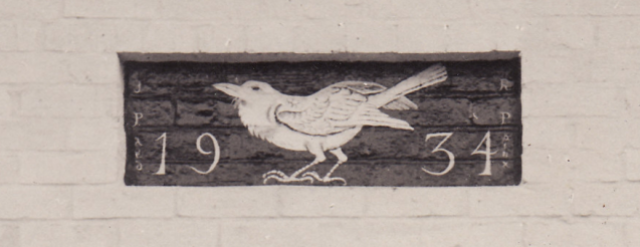
‘White Raven’ painted by Roland Pym above Kittie’s front door

Faithful followers of this blog/website will recall twelve months ago the Christmas of 1914 at Foxwold, Brasted Chart, in Kent. The Pym, Lubbock and Calderon families all participated, as well as two refugees from German-occupied Belgium who were living with George and Kittie Calderon in Hampstead. None present ever forgot it, and Percy Lubbock wrote poignantly of it in his portrait of George published in 1921.

The only other Christmas in Kittie’s life after 1914 that we have as much information about is that of 1944, thirty years later when she was seventy-seven. That too was dramatic, but in a completely different way. I felt it would be appropriate, before the year in which my biography should be published and this blog ends, to describe from manuscript sources what happened at Christmas 1944.

*                     *                    *

My deeper research into Kittie’s life at Sheet, Petersfield, persuades me that she made the mistake in 1922 of coming in at the very top of local society. She was a relation by marriage and good friend to the biggest local landowner, Helen Bonham-Carter (then hyphenated); she was the widow of a war hero and literary man whose public profile was still quite high through the 1920s; she was the scion of a famous family (the Irish Hamiltons); and she had exalted friends (Astleys, Corbets, Ripleys etc) who visited her. Yet she lived in a relatively modest Victorian cottage, ‘Kay’s Crib’, outside the village proper. Much of the rest of Sheet society was composed of upper middle class retired folk, e.g. from the military, who rather fancied themselves. Understandably, when Kittie hove in she put these people’s backs up. She described Sheet in retrospect as ‘my prison’.

By about 1932, Kittie had decided to get out of Hampshire. Her nephew Edward Pakenham Hamilton (1893-1983) had become Estate Manager at Godinton Park, near Ashford in Kent, and his father, Kittie’s only brother John Pakenham Hamilton (1861-1946), had moved to Ashford with his wife to be close to their eldest son. This, and the desire to be nearer to the Pyms at Foxwold, persuaded Kittie to buy a plot of land north of Ashford and have a house built there according to her own specifications. She asked Violet and Evey Pym’s son, the architect John Pym (1908-93), to build it for her, and she moved into it in late 1934. John Pym’s brother, the artist Roland Pym (1910-2006), then painted the above white raven over the door, as that was to be the new house’s name.

‘White Raven’ was the sobriquet she had adopted in her relationship with Caroline (Nina) Corbet (1867-1921), who was ‘Black Raven’ because her first husband was Walter Corbet (1856-1910), descended from a henchman of William the Conqueror’s called ‘Le Corbeau’.

Unlike ‘Kay’s Crib’ in Sheet, Kittie settled into ‘White Raven’ extremely well. She designed a formal garden and took on a gardener called Grant. Although at that time ‘White Raven’ was in relatively open countryside, she was in easy distance of a church and village, and beyond that was Ashford with its fast line to London. The people who lived around her were far more middle class than at Sheet and she became something of a local treasure. She was visited by friends from her earlier life (probably including Sir Coote Hedley, the ‘Godfather in War’ (q.v.), who died in 1937) and often saw her brother John and nephew Edward. By April 1942, however, Edward Hamilton had had to move to a job at Retford.
Caption goes here

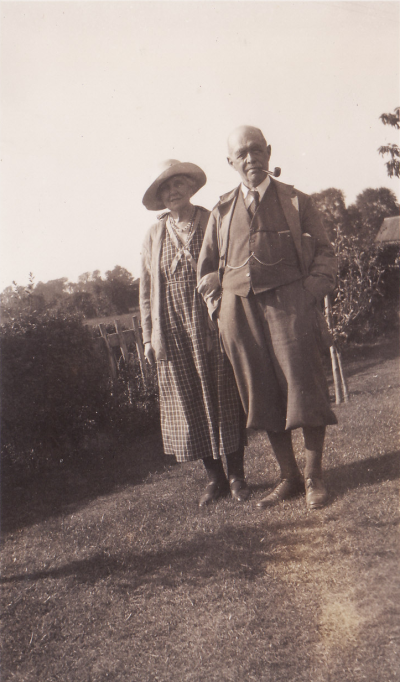
Sarah and John Pakenham Hamilton at ‘White Raven’, c. 1936

Kittie and her housekeeper Elizabeth Ellis remained at ‘White Raven’ throughout the War. Dog fights and phalanxes of German bombers passed overhead, and as a major railway hub Ashford itself was targeted. The noise was so loud that on 24 October 1943 Kittie wrote to Percy Lubbock that, sitting in the kitchen, she and Elizabeth were ‘bounced into the air by the shocks overhead’. Friends all over the country tried to persuade Kittie to go and live with them, but for various reasons she would not budge. Then in June 1944 the flying bomb attacks began. Up to a hundred a day roared over and Ashford became the worst-hit area after London. Kittie called them ‘Boodlebugs’. In her words, the two women suffered ‘continuous long almost sleepless nights’, which began to grind them down.
Caption goes here

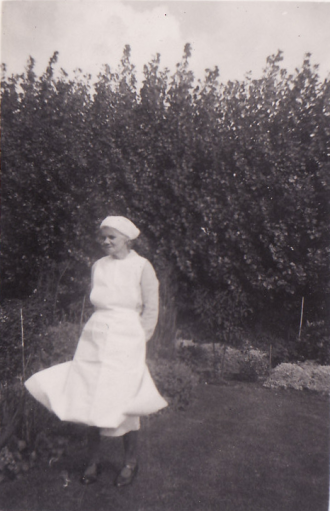
Elizabeth Ellis at ‘White Raven’, c. 1936

On 25 October 1944 John Hamilton’s wife Sarah died. His sons were extremely worried about his ability to care for himself — not to mention the dangers of continuing to live in Ashford — so after the funeral they tried to persuade him to go to live with one of them at a time. But John would not budge either. Continuing in Kittie’s words to her god-daughter Lesbia Lambe (Nina Corbet’s sole surviving child):

the sons hated him being alone in this house, so it seemed obvious I should ask them if he would let me and Elizabeth come for a few days and he said he would agree to that… So here we both came on the Wednesday [1 November 1944] and for the first day in our mutual habitation of that little house [‘White Raven’] we were both out of it when the Boodler came along and left cards but he knocked in vain for admittance, and after a rather bad attack of temper departed — after laying all the tiles upon the lawn on the south side and knocking down nearly all the ceilings, especially choosing my bedroom and in it my bed..!

A flying bomb had landed in the back garden of ‘White Raven’ and there is little doubt that Kittie and Elizabeth would have been killed if they had been there. The explosion also caused severe damage to the houses around it. Now they had to stay with John Hamilton much longer, whilst ‘White Raven’ was made habitable. As Kittie wrote to Lesbia on 8 November: ‘John is bored stiff with us in our different ways — he does not even try to camouflage the fact — indeed goes so far as to be, I think, genuinely glad that he probably saved my life by acceding to those “tiresome” sons!’ Kittie herself believed that it was God who had used her brother to save her and Elizabeth’s lives. It seems that they finally departed for ‘White Raven’ on 18 December.

Kittie and Elizabeth Ellis now prepared to celebrate Christmas at ‘White Raven’. A major problem was finding something to eat on Christmas Day. Louise Rosales, Kittie’s friend in London, had tried to get a chicken from her own butcher, but ‘he can’t let me have any more till the war is over!!!! He offered me some ROOKS (!) for you […] to replace the non-existent chickens’. However, as Kittie wrote to Lesbia on 18 December, Elizabeth managed to ‘collect a clever little teeny weeney chicken for her and me without telling me’. At this point, Kittie learned that she was going to have three unexpected guests — ‘Brother John and his nice engineer son George and his nice wife Lily’. What were Kittie and Elizabeth to do, as the midget chicken would ‘never have fed four’?

The day was saved by Lesbia and her husband Charles Lambe, who sent a ‘beautiful St Fort chicken’ by post from Fife, which arrived on Christmas Eve. St Fort is the Stewart estate near St Andrews that had been inherited by Nina and where her daughter was now living. As Kittie reported to Lesbia, ‘Brother John had been quite moved on the Christmas Day occasion when I told him he was eating a St Fort Chicken! Your Great-Grandmother had given him many a good day’s shooting when a big Eton boy and later at Cambridge in his vacations when we were sometimes in Fife’.

After Christmas 1944, John Hamilton sold his house in Ashford. His eldest son, Edward, helped him to pack up. The two men then stayed a night at ‘White Raven’ and left for Nottinghamshire, where Edward was living with his family.

So Kittie’s plan of living out her life near relations in Ashford had been frustrated. Her closest relation (by marriage) in Kent was now Evey Pym, forty miles away.

*                    *                    *

The high point of researching Kittie’s life 1923-50 over the last few months has been discovering that Elizabeth Ellis did not die before Kittie left Kent for Brighton in January 1948 (or possibly late 1947). This is entirely thanks to my superb London researcher Mike Welch, who specialises in large institutional and genealogical databases. The truth that Mike uncovered about Elizabeth Ellis is both fascinating and revealing.

When I was doing the initial research on this period of Kittie’s life about a year ago, I asked Mike to look for Elizabeth Ellises who had died between 1945 and 1947. This was because there was no mention of Elizabeth in Kittie’s papers after 1945 and I knew that she had died before Kittie. But if she had retired because of illness before Kittie moved to Brighton, she could have lived and died anywhere. The name Elizabeth Ellis was so common that without a date of birth it was impossible to narrow down which one in the registers of deaths she might be.

However, last month the National Archive made available a new source of information, the 1939 residential register, and Mike saw the opportunity to discover Elizabeth Ellis’s date of birth (5 June 1869) from the entry for ‘White Raven’. Comparing this with a wider swathe in the register of deaths, Mike spotted an Elizabeth Ellis who died in BRIGHTON in 1948. Tracing this Elizabeth Ellis back through the 1911, 1901, 1891 and 1881 censuses, it became clear that she was indeed Kittie’s long-serving housekeeper.

She was born in Lincolnshire and in 1881 was living in a workhouse with her mother, a domestic servant. Elizabeth went into service herself and by 1911 was working for the family of one Wright Provost in Hampstead. The next year, when the Calderons moved to Well Walk in Hampstead, she became their housekeeper (a promotion). We now know that she moved with Kittie to Brighton in 1947/48. Staggeringly, Elizabeth Ellis was probably still living and working with Kittie at the age of seventy-eight.

Elizabeth Ellis had been, as Kittie expressed it, ‘my valued old servant’ for thirty-six years, but we know from the records that Kittie provided generously for her too. Elizabeth died on 3 September 1948 in the same Brighton nursing home that Kittie was to die in on 30 January 1950.
Posted in Personal commentary | Leave a comment

Watch this Space

16/12/15. It seems to me in retrospect that every one of the fifteen chapters I have written of George Calderon’s biography is perilously different in length, form and style; but none is so different as the one I am writing at the moment — the last one of the book. It is the story of Kittie’s last twenty-eight years and George’s posthumous literary life, yet it will be the shortest (about 3000 words). The ‘deep chronology’ that I spent two months constructing proved only the beginning. I realise now that I have to evoke not only the key events in Kittie’s life 1922-50, but the ‘feel’ of her life through those years. I have, in fact, to evoke how it felt to be Kittie. Quite, quite different from the other chapters. And, I have to admit, a tall order. But that’s enough of a ‘spoiler’…

*                    *                    *

Cambridge Professor of International History David Reynolds’s lecture at the Perse School on 2 December entitled ‘Making Peace with the Great War: Centenary Reflections’, was a virtuoso performance — restrained, relaxed, magisterial, deeply challenging. The audience of about a hundred and fifty gave him a long ovation.

Many of Reynolds’s points are made in his recent book (and TV series) The Long Shadow, which I was familiar with, but I was surprised to find myself taking three pages of notes. If I were to summarise and quote from the whole lecture it would take thousands of words. Personally, I hope the lecture is published in some form, as it is surely something of an historic turning-point itself in how we think of the First World War.

Reynolds is ‘not sure that the way we remember the War is conducive to making our peace with the War’. Poets like Owen and Sassoon are our ‘supreme interpreters of the War’, and he implied that they won’t lie down… There has been a revival in Remembrance Sunday and the two-minute silence. Our difficulty in making our peace with WW1 can be traced to disillusion after 1918 with the idea that it had been ‘the war to end all wars’ and therefore justified. We are troubled by the fact that it did not solve the ‘German Problem’, and the biggest loss of life in British military history was therefore wasted. Reynolds quoted Hannah Arendt to the effect that the great problem after WW1 was ‘coming to terms with sudden, random death’. He gave a harrowing example of this from Vera Brittain and could only compare it today with the devastating emotional impact of road deaths. He described his experience of the charity Road Peace, whose own act of remembrance is held the week after Armistice Day, and drew parallels between national attitudes to WW1 and grieving. By contrast, we have made our peace with the Second World War because it ‘ended by revealing the morality of the War…it was our Finest Hour’.

A particularly interesting section of Reynolds’s lecture was where he compared attitudes to both wars in the rest of Europe. The French have no difficulty with WW1 because it was a ‘war of national liberation that they won’, whereas WW2 was a disaster for them (‘capitulation and collaboration’) that traumatised French society. But, like the Germans themselves, they have been able to view both wars as a single agony that was laid to rest in 1945 — and even more so by the Treaty of Rome (founding the EU), which Reynolds described as ‘the Peace Treaty that didn’t happen after 1918’. The French and Germans have, Reynolds claimed, ‘moved on’ because they accept a common European destiny, whereas we have difficulty believing we ‘belong’ to Europe and our ancillary role in WW1 itself questions the fact.

Reynolds’s peroration was that ‘we need to remember but also understand’. We are now as far away from the Great War as its participants were from Waterloo (it amused me slightly that he seemed to be suggesting that Waterloo no longer meant anything to WW1 soldiers, when we know from George Calderon’s letters that even as the Orsova was taking him and fellow-officers to Gallipoli they were planning a celebration of it!). ‘We need to remember the men who marched away’, Reynolds concluded, but also:

  1. ‘Clamber out of the Trenches’
  2. ‘Escape from Poets Corner’
  3. ‘Understand the Great War as history’

The latter, of course, is what you would expect an historian to say, but Reynolds meant specifically to understand it as a global war, as one that ‘reshapes the Middle East, and involved China and Japan’.

There was a fascinating range of questions afterwards, both from the audience and from Reynolds to the audience, but the very first participant asked forcefully ‘when?’ would we make our peace with WW1; he felt it would take ‘a long time’ because at the moment we plainly did not want to. At this point, I felt, Reynolds’s own attitude revealed itself as more nuanced. ‘I want to continue remembering these people’, he said, meaning the names all over our war memorials and Thiepval’s arches, and implied that he approved of the public acts of remembrance. But he also added, in a phrase that deeply struck home with me at least, that ‘we have to start letting go of the dead’.

Posted in Personal commentary | Leave a comment

Watch this Space

9/12/15. Cambridge Professor of International History David Reynolds’s lecture at the Perse School on 2 December entitled ‘Making Peace with the Great War: Centenary Reflections’, was a virtuoso performance — restrained, relaxed, magisterial, deeply challenging. The audience of about a hundred and fifty gave him a long ovation.

Many of Reynolds’s points are made in his recent book (and TV series) The Long Shadow, which I was familiar with, but I was surprised to find myself taking three pages of notes. If I were to summarise and quote from the whole lecture it would take thousands of words. Personally, I hope the lecture is published in some form, as it could itself be an historic turning-point in how we think of the First World War.

Reynolds is ‘not sure that the way we remember the War is conducive to making our peace with the War’. Poets like Owen and Sassoon are our ‘supreme interpreters of the War’, and he implied that they won’t lie down… There has been a revival in Remembrance Sunday and the two-minute silence. Our difficulty in making our peace with WW1 can be traced to disillusion after 1918 with the idea that it had been ‘the war to end all wars’ and therefore
justified. We are troubled by the fact that it did not solve the ‘German Problem’, and the biggest loss of life in British military history was therefore wasted. Reynolds quoted Hannah Arendt to the effect that the great problem after WW1 was ‘coming to terms with sudden, random death’. He gave a harrowing example of this from Vera Brittain and could only compare it today with the devastating impact of road deaths. He described his experience of the charity Road Peace, whose own act of remembrance is held the week after Armistice Day, and drew parallels between national attitudes to WW1 and grieving. By contrast, we have made our peace with the Second World War because it ‘ended by revealing the morality of the War…it was our Finest Hour’.

A particularly interesting section of Reynolds’s lecture was where he compared attitudes to both wars in the rest of Europe. The French have no difficulty with WW1 because it was a ‘war of national liberation that they won’, whereas WW2 was a disaster for them (‘capitulation and collaboration’) that traumatised French society. But, like the Germans themselves, they have been able to view both wars as a single agony that was laid to rest in 1945 — and even more so by the Treaty of Rome (founding the EU), which Reynolds described as ‘the Peace Treaty that didn’t happen after 1918’. The French and Germans have, Reynolds claimed, ‘moved on’ because they accept a common European destiny, whereas we have difficulty believing we ‘belong’ to Europe and our ancillary role in
WW1 itself questions the fact.

Reynolds’s peroration was that ‘we need to remember but also understand’. We are now as far away from the Great War as its participants were from Waterloo (it amused me slightly that he seemed to be suggesting that Waterloo no longer meant anything to WW1 soldiers, when we know from George Calderon’s letters that even as the Orsova was taking him and fellow—officers to Gallipoli they were planning a celebration of it!). ‘We need to remember the men who marched away’, Reynolds concluded, but also:

1. ‘Clamber out of the Trenches’
2. ‘Escape from Poets Corner’
3. ‘Understand the Great War as history’

The latter, of course, is what you would expect an historian to say, but Reynolds meant specifically to understand it as a global war, as one that ‘reshapes the Middle East, and involved China and Japan’.

There was a fascinating range of questions afterwards, both from the audience and from Reynolds to the audience, but the very first participant asked forcefully ‘when?’ would we make our peace with WW1; he felt it would take ‘a long time’ because at the moment we plainly did not want to. At this point, I felt, Reynolds’s own attitude became more nuanced. ‘I want to continue remembering these people’, he said, meaning the names all over our war memorials and Thiepval’s arches, and implied that he approved of the public acts of remembrance. But he also added, in a phrase that deeply struck home with me at least, that ‘we have to start letting go of the dead’.

*                    *                     *

I am coming to the end of my deeper research into Kittie Calderon’s life 1923-50, which is the subject of my last chapter. For this purpose I am doing something that I did not do for George’s life: I am transferring every known event (including letters) in this period of Kittie’s life to a chronology. At the moment, it covers twenty-eight pages and contains over 300 entries. I decided this was necessary in order to get a grip on the ‘shape’ of her last twenty-eight years. It wasn’t necessary for George, because there was far less known ‘data’, each chapter deals only with four or five years, and most chapters home into texts.

*                    *                     *

I have several approaches to publishers in the air, but if you have any ideas about plausible ones yourself, for George Calderon: Edwardian Genius, please don’t hesitate to email them me through my Website http://patrickmiles.co.uk. Thank you for reading!

Comment Image

Posted in Personal commentary | Tagged , , , , , , , , , , , , , , , , , , , , | Leave a comment

Watch this Space

23/11/15. I am now reading and digesting every item in Kittie’s archive that relates to the period 1923-50, and it’s immeasurably deepening my understanding of her life in that period, which spans Sheet in Hampshire (1923-34) and Kennington in Kent (1934-48).

The prime source is the 248 letters written to her and by her in that period which have survived in her archive.

The largest number (120) are those from Percy Lubbock to Kittie 1923-45, which took me four days to read and digest.

As one would expect of Percy Lubbock, they are beautifully written, with hardly a grammatical mistake. I am sure they will all be published one day. However, reading his letters from 1927-40 was sheer agony. In 1926 he married Sybil Scott/ Cutting, who was an extremely rich woman then on her third marriage and with a formidable reputation for neurosis. Percy’s letters to Kittie from this period are almost entirely given over to the exquisite variations in ‘Lady Sybil’s’ supposed condition. No sense of her as a person comes over, merely as a kind of medical and psychotic ganglion: she has ‘rheumatic eye-poisoning’, ‘intestinal parasites’, ‘an amoeba’, ‘nervous prostration’, ‘perpetual dysenteric attacks’, ‘internal collapse — digestive etc’, ‘an obstinate and vicious influenza’, ‘a revival of a germ (intestinal)’, ‘intestinal neuritis’, and so ad infinitem. She is borne downstairs and upstairs, European authorities in various opaque diseases visit her regularly, her ‘poor little bent legs’ have to be straightened out in Aix-les-Bain, she can consume nothing but her ‘poor little pâté jelly and a glass of champagne’ before subsiding again; but somehow she manages to control everyone around her. Lubbock is entirely at her beck and call and does not write anything for fifteen years…

Then (1940) the couple are stranded, with a few servants, at Montreux for five years, unable to return to their villas at Fiesole and Lerici because of the war. It concentrates both their minds. Percy’s letters to Kittie become a narrative at last, rather than a series of stand-alone stress-rep0rts. He follows the war as closely as he can from any newspapers he can get hold of and by listening to the BBC; the seasons and flowers become intimately important to him and Sybil; he depends utterly on Kittie (who writes about every ten days) for news of the Lubbock and Pym families, for her special ability in her letters to enable him to ‘see’ his nephews and nieces and interpret their characters and actions…

In 1937, at the height of his desperation about Sybil’s condition, Percy Lubbock made what he called a ‘pact’ with Kittie — that if he needed her by him, she would come to Italy. She replied by telegram: ‘of course, yes’. In 1945, after the war, after his wife had died in Switzerland and he was about to return to Italy, he thanked Kittie for ‘how much your letters have done for me and given me first and last, in my life abroad’.

A picture is emerging of Kittie rushing all over England to help family and friends in the 1920s and 30s, and (from her three extant diaries) of friends, family and godchildren constantly descending upon her at Sheet and Kennington. One of them in a Christmas card addressed her as ‘Dear Boon’, another thanked her in 1938 for ‘the love you have shown in a thousand ways to me and mine through the years too long to count’.

Without, I think, consciously willing it, the widow of George Calderon became something of a grande dame in the communities where she settled, and counsellor in matters emotional, psychological and practical amongst her friends and adopted family. Well, she did have enormous emotional experience and intelligence, and was as competent as any man at managing her own and others’ affairs. But not everyone liked it. Some thought her dominating and interfering.

*                    *                     *

If you haven’t read it already, please read Clare Hopkins’s latest Comment now. It is definitive, in my view, but still there is plenty that some might find contentious. If you do have a reaction, PLEASE comment in your turn! I have received some short emails about Clare’s Comment, but we would all much rather follow a debate on the website. Some issues might be:

— Recently, there have been cases reported in the press of people who were counselled towards ‘closure’ after bereavement, went with it, but were ‘hurried’ and in fact just repressed their mourning; and they feel this did them psychological damage. It has led them to question the whole concept of closure.

— An issue is, then, can we actually direct (‘manage’) bereavement and commemoration? Are Clare’s ‘stages’ prescriptive, or ex post facto, i.e. retrospective?

— I see that Cambridge history professor David Reynolds, who has written about the factual side of WW1 memorials and the work of the Imperial War Graves Commission, is giving a public lecture at the Perse School on 2 December entitled ‘Making Peace With the Great War: Centenary Reflections’. In an interview, he says that WW1 is now ‘turning into a historical issue rather than one with a personal focus’, which reminds me of Clare’s ‘stage four’, when in her words ‘commemoration distils into History’. However, do we want our live emotions to be ‘historicised’? A recent German president said that for the German nation there can be ‘no moral closure’ on two world wars, so why should we expect our own empathic, existential closure on WW1? Even Reynolds admits ‘it will be hard to ever truly move on from the trauma of the conflict’. I shall be going to Prof. Reynolds’s lecture on 2 December and reporting about it afterwards.

— Will WW1 ever come to ‘exemplify important qualities in the English (or British) character’ the way Agincourt, the defeat of the Spanish Armada, or the Battle of Britain have? Was our part in WW1 tragic rather than heroic?

*                    *                     *

I have several approaches to publishers in the air, but if you have any ideas about plausible ones yourself, for George Calderon: Edwardian Genius, please (lon’t hesitate to email them me through my Website http://patrickmiles.co.uk. Thank you for reading!

Comment Image

Posted in Personal commentary | Tagged , , , , , , , , , , , , , , , , , , , , , | Leave a comment

Watch this Space

16/11/15. I have been reading the copy of The Sayings of Lao Tsŭ (John Murray, 1905) that George Calderon gave his wife Kittie on her birthday, 5 March 1905. I had always known that George was interested in Taoism, but the signs had steadily been mounting that it was more than that. Since I knew nothing previously about Taoism, I thought I had better start by reading this short book translated by the famous Sinologist Lionel Giles, then branch out. There are no books about Taoism in the remains of George’s own library.

The documentary evidence of George’s reading and knowledge of Taoist texts falls in the years 1905-12. He thanks William Rothenstein in a letter provisionally dated 1905 for helping him find some of these texts. On Tahiti in 1906 he quotes Lao Tsu in a discussion about beauty. In a 1910 review of Chesterton’s What’s Wrong With the World? he accuses Chesterton of ‘not perceiving the virtues, the “identity”, or “tao” of the thing that he attacks’. George’s contention in his Preface to The Fountain (1911) that ‘all the Evil that matters is produced, not by evil intention, as is generally supposed, but by good intention working through the complicated channels of our social system’ could be interpreted as a plea to practise Taoist wu wei (active non-action). A 1912 note in his own shorthand also sounds distinctly in the spirit of the Sage: ‘Play. To show that pleasure is to be had only by
refraining from it. It is a thing of the imagination. It is too confused in reality. The mirage goes.’ Even George’s belief that there is a ‘profound philosophy’ behind Chekhov’s endeavour ‘to establish the true relation of Man to the surrounding universe’, and that ‘ever since we began to think in Europe, we have been wrong about Man’ because we have sought to ‘sever the individual, to abstract him in thought’ from his widest environment, could be taken to hint at the Tao.

The more one thinks about it, the more resemblances one sees between some of the precepts of Taoism and George’s personality in the last ten years of his life. Given that Taoism is not theistic (by the 1890s George was an agnostic/ atheist), and given some of the intriguing overlaps between Taoism and the kind of Christianity George did believe in, it is tempting to conclude he was a private Taoist. But this is an all too familiar trap for the
biographer. Nothing but empirical evidence will do. In the absence of it, one could construct a species of conspiracy theory that explained ‘everything’ about George Calderon — and was literally undisprovable.

I content myself at the moment by deeply internalising the Sage’s saying: ‘If people took as much care at the end as at the beginning, they would not fail in their enterprises.’

*                    *                     *

If you haven’t read it already, please read Clare Hopkins’s latest Comment now. It is definitive, in my view, but still there is plenty that some might find contentious. If you do have a reaction, PLEASE comment in your turn! I have received some short emails about Clare’s Comment, but we would all much rather follow a debate on the website. Some issues might be:

— Recently, there have been cases reported in the press of people who were counselled towards ‘closure’ after bereavement, went with it, but were ‘hurried’ and in fact just repressed their mourning; and they feel this did them psychological damage. It has led them to question the whole concept of closure.

— An issue is, then, can we actually direct (‘manage’) bereavement and commemoration? Are Clare’s ‘stages’ prescriptive, or ex post facto, i.e. retrospective?

— I see that Cambridge history professor David Reynolds, who has written about the factual side of WW1 memorials and the work of the Imperial War Graves Commission, is giving a public lecture at the Perse School on 2 December entitled ‘Making Peace With the Great War: Centenary Reflections’. In an interview, he says that WW1 is now ‘turning into a historical issue rather than one with a personal focus’, which reminds me of Clare’s ‘stage four’, when in her words ‘commemoration distils into History’. However, do we want our live emotions to be ‘historicised’? A recent German president said that for the German nation there can be ‘no moral closure’ on two World wars, so why should we expect our own empathic, existential closure on WW1? Even Reynolds admits ‘it will be hard to ever truly move on from the trauma of the conflict’.

— Will WW1 ever come to ‘exemplify important qualities in the English (or British) character’ the way Agincourt, the defeat of the Spanish Armada, or the Battle of Britain have? Was our part in WW1 tragic rather than heroic?

*                    *                     *

Benedict Cumberbatch’s nightly outbursts about the Government’s policy towards Syrian refugees, delivered from the stage after the cast curtain-call for Hamlet, call to mind George Calderon’s after-performance oratory at the New Theatre, Oxford, in March 1912.

Liverpool Repertory Company, under Basil Dean, were touring their production of George’s The Fountain. As was the custom, the author was called onto the stage by the audience after the first night in Oxford, 4 March 1912. But the first national Coal Strike was in progress, slowly throttling the country. Instead of just taking his bow, George burst into a rousing appeal to the undergraduates present to form a body to go and work in the mines. ‘I was simply cold with terror’, wrote Kittie afterwards: ‘I had no notion this had been in his head.’ George invited volunteers to meet him outside Trinity College next morning, in the evening he led a mass debate in the college hall about what action to take, and by the end of the day an Oxford University Strike Emergency Committee with 300 members had been formed under George’s chairmanship. On 6 March he and Kittie left for London to coordinate with activists there…

One of the questions in my mind about Cumberbatch’s action is, what did the other actors think about being detained by it every evening and what was the management’s attitude? As it happens, subsequent events in George’s case may give us an intimation. On 7 March 1912 George travelled on his own to Cambridge for the first night there of The Fountain. The audience was small and the actors ‘livened things up’ with some anachronistic adlibbing about the Coal Strike, presumably partly aimed at George. When there were calls for the author afterwards, George was ‘prepared to take a call’, the Cambridge Daily News reported, but was prevented ‘possibly because Mr Basil Dean thought the time and the place were hardly suitable for propaganda’.

George was unable, then, to repeat his political theatre in Cambridge. But this did not prevent him from addressing a meeting of over two thousand students that had already been organised for the day after in Cambridge’s new Examination Hall.

*                    *                     *

I have several approaches to publishers in the air, but if you have any ideas about plausible ones yourself, for George Calderon: Edwardian Genius, please don’t hesitate to email them me through my Website http://patrickmiles.co.uk. Thank you for reading!

Comment Image

Posted in Personal commentary | Tagged , , , , , , , , , , , , , , , , , , , , , , , , | Leave a comment

Watch this Space

9/11/15. It is a huge relief to have ‘finished writing’ the penultimate chapter, ‘Aftermath and Masterpiece’, of my biography. Although it is only 9000 words long, it has taken me ten weeks to research and write (in pencil). It has been by far the most difficult of the fifteen I have written, and it’s not in a good state. It’s a patchwork held together by hiatuses. The reason it is so different is, of course, that George isn’t physically alive in it; it’s about Kittie’s life after George and her posthumous creation of his reputation. Hundreds of changes, some radical, will probably be made when I ‘type it up’, and then each time I read it on the screen. I expect I shall manage to knock it into shape. Meanwhile, on with researching the very last chapter, ‘White Raven’, which follows Kittie’s life to its end and George’s continuing afterlife. It will be short, but quite full of incident. I just hope the research does not take an unconscionable time…again.

*                    *                     *

If you haven’t read it already, please read Clare Hopkins’s latest Comment now. It is definitive, in my view, but still there is plenty that some might find contentious. If you do have a reaction, PLEASE comment in your turn! I have received some short emails about Clare’s Comment, but we would all much rather follow a debate on the website. Some issues might be:

— Recently, there have been cases reported in the press of people who were counselled towards ‘closure’ after bereavement, went with it, but were ‘hurried’ and in fact just repressed their mourning; and they feel this did them psychological damage. It has led them to question the whole concept of closure.

— An issue is, then, can we actually direct (‘manage’) bereavement and commemoration? Are Clare’s ‘stages’ prescriptive, or ex post facto, i.e. retrospective?

— I see that Cambridge history professor David Reynolds, who has written about the factual side of WW1 memorials and the work of the Imperial War Graves Commission, is giving a public lecture at the Perse School on 2 December entitled ‘Making Peace With the Great War: Centenary Reflections’. In an interview, he says that WW1 is now ‘turning into a historical issue rather than one with a personal focus’, which reminds me of Clare’s ‘stage four’, when in her words ‘commemoration distils into History’ . However, do we want our live emotions to be ‘historicised’? A recent German president said that for the German nation there can be ‘no moral closure’ on two world wars, so why should we expect our own empathic, existential closure on WW1? Even Reynolds admits ‘it will be hard to ever truly move on from the trauma of the conflict’.

— Will WW 1 ever come to ‘exemplify important qualities in the English (or British) character’ the way Agincourt, the defeat of the Spanish Armada, or the Battle of Britain have? Was our part in WW1 tragic rather than heroic?

*                    *                     *

Benedict Cumberbatch’s nightly outbursts about the Government’s policy towards Syrian refugees, delivered from the stage after the cast curtain-call for Hamlet, bring to mind George Calderon’s after-performance oratory at the New Theatre, Oxford, in March 1912.

Liverpool Repertory Company, under Basil Dean, were touring their production of George’s The Fountain. As was the custom, the author was called onto the stage by the audience after the first night in Oxford, 4 March 1912. But the first national Coal Strike was in progress, slowly throttling the country. Instead of just taking his bow, George burst into a rousing appeal to the undergraduates present to form a body to go and work in the mines. ‘I was simply cold with terror’, wrote Kittie afterwards: ‘I had no notion this had been in his head.’ George invited volunteers to meet him outside Trinity College next morning, in the evening he led a mass debate in the college hall about what action to take, and by the end of the day an Oxford University Strike Emergency Committee with 300 members had been formed under George’s chairmanship. On 6 March he and Kittie left for London to coordinate with activists there…

One of the questions in my mind about Cumberbatch’s action is, what did the other actors think about being detained by it every evening and what was the management’s attitude? As it happens, subsequent events in George’s case may give us an intimation. On 7 March 1912 George travelled on his own to Cambridge for the first night there of The Fountain. The audience was small and the actors ‘livened things up’ with some anachronistic adlibbing about the Coal Strike, presumably partly aimed at George. When there were calls for the author afterwards, George was ‘prepared to take a call’, the Cambridge Daily News reported, but was prevented ‘possibly because Mr Basil Dean thought the time and the place were hardly suitable for propaganda’.

George was unable, then, to repeat his political theatre in Cambridge. But this did not prevent him from addressing a meeting of over two thousand students that had already been organised for the day after in Cambridge’s new Examination Hall.

*                    *                     *

I have several approaches to publishers in the air, but if you have any ideas about plausible ones yourself, for George Calderon: Edwardian Genius, please don’t hesitate to email them me through my Website http://patrickmiles.co.uk. Thank you for reading!

Comment Image

Posted in Personal commentary | Tagged , , , , , , , , , , , , , , , , , , , , , | Leave a comment

Watch this Space

2/11/15. I have a hunch that the word ‘unconscionable’ features regularly in biographers’ conversations with themselves…

It has taken me an ‘unconscionable’ four and a half years to reach the endgame of writing George Calderon’s biography, when I thought it would take three…

I spent an ‘unconscionable’ length of time piecing together the sequence of George’s frequently undated love letters to Kittie over a mere five months in 1898-99, and when I came to present that story it turned into an ‘unconscionably’ long chapter…

Suddenly you discover you have to inform yourself about the whole of Edwardian theatre before you can talk about George Calderon’s place in it, or research in ‘unconscionable’ detail events in the suffragist movement 1909-10, or spend ‘unconscionable’ whole months educating yourself about a battle on the Gallipoli Peninsula…

Now I have spent an ‘unconscionable’ three weeks reading and re-reading George’s Tahiti, digging into other books about Tahiti, reading and re-reading dozens of reviews of George’s book, taking notes from them, photocopying some of them, checking numerous Latin quotations he has embedded in his text (mainly from Horace and Virgil, but two he appears to have made up), and ‘unconscionably’ fiddling with ‘unconscionably’ many other aspects, too… And all to write 800 words on Tahiti in the penultimate chapter!

I must say, though, that my predicament is one of the most difficult I’ve had to face whilst writing the book. Tahiti is George’s masterpiece. I could, probably should, write a whole chapter on its literary brilliance and thematic complexity. But I have to discuss that side of it in my penultimate chapter, which concerns George’s ‘afterlife’, because Tahiti is a posthumous work. The storyline of this chapter is Kittie’s, since she is its surviving protagonist, and I cannot ‘go on’ too long… I therefore have to compress the essence of the essence of what I want to say about Tahiti into no more than 800 words, before getting back to this most traumatic time in Kittie’s life. Hence the very long — ‘unconscionably’ long — run-up to writing the few paragraphs. I have to be absolutely sure of what I want to say. Although I have written many pages on all of George’s major literary works (so much so that in those chapters I will be accused of writing literary criticism rather than biography), these few paragraphs have to be in a class of their own.

Biographically speaking, George’s four months on Tahiti in 1906 are described in a separate chapter in their appropriate chronological place. They took an ‘unconscionable’ effort (with research assistants in the UK, New Zealand and Tahiti) to break down into an almost day-by-day sequence…

I have several approaches to publishers in the air, but if you have any ideas about plausible ones yourself, for George Calderon: Edwardian Genius, please don’t hesitate to email them me through my Website http://patrickmiles.co.uk. Thank you for reading!

Comment Image

Posted in Personal commentary | Tagged , , , , , , , , , , , , , | Leave a comment

Watch this Space

26/10/15. It was remiss of me, in my last Comment, not to address the first paragraph of Clare Hopkins’s last Comment, which concerned commemoration. Clare began the paragraph by asking ‘Can there ever be a last word on the subject of commemoration?’ As new followers of the blog may ascertain by searching on ‘Commemoration’, we debated this subject over the year, with reference to World War I, a great deal.

I think it possible, therefore, that I subconsciously answered ‘no, there can’t be a last word on commemoration’, and moved on… Equally, back in August I was feeling ‘warred out’ and ‘commemorationed out’ and simply had nothing more to say. That situation has been changed by a visit that I made this weekend to the Sandham Memorial Chapel at Burghclere in Hampshire, which was conceived and painted by Stanley Spencer.

In my own Comment of 6 August I said that the images and all that I know of Auschwitz and the Holocaust constrain me from visiting Auschwitz. I would he incoherent with emotion. The same is true for me of the Helles Memorial at Gallipoli or visiting the battlefield itself (to go to the spot where George Calderon was killed would be totally impossible). But Clare reasonably remarked that she saw ‘nothing wrong in being incoherent’ and that ‘to stand in numb or anguished silence’ at Helles or in Auschwitz ‘seems an entirely appropriate act of commemoration’.

Although I still know I couldn’t go to these places, I accept Clare’s View here. I have come to feel since August that the completely empathic response to such terrible events and individual sacrifice is ‘not enough’, in the sense that it’s only half of the act of commemoration. I’ve come round to this because of my personal experience that the subjective, holistic-empathic response reaches a limit where you have no more to give. Indeed you are exhausted, ‘gutted’ by it. Ceremony, ritual, more impersonal, rational and objective forms of commemoration, have to take over.

Another difficulty I have always had with memorials like Helles, Thiepval, or the daily ceremony at the Menin Gate, is their sheer scale. Certainly they create an awe-ful sense, but their size and architecture also seem uncomfortably ‘imperial’ — partaking even of the very gigantism and marmoreal impersonality that made World War I possible. Many people have said to me that the scale of and the silence at these memorials are what has
made the deepest impression on them. I can’t help feeling, though, that I wouldn’t be able to get that experience from them myself with so many hundreds of other people present. There is an undeniable element of tourism at these memorials, even Auschwitz, which I have no difficulty with but which I wouldn’t be able to stomach.

The reason I have no difficulty with this commemorative tourism, or even with what Clare Hopkins aptly termed in her Comment of 30 July ‘war porn’, is that it surely does not matter how people are brought to a realisation of the horror of these events and, dare I say it, the sanctity of the victims, as long as they are brought to it. Of course the simply ‘educational’ value of a visit to such places is gold. And, as I say, the monument, war grave, ceremony, service or ritual seem to complete (close?) somewhat unemotionally an act that untrammeled empathy cannot.

But I have to say that Spencer’s nineteen frescoes in the Sandham Memorial Chapel are the most satisfying commemoration of World War I that I know. There are no corpses, gunfire, attacks and carnage in them, very few discernible weapons even, but the horror of actual warfare is the great Unspoken at the back of your mind as you study them. What the panels draw you into (and you could spend all day discovering new things in them) is the
most basic human life of the war, from scrubbing floors in hospitals, sorting the laundry, setting out kit for inspection, to scraping dead skin off frostbitten feet, buttering sandwiches in a hospital ward, map-reading or making a military road. All of the scenes are collective ones. As the excellent National Trust brochure puts it, they celebrate the ‘human companionship of war’. The sheer positiveness of this companionship — the utter humanity of the paintings — triumphs.

At the same time, Spencer’s personal and wonderfully modern christianity (the small letter seems appropriate) shines through everything, especially the vast altarpiece ‘Resurrection of the Soldiers’. In the centre of it are two mules waking from death and craning their necks round to look at the almost unnoticeable white figure of Christ in the mid-distance, to whom the resurrected soldiers are bringing their crosses. Apparently, Spencer believed that animals have souls and that is why he wasn’t invited to the consecration of the chapel by an Anglican bishop. It also explains why a soldier waking far right from his grave is touching two hilarious tortoises (the scene recalls Spencer’s war service in Greece and Macedonia), who presumably have also been resurrected.

It will take me ages, I think, to get my head round Spencer’s masterpiece (surely it is one of the greatest works of art of the twentieth century), but at the moment I would say that the reason I find it such a satisfying commemoration is that its celebration of common life, its astounding evocation of ‘ordinary’ men and women, is empathetically totally engaging, whilst his personal religious conception of the work provides ‘meaning’, a tentative, almost indefinable rational closure to the empathic. Spencer wrote of the altarpiece: ‘The truth that the cross is supposed to symbolise in this picture is that nothing is lost where a sacrifice has been the result of a perfect understanding.’ Not an exclusively Christian, or religious, truth, then; all can accept it as a moral and humanistic one.

I have several approaches to publishers in the air, but if you have any ideas about plausible ones yourself, for George Calderon: Edwardian Genius, please don’t hesitate to email them me through my Website http://patrickmiles.co.uk. Thank you for reading!

Comment Image

Posted in Personal commentary | Tagged , , , , , , , , , , , , , | Leave a comment

Watch this Space

12/10/15. There were dozens of books published by English and American visitors to Tahiti between about 1890 and 1930, and Rupert Brooke’s poems about the island became extremely well known. I have to admit that this literature is so large that I have scarcely dipped into it. Understandably (I hope) I have concentrated on reading, re-reading, and penetrating George Calderon’s posthumous Tahiti, which I regard as his masterpiece. However, without reading the other books it is difficult to know what the standard is. I was delighted, therefore, to be given recently a copy of Robert Keable’s Tahiti: Island of Dreams (1925), because it compares books on the island from Loti to George: compares them with each other, and with the author’s own experience of the island.

Keable devotes seven pages to Tahiti. He writes: ‘It is the best book on the island that has been written, and for that very reason, perhaps, is not popularly known. It is a sad hook, and in it George Calderon depicts, with simple truth, at once the beauty and the sorrows of the Isle of Dreams.’ That is gratifying, at least. But when Keable visited the island, he could find only one Tahitian still alive of those whose portraits George had drawn in his book. Similarly, Frederick O’Brien, author of Mystic Isles of the South Seas (1921), wrote to Kittie on 30 October 1921: ‘Many of the people in your husband’s book I knew in 1913, but most of them are dead. I was again in Tahiti a few months ago. The influenza and the prevalent tuberculosis had taken more than half of those who lived there in 1913.’

From this you may conclude that I have reached 1921 and have only about 2000 words to write in my first draft of Chapter 15, ‘Aftermath and Masterpiece’. More on the difficulties next week…

I always have four or five approaches to publishers in the air, but if you have any ideas about plausible ones yourself, please don’t hesitate to email them me through my Website http://patrickmiles.co.uk. Thank you for reading!

Comment Image

Posted in Personal commentary | Tagged , , , , , , , , , | Leave a comment

Watch this Space

25/9/15. A natural consequence of turning the blog into a Website is that no-one (it seems!) wants to leave a Comment, because visitors who followed it every day last year no longer have a reason for looking in, and casual viewers now (of whom there are a decent number from all over the world) don’t, presumably, feel they know enough to ‘opinionate’. The casual viewers, incidentally, have usually just zoomed in for a post that has something

on their Google search term, e.g. Chekhov translations, Tahiti, Rabindranath Tagore, Michel Fokine or the Third Battle of Krithia.

I had hoped that by taking down my own brief response to Clare Hopkins’s superbly provocative last Comment top right I might encourage other people to weigh in. And everyone is still welcome and encouraged to do that! However, I appreciate that Clare’s Comment does draw on the whole gamut of last year’s posts — is very comprehensive — so people zooming in and out may not feel they are qualified to Comment on it… Personally, I don’t think that should put anyone off, but I know from their emails that many loyal ‘Calderonians’ also feel they have no more to say.

So I am going to leave the hall in other people’s courts for another week, before I attempt a reply to Clare myself, which she has certainly earned. The reply should be comprehensive, of course. It will be just like old times! Depending on what happens after that, I may ask my blogmaster to ‘archive’ the Comments so that viewers can read them all.

I think we have more or less exhausted the subject of what the device stands for that Kittie designed for the Arts and Crafts covers of Percy Lubbock’s George Calderon: A Sketch from Memory and George’s selected works, but I think it is so attractive that I am going to leave it here a bit longer. It will then join our Gallery at the right. A close inspection indicates, incidentally, that the gold really contains gold.

Device from George Calderon Selected Works

I am glad to report that the writing of the penultimate chapter of my biography of George, ‘Aftermath and Masterpiece’ [Kittie 1915-22] is going very well. I am hopeful that readers will have benefited from my difficulties with ‘chronotopia’, which gave me much longer to think about this chapter before writing it than would have been the case had I not been running the blog. I believe I have a far better understanding of Kittie’s life after 4 June
1915 than I would have had otherwise.

I always have four or five approaches to publishers in the air, hut if you have any ideas about plausible publishers yourself, please don’t hesitate to email them me through my Website http://patrickmiles.co.uk. Thank you for reading!

Comment Image

Posted in Personal commentary | Tagged , , , , , | 2 Comments

Watch this Space

17/09/15. We have had a wobble of excitement this week. An advertisement appeared in AbeBooks entitled ‘Calderon, Lieut George Leslie — Oxfordshire and Buckinghamshire Light Infantry — an Original Photographic Portrait […] printed circa 1919’. Sensational! The implication was that it was a studio portrait of George taken in his Ox & Bucks uniform, perhaps before embarking for Gallipoli. Not only would this have been the first such portrait to have come to light, it might have told us something about his physical condition in May 1915, a subject much speculated upon. I was sceptical, though, because there is no such photograph in Kittie’s collection and one might have thought she would have used it in Percy Lubbock’s George Calderon: A Sketch from Memory in preference to the ghastly ‘dead-eyed’ one of George in insignia-less uniform as an Interpreter in October 1914 (see the banner to this website).

Unfortunately, the photograph advertised in AbeBooks is actually the familiar 1914 one after all. Mr Barrie Kaye, of KBooks, who are selling the portrait ‘mounted and ready to frame’, kindly sent me a scan and incidentally explained that the portrait came from a seven-volume Memorial to Rugbeians killed in WW1, which was produced in 1919. This was in itself interesting, as I researched and wrote my chapter on George at Rugby long ago and was not aware of this publication. Apparently, as well as a photograph there is a page or two on each of Rugby’ s war dead, describing their school life and war services (which would, of course, specify his commission as being with the Ox & Bucks). I had better have a look at this publication. l am grateful to Mr Kaye for telling me about the
Memorial, and I see that the photograph is still available through AbeBooks.

If you haven’t read the latest cracker of a Comment from Clare Hopkins, I recommend that you do (top right)…and contribute to the discussion! Clare is absolutely right that in ‘laying out George and Kittie’s daily lives’ I have invited readers to ‘subject an Edwardian character to 21st century scrutiny’ . I think this is fruitful. It is one major reason why I am writing the biography.

(By the way, my chapter on George’s opposition to women’s suffrage is available on my website at ‘Recent Writing’.)

Katy George has emailed me with some very interesting observations on this device that Kittie Calderon designed for the cover of Percy Lubbock’s book about George and all the subsequent Volumes of George’s works:

Device from George Calderon Selected Works

I had suggested, based on Edwardian emoticons used in letters, that the two intersecting circles were George and Kittie, the letters perhaps stood for ‘George’ and ‘Catherine’ as well as ‘George Calderon’, and that the ear of barley referred to Christ’s words ‘except a corn of wheat fall into the ground and die, it abideth alone: but if it die, it bringeth forth much fruit’. However, this doesn’t explain why it is an ear of barley and not wheat (and we know from Percy Lubbock’s correspondence with Kittie that it is barley).

Katy has suggested that the barley is a reference to Robert Dwyer Joyce’s ballad ‘The Wind That Shakes the Barley’ — and I find this very plausible for two reasons. First, the ear is still a symbol of immortality because in the ballad the barley springs up every year on the graves of the Irish rebels who carried grains in their pockets as food but who, like George, also died for their country and left their loved ones in order to fight. Second, Kittie was born and brought up in Ireland, was a member of the Irish Literary Society, and I think we can presume that she knew Joyce’s ballad.

Katy has also suggested that the circles might be ‘mandorlas’. If you Google on ‘mandorla’, you will discover what a rich subject this is. I am not myself convinced that the circles in Kittie’s design are mandorlas in the religious sense (roughly, two haloes enclosing a figure, e.g. the Virgin Mary). Nor, clearly, are they examples of the most famous geometrical form of mandorla, the vesica piscis, as their perimeters do not pass through each other’s centres. However, in effect the circles on the book cover are a form of the latter. Perhaps, quite simply, they symbolise George and Kittie’s (larger and smaller) wedding rings. Whichever, I am extremely grateful to Katy for her stimulating contribution.

One of the subjects I have had to delve into more deeply in order to write my next (and penultimate) chapter, is the whole Arts and Crafts movement. it is clear to me now — from the interior furnishing of her home with Archie Ripley, through the Brasted artistic community, to the very firm that produced the blocks for illustrations in Percy
Lubbock’s Sketch — that since being an art student Kittie had always moved in the A&C swim. Even George, despite his conservative cast of mind, held views about craftsmanship and manual labour reminiscent of William Morris.

A fascinating new biography has just come out, Amazing Grace: The Man Who Was WG, by Richard Tomlinson. It is a biography after my own heart, because it not only presents the fullest account of Grace’s life to date, but has an overriding theme: the ‘amateur’ (i.e. ‘gentleman’)/ ‘professional’ divide in cricket which led to ‘shamateurisrn’ and in the words of Guardian reviewer Peter Wilby ‘turned English cricket into a joke from which it has never quite recovered’. This is an Edwardian subject, of course, and crops up periodically in my biography because Calderon believed in the ‘amateur’ both on the cricket field and in his many other life pursuits. However, the theme of my own book could perhaps best be summarized in a new title such as George Calderon: The Case For Edwardian Genius.

As always, if you have any ideas about plausible publishers, please email them me through my Website http://patrickmiles.co.uk. Thank you for reading!

Comment Image

Posted in Personal commentary | Tagged , , , , , , , , , , , , , , , , , , , , | Leave a comment

Watch this Space

2/09/15. If you haven’t seen the latest cracker of a Comment from Clare Hopkins, I recommend that you do (top right)…and contribute to the discussion! Clare is absolutely right that in ‘laying out George and Kitties daily lives’ I have invited readers to ‘subject an Edwardian character to 21st century scrutiny. This is fruitful. In fact, of course, it is why I am writing the biography.

(By the way, my chapter on George’s opposition to women’s suffrage is available on my website at ‘Recent Writing’.)

Katy George has emailed me with some very interesting observations on this device that Kittie Calderon designed for the cover of Percy Lubbock’s book about George, and all the subsequent volumes of George’s works:

Device from George Calderon Selected Works

I had suggested, based on Edwardian emoticons used in letters, that the two intersecting circles were George and Kittie, the letters perhaps stood for ‘George’ and ‘Catherine’ as well as ‘George Calderon’, and that the ear of barley referred to Christ’s words ‘except a corn of wheat fall into the ground and die, it abideth alone: but if it die, it bringeth forth much fruit’. However, this doesn’t explain why it is specifically an ear of barley and not wheat (and we know from Percy Lubbock’s correspondence with Kittie that it is barley).

Katy has suggested that the barley is a reference to the Robert Dwyer Joyce ballad ‘The Wind That Shakes the Barley’ — and I find this very plausible for two reasons. First, the ear is still a symbol of immortality because in the ballad the barley springs up every year on the graves of the Irish rebels who carried grains in their pockets as food, but who also died for their country like George and left their loved ones in order to fight. Second, Kittie was born and brought up in Ireland, was a member of the Irish Literary Society, and I think we can presume that she knew Joyce’s ballad.

Katy has also suggested that the circles might be ‘mandorlas’. If you Google on ‘mandorla’, you will discover what a rich subject this is. I am not myself convinced that the circles in Kittie’s design are mandorlas in the religious sense (roughly, enclosing haloes round figures of Christ and the Virgin Mary). Nor, clearly, are they examples of the most famous geometrical form of mandorla, the vesica piscis, as their perimeters do not pass through each other’s centres. However, in effect the circles on the book cover are a form of this. Perhaps, quite simply, they symbolise George and Kittie’s (larger and smaller} wedding rings. Whichever, I am extremely grateful to Katy for her stimulating contribution.

A fascinating new biography has just come out, Amazing Grace: The Man Who Was WG, by Richard Tomlinson. It is a biography very much after my own heart, because it not only presents the fullest account of Grace’s life to date, it has an overriding theme: the ‘amateur’ (i.e. ‘gentleman’) / ‘professional’ divide in cricket which led to ‘shamateurisrn’ and in the words of Peter Wilby ‘turned English cricket into a joke from which it has never quite recovered’. This is an Edwardian subject, of course, and crops up periodically in my biography because Calderon believed in the ‘amateur’ both on the cricket field and in his many other life pursuits. However, the theme of my own book could perhaps best be summed up in a new title such as George Calderon: The Case For Edwardian Genius.

As always, if you have any ideas about plausible publishers, please email them me through my Website http://patrickmiles.co.uk. Thank you for reading!

Comment Image

Posted in Personal commentary | Tagged , , , , , , , , , , , , , , , , | Leave a comment

Watch this Space

25/8/15. If you haven’t seen the latest cracker of a Comment from Clare Hopkins, I recommend that you do (top right)…and contribute to the discussion!

A special part of my in-depth research of Kittie’s life 1915-22, for the next chapter, has been tracing how her ideas for a ‘memoir’ about George transmogrified into Percy Lubbock’s book about him (George Calderon: A Sketch from Memory, 1921). There is a quite continuous trail of their correspondence during the collaboration. It has vastly changed my own perception of Percy’s book. Basically, I think that in important ways it was a dry run for his most famous book, Earlham, which he wrote next. Both of them present views of the past and in an essentially static form.

The book was going to be published by Grant Richards, but Kittie had a big say in its design, which was to be the same as the four volumes of George’s works that followed. She went to one of the few women bookbinders of the day, Sybil Pye, who was an Arts and Crafts disciple like herself but also a friend of Kittie’s neighbour Tom Sturge Moore and lived not far from Emmetts, the Lubbocks’ home in Kent. Pye made the following motif for the cover, to Kittie’s instructions:

Device from George Calderon Selected Works

If anyone would like to suggest what it means, do leave a Comment.

My own interpretation is based on George and Kittie’s use of the Edwardian dot-within-a-circle emoticon in their letters. The two circles may stand for George and Kittie. The dots at the bottom and top could be their ‘selves’, as well as just abbreviation dots going with their initials (Kittie’s baptismal name was Catherine). The ‘selves’ are separate but the two circles intersect. The barley ear (we know from Percy’ s letters that that is what it is) perhaps refers to St John chapter 12, verse 24: ‘except a corn of wheat fall into the ground and die, it abideth alone: but if it die, it bringeth forth much fruit.’ These words are the epigraph to The Karamazov Brothers, of which I think Kittie was an admirer (George seems to have preferred Tolstoi). Ingeniously, the combination of the barley ear and the intersecting circles itself creates a dot — the ‘corn’ (grain), or a single self?

As always, I will end by saying that if you have any ideas about plausible publishers of George Calderon: Edwardian Genius, please email them me through my website http://patrickmiles.co.uk. Thank you for reading!

Comment Image

Posted in Personal commentary | Tagged , , , , , , , , , , , , , | Leave a comment

Watch this Space

16/8/15. If you haven’t seen the latest cracker of a Comment from Clare Hopkins, I recommend that you do (top right)…and contribute to the discussion!

I have been away for a week. This necessitated carting the manuscript with me and a memory stick with the entire typescript on. At this stage in completing a book you are so paranoid about losing everything you’ve written that you don’t want to leave all your copies in one place behind you. Needless to say, I didn’t write anything.

But I did think a lot about ‘epilogues’ in modern writing and carry on wondering about the form of the next chapter, which is brief and covers the aftermath of George’s death 1915-22. Before leaving Cambridge, I was reading ‘in depth’ all of Kittie’s correspondence after 4 June 1915, and got as far as 1920. It became far clearer how Kittie set everything aside, including her health and George’s probate (much to her solicitor’s and the War 0ffice’s
annoyance), to produce Tahiti and Percy Lubbock’s book about George for publication in 1921. This has given me a completely new form — a narrative always permeated by Kittie’s ascertainable state of health and mind— for this chapter from the one I had before, and I shall probably start writing it this week.

Approaches will be made to another six carefully researched publishers this week, making twenty-six out of a total of forty-seven possibles. All the time, I have a dull feeling about who the most likely publishers (three) really are, but you have to tackle the ones you would ideally like; you would never forgive yourself if you didn’t. The existence and availability of Calderonia undoubtedly help my case.

As always, I will end by saying that if you have any ideas about plausible publishers of George Calderon: Edwardian Genius, please email them me through my website http://patrickmiles.co.uk. Thank you for reading!

Comment Image

Posted in Personal commentary | Tagged , , , , , , , , | Leave a comment