
Book no. 596. Iosif Brodskii. The Little Tugboat. Leningrad, Detskaia literatura, 1991, 18 pp.
This children’s book of 79 lines of poetry was stuck on its side behind the Brodsky section of my library (six books published between 1967 and 1993). I’d completely forgotten its existence — although it was clearly inscribed by me in 1991. Probably it was stuffed at the back because it was too tall to stand on the shelf. It needed some pressing out.
Now that I’ve discovered it, I have read it about seven times. The long preface in tiny italic print on the inside cover informs (adult) readers of Brodsky’s biography up to receiving the Nobel Prize for Literature in 1987. Bear in mind that 1991 was still in the Soviet period, so not many readers would have a clue who Brodsky was. The vital fact in this preface, however, is that The Little Tugboat was written when Brodsky was just over twenty.
That is very remarkable indeed, as I can only compare its dry-eyed, warm, limpid style and its poetic assurance to Pushkin’s mature verse fairytales. Readers of Russian will have noticed that I did not translate the word ballada in its title. This is because the only thing it has in common with the European ballad is having a hero — the tugboat. Its stanzas are of wildly differing length, so there is no point in raising false expectations about its poetic form. Yet ‘defying the genre’ is typical of Brodsky (look what he did to the limerick!). There is no set rhyme scheme. The whole work breathes creative freedom.
The little tug works in the port of Leningrad. ‘I love my job./I’m the first boat/up in the morning’. He introduces his captain, stoker, engineers (‘two doctors to keep me well’), and ‘the ship’s cook/with ladle in hand’. A lyrical octet evokes Leningrad at dawn, and two later ones the city at sunset when the tug returns to his berth. His main job that day is to guide a massive foreign liner to its dock: ‘It has come here to us/from seas far away,/seas where I can never/drop anchor myself.’ All the ships leaving Leningrad feel sorry for him that he can’t travel the world like them, but ‘It’s not the first time we have parted,/go on, disappear into the distance./I have to remain/close to this home soil./No matter that the smoke is settling/in red over the city…/I am staying without regrets/here,/where I’m needed by others.’ And that’s it (in 150,000 copies).
But it’s great. Chekhov famously rejected ‘children’s literature’ as a genre, because he knew children were too perceptive to accept condescension, mawkishness or moralising; he thought they wanted to read works written for them by adults as though they too were adults (like his Kashtanka). The Little Tugboat passes that test. Unlike, say, Scuffy the Tugboat or Thomas the Tank Engine, Brodsky’s tugboat is not anthropomorphised and in this edition he is not drawn with a face. True, as befits what a Dostoevsky hero calls ‘the most abstract and invented city in the world’ (St Petersburg/Leningrad), the illustrations in this edition are predominantly gloomy — the only flashes of light, bright colours are on the visiting foreign liner. I can’t imagine these pictures appealing to British children. But both in Brodsky’s words and Z. Arshakuni’s watercolours, the humans are very human (not Soviet cut-outs), and the tugboat especially so. Children will surely identify with the tugboat because he is little, buoyant in all senses, energetic, plucky, works in a team, loves his home ground, and above all lives for others, who need him.
Is the little tugboat a self-image? I think so. In the 1960s Joseph did not want to leave Russia for good (which he was coerced into in 1972), but he did want to see the rest of the world and come back. When I met him for an evening in his flat, he was almost obsessed with the fact that he was denied this freedom. He showed me all the air mail letters he had received wishing him a Happy New Year (it was January 1970) and joked bitterly that he had ‘often’ visited his friends in Greece (he greatly admired Cavafy’s poetry). Yet he certainly regarded himself as a Russian poet and as such ‘needed by others’ at home.
A casual browse about The Little Tugboat on the Web reveals a whole academic literature discussing its themes. The version I have looks as though it is a shortened one of the first publication (1962), which itself was censored down from the rather more tendentious original of over a hundred lines, in which the tugboat was improbably named Antaeus. In 2022 a Belorussian edition of the complete poem was arrested, as they say, from all bookshops by the Lukashenka regime as ‘extremist literature’! In a word, then, the usual cloaca surrounding any simple Russian literary masterpiece.
* * *
When I lived in Russia between 1969 and 1974, I would occasionally go for lunch at the Metropol hotel (see A Gentleman in Moscow). I would only do this when I needed a long break (the waiters were almost invisible), traditional Russian food (e.g. zander in aspic), interesting conversation (it was favoured by older Russians who had time on their hands and little to lose by being frank), and I had the money. On one occasion I came straight from analysing scores of Soviet editions of Chekhov’s early stories in the ‘Lenin Library’ to find myself sharing a table with an old man whose outstanding illustrations to these stories I had actually come across that very morning! His name was Viktor Tauber. I congratulated him on his work. To my astonishment, he scathingly articulated my own feelings about the standard Soviet illustrations to Chekhov’s stories. But he did not stop there… British children’s literature was ‘the greatest in the world’, because it favoured nonsense, which children really enjoy. Unfortunately, he said, Russian children ‘don’t understand nonsense, any more than our adults do’. He mentioned nursery rhymes, Lewis Carroll and Edward Lear. He had personally known Kornei Chukovsky, the most published Russian children’s writer ever, but Chukovsky ‘ne ponimal angliiskogo detskogo nonsensa’ (‘did not understand English nonsense writing for children’). One could read a lot into this, but it’s surely very difficult to translate our nonsense, so to speak.

ADVERTISEMENT

SOME RESPONSES TO GEORGE CALDERON: EDWARDIAN GENIUS
‘This meticulous yet nimble book is bound to remain the definitive account of Calderon’s life’ Charlotte Jones, The Times Literary Supplement
‘The effort of detection, it must be said, was worth it. The biography is a delight to read.’ Emeritus Professor Laurence Brockliss, The London Magazine
‘It is a masterly synthesis of your own approach with scholarship and very judicious discussion of the evidence.’ Emeritus Professor Catherine Andreyev, historian
‘This comprehensive, meticulously researched and highly readable biography, which the author describes as a “story” rather than an academic biography…’ Michael Pursglove, East-West Review
‘A monumental scholarly masterpiece that gives real insight into how the Edwardians viewed the world.’Arch Tait, Translator of Natalya Rzhevskaya’s Memoirs of a Wartime Interpreter
‘The book is written with great assurance and the reader always feels in safe hands. I liked the idea of it being a story and I read it the same way I would read a novel.’ Harvey Pitcher, writer
‘Presents the Edwardian age, and Calderon in particular, as new and forward-looking.’ Emeritus Professor Michael Alexander, in Trinity College, Oxford, Report 2017-18
A review by DAMIAN GRANT appears in the comments to Calderonia’s 7 September post.
A review by JOHN DEWEY appears on Amazon UK.

Related
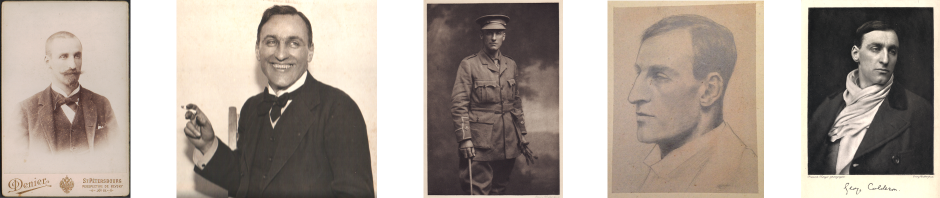

 George Calderon, 1912
 Basic form of the Calderon coat of arms
 Unpublished watercolour by George Calderon, Tahiti 1906
 Monarch Butterfly Madeira
 Captain of the 11
 Frontis piece by Frank Calderon
 Michel and Vera Fokine in “Scheherazade”, 1914 (The Music And Theatre Library of Sweden, creative commons)
 Book sent to George Calderon in Russia by his mother, Christmas 1895.
 Jean Ryckaert, May 1916.
 The entrance to Fort Brockhurst (picture from Britain’s Past)
 Sir Richard Vincent Sutton c. 1913
 George Calderon c.1901
 Patrick Miles in his summer house, 11 December 2016
 Christmas 1901 Cartoon by George Calderon
 Colonel Sir Walter Coote Hedley c. 1920
 A happy memory of Trinity College: undergraduates breakfast together in Downy V. Green, p. 77.
 Figure from Gauguin’s 1899 painting ‘Tahitian Women with Mango Blossoms’ (left); George Calderon’s pencil sketch ‘Manu’ (right)
 George and Kittie Calderon 1905
 K.N. Das Gupta and Margaret Mitchell in an Indian Dramatic Society production of The Maharani of Arakan, 1913?


‘Library Notes’ (2)
Book no. 596. Iosif Brodskii. The Little Tugboat. Leningrad, Detskaia literatura, 1991, 18 pp.
This children’s book of 79 lines of poetry was stuck on its side behind the Brodsky section of my library (six books published between 1967 and 1993). I’d completely forgotten its existence — although it was clearly inscribed by me in 1991. Probably it was stuffed at the back because it was too tall to stand on the shelf. It needed some pressing out.
Now that I’ve discovered it, I have read it about seven times. The long preface in tiny italic print on the inside cover informs (adult) readers of Brodsky’s biography up to receiving the Nobel Prize for Literature in 1987. Bear in mind that 1991 was still in the Soviet period, so not many readers would have a clue who Brodsky was. The vital fact in this preface, however, is that The Little Tugboat was written when Brodsky was just over twenty.
That is very remarkable indeed, as I can only compare its dry-eyed, warm, limpid style and its poetic assurance to Pushkin’s mature verse fairytales. Readers of Russian will have noticed that I did not translate the word ballada in its title. This is because the only thing it has in common with the European ballad is having a hero — the tugboat. Its stanzas are of wildly differing length, so there is no point in raising false expectations about its poetic form. Yet ‘defying the genre’ is typical of Brodsky (look what he did to the limerick!). There is no set rhyme scheme. The whole work breathes creative freedom.
The little tug works in the port of Leningrad. ‘I love my job./I’m the first boat/up in the morning’. He introduces his captain, stoker, engineers (‘two doctors to keep me well’), and ‘the ship’s cook/with ladle in hand’. A lyrical octet evokes Leningrad at dawn, and two later ones the city at sunset when the tug returns to his berth. His main job that day is to guide a massive foreign liner to its dock: ‘It has come here to us/from seas far away,/seas where I can never/drop anchor myself.’ All the ships leaving Leningrad feel sorry for him that he can’t travel the world like them, but ‘It’s not the first time we have parted,/go on, disappear into the distance./I have to remain/close to this home soil./No matter that the smoke is settling/in red over the city…/I am staying without regrets/here,/where I’m needed by others.’ And that’s it (in 150,000 copies).
But it’s great. Chekhov famously rejected ‘children’s literature’ as a genre, because he knew children were too perceptive to accept condescension, mawkishness or moralising; he thought they wanted to read works written for them by adults as though they too were adults (like his Kashtanka). The Little Tugboat passes that test. Unlike, say, Scuffy the Tugboat or Thomas the Tank Engine, Brodsky’s tugboat is not anthropomorphised and in this edition he is not drawn with a face. True, as befits what a Dostoevsky hero calls ‘the most abstract and invented city in the world’ (St Petersburg/Leningrad), the illustrations in this edition are predominantly gloomy — the only flashes of light, bright colours are on the visiting foreign liner. I can’t imagine these pictures appealing to British children. But both in Brodsky’s words and Z. Arshakuni’s watercolours, the humans are very human (not Soviet cut-outs), and the tugboat especially so. Children will surely identify with the tugboat because he is little, buoyant in all senses, energetic, plucky, works in a team, loves his home ground, and above all lives for others, who need him.
Is the little tugboat a self-image? I think so. In the 1960s Joseph did not want to leave Russia for good (which he was coerced into in 1972), but he did want to see the rest of the world and come back. When I met him for an evening in his flat, he was almost obsessed with the fact that he was denied this freedom. He showed me all the air mail letters he had received wishing him a Happy New Year (it was January 1970) and joked bitterly that he had ‘often’ visited his friends in Greece (he greatly admired Cavafy’s poetry). Yet he certainly regarded himself as a Russian poet and as such ‘needed by others’ at home.
A casual browse about The Little Tugboat on the Web reveals a whole academic literature discussing its themes. The version I have looks as though it is a shortened one of the first publication (1962), which itself was censored down from the rather more tendentious original of over a hundred lines, in which the tugboat was improbably named Antaeus. In 2022 a Belorussian edition of the complete poem was arrested, as they say, from all bookshops by the Lukashenka regime as ‘extremist literature’! In a word, then, the usual cloaca surrounding any simple Russian literary masterpiece.
* * *
When I lived in Russia between 1969 and 1974, I would occasionally go for lunch at the Metropol hotel (see A Gentleman in Moscow). I would only do this when I needed a long break (the waiters were almost invisible), traditional Russian food (e.g. zander in aspic), interesting conversation (it was favoured by older Russians who had time on their hands and little to lose by being frank), and I had the money. On one occasion I came straight from analysing scores of Soviet editions of Chekhov’s early stories in the ‘Lenin Library’ to find myself sharing a table with an old man whose outstanding illustrations to these stories I had actually come across that very morning! His name was Viktor Tauber. I congratulated him on his work. To my astonishment, he scathingly articulated my own feelings about the standard Soviet illustrations to Chekhov’s stories. But he did not stop there… British children’s literature was ‘the greatest in the world’, because it favoured nonsense, which children really enjoy. Unfortunately, he said, Russian children ‘don’t understand nonsense, any more than our adults do’. He mentioned nursery rhymes, Lewis Carroll and Edward Lear. He had personally known Kornei Chukovsky, the most published Russian children’s writer ever, but Chukovsky ‘ne ponimal angliiskogo detskogo nonsensa’ (‘did not understand English nonsense writing for children’). One could read a lot into this, but it’s surely very difficult to translate our nonsense, so to speak.
ADVERTISEMENT
SOME RESPONSES TO GEORGE CALDERON: EDWARDIAN GENIUS
‘This meticulous yet nimble book is bound to remain the definitive account of Calderon’s life’ Charlotte Jones, The Times Literary Supplement
‘The effort of detection, it must be said, was worth it. The biography is a delight to read.’ Emeritus Professor Laurence Brockliss, The London Magazine
‘It is a masterly synthesis of your own approach with scholarship and very judicious discussion of the evidence.’ Emeritus Professor Catherine Andreyev, historian
‘This comprehensive, meticulously researched and highly readable biography, which the author describes as a “story” rather than an academic biography…’ Michael Pursglove, East-West Review
‘A monumental scholarly masterpiece that gives real insight into how the Edwardians viewed the world.’Arch Tait, Translator of Natalya Rzhevskaya’s Memoirs of a Wartime Interpreter
‘The book is written with great assurance and the reader always feels in safe hands. I liked the idea of it being a story and I read it the same way I would read a novel.’ Harvey Pitcher, writer
‘Presents the Edwardian age, and Calderon in particular, as new and forward-looking.’ Emeritus Professor Michael Alexander, in Trinity College, Oxford, Report 2017-18
A review by DAMIAN GRANT appears in the comments to Calderonia’s 7 September post.
A review by JOHN DEWEY appears on Amazon UK.
Share this:
Related