I have just been asked for advice about self-publishing from someone who has come into the possession of a First World War soldier’s original memoir. It’s hundreds of pages long and includes many photographs and colour drawings. Obviously such a thing from that era has value as a view of an extraordinary time, but whether it is worth the toil and expense and risk of self-publishing it as a large colour book is a whole different proposition. As a self-publisher you do not have the advantages of a major publisher with their financial clout and publicity machine, so your book has got to really make an impact in order to get noticed and have people talking about it. So I asked him the question: ‘What does this material say (or allow you to say with the way that you present it) that is unique and original, that will make it stand out from all the other books about the First World War?’
Being on the verge of publishing my own large colour book after three years of work and with a print run costing £29,000, I realise that that question is one that I also have to answer. I Shall Not Be Away Long is based on the First World War letters of Lt Col Charles Bartlett. The letters provide an immediate and uncensored portal into the life and times of a rather roguish infantry officer, full of humour and surprises as he attempts to navigate the challenges presented by the war and his marriage. On their own they make fascinating reading but to really make use of them to transport you to that time I have presented them visually to give the idea that you have opened them yourself and I have included images that evoke the circumstances in which they were written. I can’t recall seeing another book that has done this in this way, nor one where nearly every person and item and event mentioned in the letters has been investigated to be able to present the wider context of the main story in the letters. In particular, the lives that have sailed alongside Charles Bartlett’s, some for only very brief times, have in many cases got quite incredible stories attached to them. Just as with the people that we meet in our own lives, there are secrets that are hidden from contemporary view. Sometimes these have not escaped the historical record and so we end up knowing more about Charles Bartlett’s acquaintances than he probably did. We also get to see what happened to them all and get some idea of the long-term effects of the War. All of this gives context as does the benefit of hindsight to be able to take the views and beliefs that were held at a particular time and compare them with what we know now to have been the case. This is nowhere more starkly shown than in his comment one week after the start of the Battle of Somme (albeit from 13 miles behind the lines) that ‘The news seems very good and everyone seems very pleased’. If there is anything to be taken from all this it is that there is always a story beneath the surface and we would do well to question our assumptions about most things – and indeed it is only by asking questions and seeking answers that we can make progress, whether that be in self-publishing or in life in general.
You can get an idea of the contents of I Shall Not Be Away Long from this flick through the book:
Catherine Brown on The diary of a writer-publisher: 38 Thank you so much for this wonderful recollection of Mr Prynne. In case of interest, my own, which concerns Prynne in the 1990s, is here:... (May 21, 2026 at 11:20 am)
harvey pitcher on The diary of a writer-publisher: 37 well, i had a shock when you said you'd acquired a dog but then i saw it wasn't. i have nothing against dogs though i prefer cats but fiona is very opposed to dogs or rather... (April 15, 2026 at 4:35 pm)
Laurence Brockliss on A new story by John Melmoth: ‘Snowballs’ What a pitch perfect short story: crisp, graphic, nostalgic, evocative and mischievous.
The injustice of schoolboy punishments comes in many forms, is never forgotten and is... (March 10, 2026 at 10:09 am)
 Michel and Vera Fokine in “Scheherazade”, 1914 (The Music And Theatre Library of Sweden, creative commons)
 Unpublished watercolour by George Calderon, Tahiti 1906
 Figure from Gauguin’s 1899 painting ‘Tahitian Women with Mango Blossoms’ (left); George Calderon’s pencil sketch ‘Manu’ (right)
 Sir Richard Vincent Sutton c. 1913
 Captain of the 11
 The entrance to Fort Brockhurst (picture from Britain’s Past)
 A happy memory of Trinity College: undergraduates breakfast together in Downy V. Green, p. 77.
 Jean Ryckaert, May 1916.
 Monarch Butterfly Madeira
 Patrick Miles in his summer house, 11 December 2016
 George Calderon c.1901
 Frontis piece by Frank Calderon
 Basic form of the Calderon coat of arms
 K.N. Das Gupta and Margaret Mitchell in an Indian Dramatic Society production of The Maharani of Arakan, 1913?
 George and Kittie Calderon 1905
 Book sent to George Calderon in Russia by his mother, Christmas 1895.
 Christmas 1901 Cartoon by George Calderon
 Colonel Sir Walter Coote Hedley c. 1920
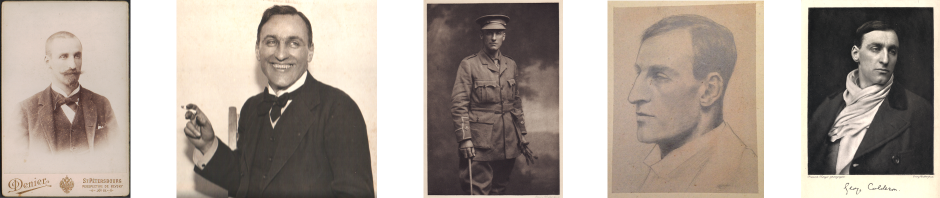
 George Calderon, 1912


Guest Post: Andrew Tatham, ‘The Pursuit of Uniqueness and Originality in Self-Publishing’
I have just been asked for advice about self-publishing from someone who has come into the possession of a First World War soldier’s original memoir. It’s hundreds of pages long and includes many photographs and colour drawings. Obviously such a thing from that era has value as a view of an extraordinary time, but whether it is worth the toil and expense and risk of self-publishing it as a large colour book is a whole different proposition. As a self-publisher you do not have the advantages of a major publisher with their financial clout and publicity machine, so your book has got to really make an impact in order to get noticed and have people talking about it. So I asked him the question: ‘What does this material say (or allow you to say with the way that you present it) that is unique and original, that will make it stand out from all the other books about the First World War?’
Being on the verge of publishing my own large colour book after three years of work and with a print run costing £29,000, I realise that that question is one that I also have to answer. I Shall Not Be Away Long is based on the First World War letters of Lt Col Charles Bartlett. The letters provide an immediate and uncensored portal into the life and times of a rather roguish infantry officer, full of humour and surprises as he attempts to navigate the challenges presented by the war and his marriage. On their own they make fascinating reading but to really make use of them to transport you to that time I have presented them visually to give the idea that you have opened them yourself and I have included images that evoke the circumstances in which they were written. I can’t recall seeing another book that has done this in this way, nor one where nearly every person and item and event mentioned in the letters has been investigated to be able to present the wider context of the main story in the letters. In particular, the lives that have sailed alongside Charles Bartlett’s, some for only very brief times, have in many cases got quite incredible stories attached to them. Just as with the people that we meet in our own lives, there are secrets that are hidden from contemporary view. Sometimes these have not escaped the historical record and so we end up knowing more about Charles Bartlett’s acquaintances than he probably did. We also get to see what happened to them all and get some idea of the long-term effects of the War. All of this gives context as does the benefit of hindsight to be able to take the views and beliefs that were held at a particular time and compare them with what we know now to have been the case. This is nowhere more starkly shown than in his comment one week after the start of the Battle of Somme (albeit from 13 miles behind the lines) that ‘The news seems very good and everyone seems very pleased’. If there is anything to be taken from all this it is that there is always a story beneath the surface and we would do well to question our assumptions about most things – and indeed it is only by asking questions and seeking answers that we can make progress, whether that be in self-publishing or in life in general.
You can get an idea of the contents of I Shall Not Be Away Long from this flick through the book:
Find out more and order your own copy from www.ishallnotbeawaylong.co.uk
Share this:
Related