
The topic of path dependence arose in email exchanges I had recently with Patrick Miles concerning the current state of Russia and China. In my studies of energy governance in China, I have had to dig deep into the nation’s Imperial and Communist history to interpret what we see today.1 While path dependence does not explain everything, it can provide useful insights.
The academic concept of path dependence dates back decades. Its systematic application to economics was stimulated by Brian Arthur and Douglass North in the 1990s and to politics by Paul Pierson in the 2000s. This is one of North’s key texts published in 2009:

Click the image to find this book on amazon.co.uk.
In simple terms the concept can be phrased as ‘history matters’. Your choices depend on where you are and whence you came, and the costs and risks of exit or radical change are high. In other words, path dependence results from increasing returns.
These increasing returns are rooted in societal institutions – institutions being the formal and informal rules of a society or within an organisation. The formal institutions comprise the laws, regulations and other rules that are intended to govern day-to-day transactions, whether economic or political. Depending on the rigour of enforcement, these rules constrain the behaviour of individuals and organisations to a greater or lesser extent. These formal institutions can be changed in a relatively short period by players, either powerful organisations or individuals, that seek benefit from the change. Conversely, actors that benefit from the prevailing institutions will resist such change.
Informal institutions include societal beliefs, norms and values, and may be captured by the term ‘culture’. Attitudes to authority, the family and death, the strength of impersonal trust, and confidence in the legal system are examples. Informal institutions may change only slowly, over decades or longer. Political elites that gain from the persistence of a particular set of informal institutions may choose to deploy propaganda and education to ensure the continuance of these institutions.
Between these informal institutions and the formal institutions that govern individual transactions lies what Oliver Williamson called the ‘institutional environment’. I describe this as comprising the general features of the political, legal and economic systems. A nation’s political and legal traditions, in particular, may be longstanding and resistant to change due to a combination of vested interests and societal beliefs.
These three levels of institution interact with each other. The informal institutions constrain changes in the institutional environment, and the institutional environment constrains the effectiveness of any short-term changes in the rules that govern individual transactions. All three sets of institutions act together to create path dependence. Any individual or group making a decision is likely to be constrained consciously by these institutions and unconsciously by their ‘bounded rationality’ – a term introduced by Herbert Simon to explain how we use mental models to make decisions, given that time, information and cognitive capacity are limited.
So, why do these concepts help us understand certain features of today’s world? The most obvious example is the fallacious belief that countries such as Russia and China could become liberal democracies and market economies in a short period of time. Russia experienced a short period of democracy and economic liberalisation in the 1990s before reverting to a type of political and economic regime with features reminiscent of the Imperial and Communist eras. Likewise, China’s current leadership has more in common with that of Mao Zedong than that of Jiang Zemin and Zhu Rongji, let alone the relatively open chaotic regime of the 1920s and 1930s. I have argued elsewhere that elements of China’s political and legal cultures have their roots in Imperial times.2 I am sure that similar assessments could be made of other societies.
A second implication of institutional theory arises from efforts to introduce new rules to govern individual transactions with few or no changes being made to the institutional environment and informal institutions. In Russia, we saw how the hurried introduction of market rules created chaos in the absence of an appropriate legal system and social safety nets, and in a society with little understanding of market economics.
In contrast, China deliberately introduced market forces over a period of decades in order to avoid economic crises such as that experienced by Russia. However, the slow pace of change in the institutional environment has constrained the effectiveness of some market reforms, not least owing to the ability of local governments and state-owned enterprises to distort the implementation of the reforms. This has been particularly strong in the energy sector. The consequence of these institutional constraints is that societal change tends to be incremental.
So, how does revolutionary political or economic change occur? This requires a crisis of such magnitude that it destroys the credibility of the existing set of institutions and allows actors with new ideas and priorities to implement a new institutional environment and new formal rules. Such revolutions occurred in China in 1911 and 1949 and in Russia in 1917 and 1991. In academic terms, these could be termed ‘critical junctures’ – in other words, the crisis was of sufficient magnitude that the changes were sustained for a significant period. However, some ‘junctures’ may not become ‘critical’. The opportunity is there but is not taken, usually because the pre-existing conditions were not supportive of the change sought. The so-called ‘Arab Spring’ may be an example.
In their book Violence and Social Orders. A Conceptual Framework for Interpreting Human History, Douglass North and colleagues identified three ‘doorstop’ conditions for nations to transition from being limited access social orders to being open access orders, or mature liberal democracies. These are: the rule of law for elites, perpetually lived organisations independent of their members, and consolidated control of the military by the state. Many countries today lack these conditions.
What does all this mean in today’s world? We should not expect rapid and sustained political or economic change in countries with a long history, such as Russia and China. Modes of governance may oscillate between different forms but will tend to revert to a long-term trajectory of gradual change.
1 Philip Andrews-Speed and Sufang Zhang, China as a Global Clean Energy Champion. Lifting the Veil (Palgrave Macmillan, 2019)
2 Philip Andrews-Speed, ‘How May National Culture Shape Public Policy? The Case of Energy Policy in China’, The Energy Journal (2022) 43 (3), 257-273
© Philip Andrews-Speed, 2026
Philip Andrews-Speed is a Senior Research Fellow at the Oxford Institute for Energy Studies. He has more than 40 years experience in the field of energy and resources. After a spell carrying out geological research at Columbia and Cambridge Universities, he spent three years in Zambia as a mineral exploration geologist. He then moved to BP as an oil exploration geologist where he spent ten years, latterly in China. Since 1994, Philip has been an academic in universities and think tanks carrying out research on the political economy of energy and natural resource governance, with a particular focus on China.

ADVERTISEMENT

SOME RESPONSES TO GEORGE CALDERON: EDWARDIAN GENIUS
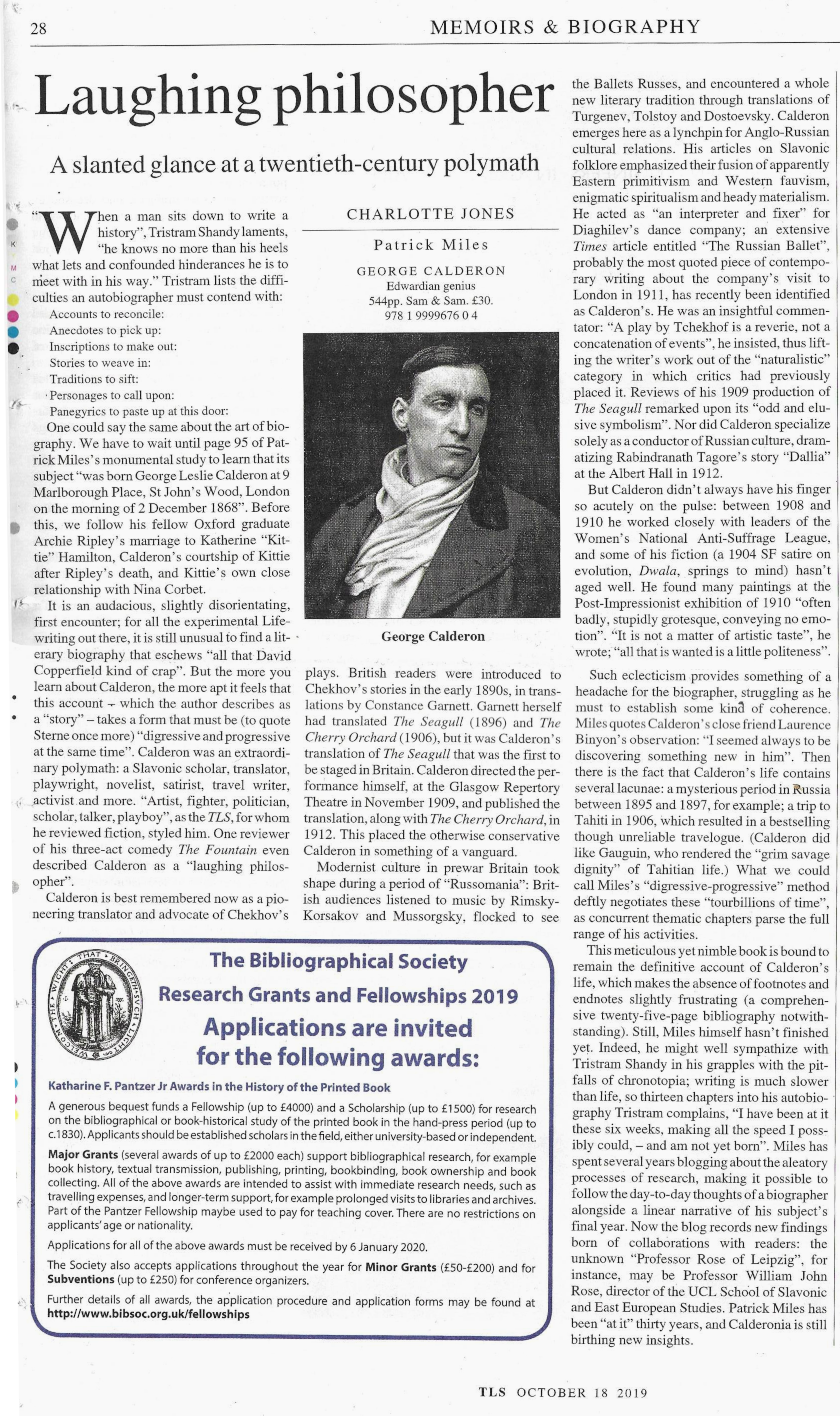
‘This meticulous yet nimble book is bound to remain the definitive account of Calderon’s life’ Charlotte Jones, The Times Literary Supplement
‘The effort of detection, it must be said, was worth it. The biography is a delight to read.’ Emeritus Professor Laurence Brockliss, The London Magazine
‘It is a masterly synthesis of your own approach with scholarship and very judicious discussion of the evidence.’ Emeritus Professor Catherine Andreyev, historian
‘This comprehensive, meticulously researched and highly readable biography, which the author describes as a “story” rather than an academic biography…’ Michael Pursglove, East-West Review
‘A monumental scholarly masterpiece that gives real insight into how the Edwardians viewed the world.’Arch Tait, Translator of Natalya Rzhevskaya’s Memoirs of a Wartime Interpreter
‘The book is written with great assurance and the reader always feels in safe hands. I liked the idea of it being a story and I read it the same way I would read a novel.’ Harvey Pitcher, writer
‘Presents the Edwardian age, and Calderon in particular, as new and forward-looking.’ Emeritus Professor Michael Alexander, in Trinity College, Oxford, Report 2017-18
A review by DAMIAN GRANT appears in the comments to Calderonia’s 7 September post.
A review by JOHN DEWEY appears on Amazon UK.


Thank you profoundly, Philip, for such a lucid explanation of a term that was unfamiliar to me, and for such relevant examples. I can confidently say that this post will be of great interest to Calderonia’s subscribers and viewers worldwide.
Whilst historians would surely agree that ‘history matters’ in understanding other countries, and culturologists equally believe that ‘culture matters’ in this subject area, the concept of ‘path dependence’ has the advantage of melding both the diachronic and synchronic aspects. You have proved that it ‘can provide useful insights’, so I shall use it!
At the same time, you give the caveat that it ‘does not explain everything’. In that spirit, could I ask you three questions that have come to mind?
First, what exactly is meant by the ‘increasing returns’ that ‘result’ in path dependence?’ To many path dependence may suggest decreasing returns. What are the benefits of what seems essentially a process of stagnation or nuclear decay?
Second, it seems to me you give an exemplary explanation of ‘revolutionary’ change, but how does just ‘positive’ change occur in a country with heavy path dependency? When in 1988 — to his stupefaction — I was taking twenty pounds in cash out of an ATM on the street for a prominent Russian intellectual and suggested that one day Russia might have ATMs, too, he responded with a vituperous tirade that it wouldn’t, because ‘Russia will have a path of its own! It will always do things its own way, not imitate you in the West!’. How do you ever ‘change’ such visceral dogmatism (tunnel vision)? Is it fatuous, even dangerous, of foreigners to try?
Third, in your conclusion you say that ‘we should not expect rapid and sustained political or economic change in countries with a long history, such as Russia and China’. How long is ‘long’? An identifiable state of Russia has existed for less than a thousand years, but China’s for at least twice that length of time. Is there not a temptation to equate ‘long’ with ‘long periods of no change’? (Yet both countries have a history of sporadic catastrophic, ‘revolutionary’ collapse.)
Apologies for these questions, which I well appreciate you may find naive!
And renewed thanks.
Patrick
Thank you, Patrick, for your three questions. I will address each in turn:
1. The term “increasing returns” as applied to politics was used by Paul Pierson in a paper published in 2000, borrowing the term from economics. In his 2004 book “Politics in Time”, he switched to using the term “positive feedback”, and I should have followed his example. In brief, Pierson identified four sources of positive feedback in politics: the collective nature of politics, the institutional density of politics, political authority and power asymmetries, and the complexity and opacity of politics.
2. “How does positive change occur?”. Let us leave aside your use of the term “positive” – positivity in politics or culture is in the eyes of the beholder. In the political field, established institutional frameworks are difficult to change, except gradually (eg the 100’s of years to build a parliamentary democracy in the UK). Radical change, as we have seen in various “revolutions”, is very often not as profound as anticipated. In addition to the examples of Russia and China that I mentioned, we can also look at countries like Myanmar (short interlude of democracy) and Egypt (“Arab Spring”). In these and other cases, the political system has reverted to type. The US and Canada had the advantage of starting with a blank sheet of paper (literally).
3. “How long is long?”. As a piece of string. And, yes, there have been crises. In academic terms, there have been potential “critical junctures” when democracy had a chance: Russia in the 1990s and China in the 1920s. But these chances were not taken. Come back in 100 years time and ask me the same question.