12 January 2026
I don’t know why I have always had ridiculously sensitive hearing (my ears have been described as ‘tiny’ and ‘porcelain’), but at seventy-seven I still have. A year or two ago I was walking to get the morning paper and heard a small boy tell his father, fifty yards away on the other side of the road, ‘Daddy, that man walks like a penguin’ (I deny it, of course).
This morning, when it was a bit icy, I was cautiously bearing my newspaper home wearing a dull green Parka and carrying a Rexine shopping bag, when I noticed four or five boys aged about 8-11 on the other side of the road waiting for parents to emerge and take them to school. They glanced across the road and said something to each other. Suddenly it flashed upon me that they were seeing, and committing to memory, an image that I often beheld myself at that age: an old fogey in drab coat shuffling along with his daily paper and carrying the de rigueur Rexine bag…the only difference from about 1957 being that I wasn’t wearing a flat cap and smoking a roll-up!
28 January
Over the past four years, I have had the task of finding homes for the libraries of four academics, totalling about 2500 books and mainly in Russian. As some readers will know, it’s difficult enough to relocate books in English these days. Russian books are almost impossible, as interest in the country’s language and culture is understandably at an all-time low. The experience convinced me that one should make provision for the proper disposal of one’s books well before one pops it, and especially if they are in a foreign language that no-one else in the family commands. One should spare one’s executors.
I once had a Russian working library of 1500+ books. Most (380 volumes) of my Chekhov library went to Nottingham University in 2000, along with 30 boxes of ‘materials’. About twenty years ago I provided in a Will for the rest of my Russia-subject books (some in English, of course) to go to my old college library, whose Russian section I’d helped build up in the 1970s. But a few years ago it became clear they wouldn’t be able to accommodate them; or they would have to shed about 80% first. Most of our museums can’t take any more items, apparently, and I have discovered it is the same with our libraries.
You may ask yourself why I ‘really’ want to get rid of this comprehensive subject-library built up over sixty years. Well, the first reason is as stated — that if I don’t, I am going to create a real problem for my executors. But I also don’t now read, or consult, 90% of the books, so I feel they should go to people who would cherish and use them. Yes, I do think the ‘Patrick Miles Russian Library’ is worth preserving as an entity, a time capsule of a late twentieth century Russianist’s interests, but who else thinks that?! (It grieves me that George Calderon’s Russian library was split up and we have only two volumes from it, though annotated and really useful.) None of the specialist dealers in Russian books, whom I have spoken to, can contemplate buying or selling mine. What then to do?
Quite breathtakingly — without my advertising, as it were — a serious American bibliophile, whom I did not previously know, has contacted me about acquiring the lot and keeping them all together. It’s a miracle! So I have set about cataloguing the 1100+ works, spanning from the earliest byliny (folk epics) to the war on Ukraine (my disgust with Russia, I admit, is another factor in wanting to stop seeing Cyrillic book spines).
It’s a strange experience, because I have to hold each book in my hand and I involuntarily remember when and how I acquired it. Some are inscribed ‘Leningrad, 1970’ etc, many bear a variety of my ex libris, and some I can’t help but dip into. Here’s a book I was very proud of finding on the Moscow secondhand book market for four roubles in 1974:

It’s the second edition (1912) of Tolstoi’s essay ‘On Shakespeare and the Drama’. I’d read Orwell’s brilliant essay ‘Lear, Tolstoy and the Fool’ at least twice in the 1960s, but never been able to find a copy of Tolstoi’s essay in Russian. (Orwell read the 1906 American translation, I believe.) This Russian copy is coverless and a bit battered, so I had the venerable Grays bookbinders of Cambridge make a box for it. And this box enabled me to enclose with it a photograph of Tolstoi that is to me at least as evocative as the book.
Moscow, 1972. I had just met Sam1, who had contacts all over the Russian literary world. He took me to meet the second wife, Elena Ivanovna, of Aleksandr Borisovich Gol’denveizer, a top classical pianist who was a close friend of Tolstoi (he played for Tolstoi, was present at his death, and was the person who had to go outside the stationmaster’s house at Astapovo and tell the world Tolstoi had passed). I was particularly keen on Gol’denveizer as he had written a good memoir of Chekhov, from which I had quoted in my undergraduate dissertation. The widow seemed quite young still (Gol’denveizer had died in 1961), and was charming. She lived in an old corner flat overlooking Pushkin Square. She showed me various items in glass cases, then gave me this photograph, which was one of a series taken of Tolstoi in the 1900s. Suspecting I was having problems with the hard Russian winter, she even offered me Gol’denveizer’s long, dark, padded overcoat! It would, of course, have been an extraordinary experience, wearing around Moscow the coat of someone so famous who had known Lev Tolstoi, but it was far too big for me, so I had to decline. Of the series of photographs, I remember Sam1 saying that ‘you can see Lev Nikolaevich had gone a bit dotty by then’. Per-haps.
13 February
Putin is now firmly stuck to the Trump fly paper. His 2022 bid to annex Ukraine has been a catastrophe for Russia, the longer it drags on the more Russians realise that, and Putin has no alternative but to negotiate. However, in his own mind he doesn’t do negotiation. He wants the rest of Donbas, but there is no way the Ukrainians are going to give him it. The latest military assessment is that he can’t take it by force and the Ukrainians are even gaining. He is, then, in a lose-lose situation: he has to get the war over as fast as possible (the Russian economy is breaking up, Russians can’t even buy cucumbers), yet his own megalomania delays it. Whether the war grinds on into a fifth year or whether he has to settle for what is blatantly not victory, I would not be surprised if there were some attempt to unseat him this year. Very interestingly, facts have suddenly started circulating about Putin’s long-term advisor Dmitrii Kozak being opposed in 2022 to the invasion, even telling Putin that he could ‘arrest me or shoot me’ for not carrying out an order to demand the Ukrainians’ surrender, and delivering a prophetic analysis of the invasion’s consequences for Russia. Kozak himself remains silent, but evidently certain other people now want it to be known that from the start there was opposition at the top to Putin’s Great Russia power ambitions. These people are very cautiously testing the waters. On the pro-war side, if Kyiv hung on to a large piece of Donbas Putin would face ‘blow-back’ from the rabid nationalist elements in his power base. He’s trapped.
26 February
Next week (5 March) Calderonia is honoured to be posting John Melmoth’s short story ‘Snowballs’, which will be appearing soon in his next collection:

John is one of the finest, most varied and productive of the relatively few male writers of English short stories today. He has just sent me this ‘biog’:
After a spectacularly modest and uneventful career in corporate communications, John bit off HR’s hand when offered early retirement.
No longer required to earn a living, he has been able to spend more of his time writing. In the past fifteen years he has produced five novels and eight collections of short stories. He has become ever more convinced that pensions are wonderful things.
His novels consist of a supernatural trilogy set in Norfolk (The Revenant Trilogy), a time-shifting ghost story set in Turkey both now and almost two thousand years ago (Alexander’s Dream), and — something of an outlier — a novel about Freud (The Book of Dreams).
John likes to think that his short stories are witty, strange, moving and sometimes surreal. His most recent collection is The Suburban Enchantress.
All of these are available from Amazon Books, where you can read a number of the stories for free.

ADVERTISEMENT

SOME RESPONSES TO GEORGE CALDERON: EDWARDIAN GENIUS
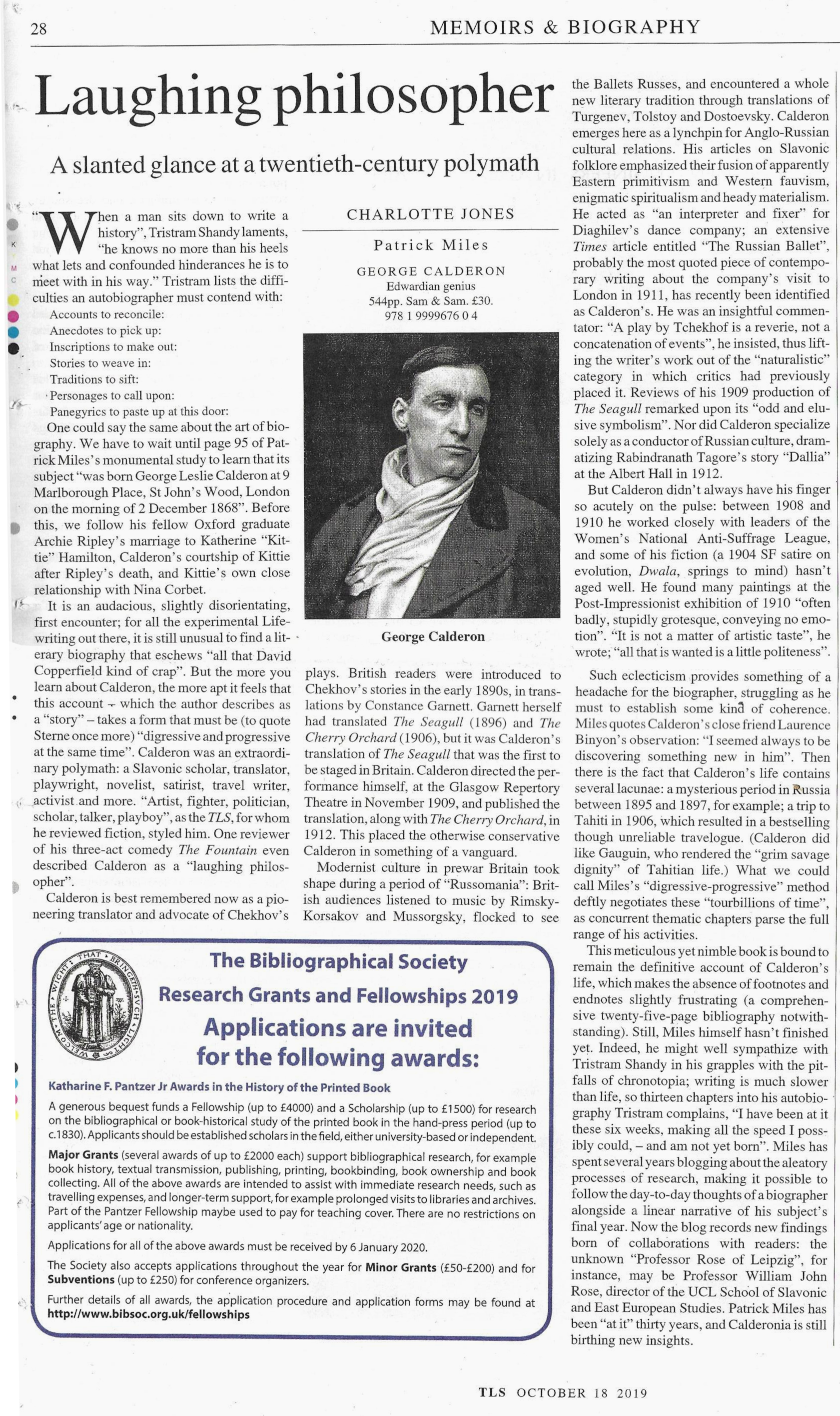
‘This meticulous yet nimble book is bound to remain the definitive account of Calderon’s life’ Charlotte Jones, The Times Literary Supplement
‘The effort of detection, it must be said, was worth it. The biography is a delight to read.’ Emeritus Professor Laurence Brockliss, The London Magazine
‘It is a masterly synthesis of your own approach with scholarship and very judicious discussion of the evidence.’ Emeritus Professor Catherine Andreyev, historian
‘This comprehensive, meticulously researched and highly readable biography, which the author describes as a “story” rather than an academic biography…’ Michael Pursglove, East-West Review
‘A monumental scholarly masterpiece that gives real insight into how the Edwardians viewed the world.’Arch Tait, Translator of Natalya Rzhevskaya’s Memoirs of a Wartime Interpreter
‘The book is written with great assurance and the reader always feels in safe hands. I liked the idea of it being a story and I read it the same way I would read a novel.’ Harvey Pitcher, writer
‘Presents the Edwardian age, and Calderon in particular, as new and forward-looking.’ Emeritus Professor Michael Alexander, in Trinity College, Oxford, Report 2017-18
A review by DAMIAN GRANT appears in the comments to Calderonia’s 7 September post.
A review by JOHN DEWEY appears on Amazon UK.


A brilliantly evocative and thought-provoking medley of observations that would not be out of place in ‘The collected life of a flat-cap penguin’ (your words, only slightly re-arranged). Please don’t protest that you are too old – I’ve just had an email from the son of one of my Group Photograph chaps – he’s just started to put together a book about his father, and he’s 97! More power to you from a fellow bibliomaniac.
Wonderful, Andrew! Thank you very much. I will borrow that title, if you don’t object… I hope you will allow Calderonia to feature your own next magnum opus after the Great War duology!