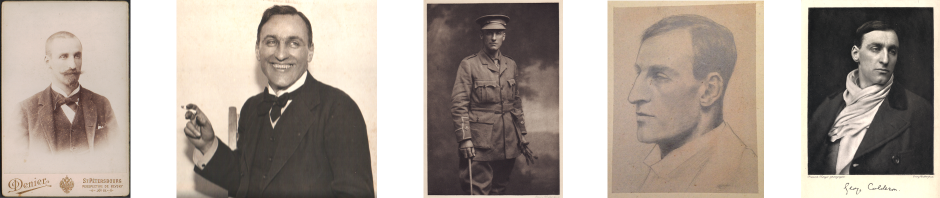

Click the cover to find this book on Amazon.
As Calderonians know, there were two wildly popular novels about Oxford University in the nineteenth century: Cuthbert Bede’s The Adventures of Mr Verdant Green (1853) and George’s The Adventures of Downy V. Green, Rhodes Scholar at Oxford (1902). They have gone through every media metamorphosis including film and are still in print today. But where are the Oxford campus authors of the twentieth century to compare with Cambridge’s M.R. James, C.P. Snow, Tom Sharpe or F.T. Unwin? Apart from the countless Oxford murder mysteries, there seems to have been no novel about the Oxford dons’ world since Dorothy Sayers’ Gaudy Night (also a murder mystery) of 1935.
Until now! A distinguished subscriber to Calderonia has sent me a copy of Horace Hare’s Confessions of an Oxford Don, which came out just before Christmas, and I can honestly say it is up there with Bede and Calderon. It is a comedic, eviscerating, exhaustive portrait of Oxford college and university life between 1963 and 2006. The archivist of St Jocasta’s College, Mary-Jo Poltowa, who is responsible for the meticulous and delightfully woke 471 notes at the back of this blockbuster, says on page xiii that she is sure it will ‘in time bear comparison with the Confessions of St Augustine, Rousseau and De Quincy’, but I would suggest a closer affinity with classic picaresque novels such as Don Quixote, Moll Flanders, or Dead Souls. For Hare is pícaro — a conman and fraud.
Unexpectedly for ‘confessions’, the novel is narrated not in the first person but in the third; in other words Hare is trying to distance himself from his own self. Why he would want to do this is explained by Poltowa in her admirable Preface, just as the nature of what Hare calls his ‘original sin’ is gradually revealed in the course of the novel, and I am not going to spoil either here. Suffice it to say, Hare was born (1938) into a poor Bradford family, had a brilliantly historical mind, as well as real acting talent, graduated from Leeds, began a Ph.D. on Voltaire, made a mould-breaking discovery about him in Paris archives, and this catapulted him into a research fellowship at St Jocasta’s College, Oxford, and a culture of which he had previously known zilch. He is taken under the wing of Lewis Cadogan, known as ‘the Colossus’, who is the prime college politician and grooms Hare as his tool. But Hare is a master of dissimulation. It is 1970 and the college is tearing itself apart over admitting women. Hare appears to support the conservative faction under the Colossus and to engineer its victory, but manages to escape the vote, whereas Cadogan dies of a stroke when the vote goes against him. Although a natural conservative, Hare sees the way the wind is blowing, joins the college’s liberal faction, gets himself appointed the college’s Women’s Officer, and even produces the bestseller Nuns, Nymphos and Noblewomen: Female Sexuality in the French Enlightenment. His own career as the college’s Machiavellian is launched and on retirement he is said to have ‘ruled’ St Jocasta’s.
Along the way, there is plenty of action: a murder on the college’s premises, drugs, an attempted suicide, sudden deaths (including from an escaped boa constrictor), shocking philandery, consumption of malt whisky on a Rabelaisian scale, a nude miracle at the Founder’s tomb, forgery and skullduggery. Despite its length (401 pages), there is never a dull moment in this epic because the telling itself explodes with humour, irony and Hare’s copious obiter dicta, e.g. ‘All Oxford dons are fallen angels’, ‘All historians were cheats’, ‘There were more and more foreign Fellows. They were part of the people from nowhere, who found Oxford provincial and archaic, and were applying to Harvard, Berkeley or MIT within two years’. The author (who s/he?) has an inexhaustible talent for creating hilarious names, details of appearance and book titles. My favourite is Professor Penfold Huddlestone, who had ‘done his own doctorate at Cambridge on Rousseau and chess and become an academic superstar overnight with his first book Lighting up the Enlightenment, a study of the social and cultural influence of the chandelier’. Ouch!
Professor Hare recalls his life at Oxford through twelve self-contained story-chapters, often with many years between them. Thus it might look as though there is no plot. But this is exactly what you should expect and want: as the critic J.P. Stern once said apropos of The Good Soldier Švejk, in the picaresque novel ‘one damn thing follows another’. And Confessions of an Oxford Don bursts with all the features of what one might call ‘satire for grown-ups’ from Juvenal to Swift and Orwell: body fluids, seediness (Hare always wears ‘a threadbare tweed jacket, rumpled white shirt and frayed tie’), bad food, grotesquerie (every third person has acne), fornication, swearing and political incorrectness.
The novel’s architecture, however, is bigger than this. Hare the picaresque rogue is to be redeemed, or in his own word ‘reborn’. This is a notoriously ambitious and difficult task in literature. When Gogol’ tried to redeem his confidence trickster Chichikov in a sequel to Dead Souls, it broke him. Some would say Milton similarly failed in Paradise Regained. But I think that the author of Confessions of an Oxford Don pulls the act off as far as it is artistically feasible, partly by leaving it to chapter ten before he broaches it — and then through a flashback — and partly by leaving it to Hare’s acolyte Silas Burke to report in an Appendix the crumbs of intelligence he has gathered about Hare’s possible happiness in Ireland after retiring and completely breaking with Oxford. Spoilers aside, I think I can say that Hare’s redemption is effected by Deirdre Maguire and Mary Magdalene.
Altogether, I warmly endorse the judgement of Morton Pinkney, whose closest friend Hare was at Oxford and who has supplied the Introduction. He writes: ‘I cannot recommend this autobiography too highly. Read it, and your life will be changed.’ I agree. The tale it tells ‘Of carnal, bloody, and unnatural acts,/Of accidental judgements, casual slaughters’ etc (Hamlet) is quite different from college life in Cambridge.

ADVERTISEMENT

SOME RESPONSES TO GEORGE CALDERON: EDWARDIAN GENIUS
‘This meticulous yet nimble book is bound to remain the definitive account of Calderon’s life’ Charlotte Jones, The Times Literary Supplement
‘The effort of detection, it must be said, was worth it. The biography is a delight to read.’ Emeritus Professor Laurence Brockliss, The London Magazine
‘It is a masterly synthesis of your own approach with scholarship and very judicious discussion of the evidence.’ Emeritus Professor Catherine Andreyev, historian
‘This comprehensive, meticulously researched and highly readable biography, which the author describes as a “story” rather than an academic biography…’ Michael Pursglove, East-West Review
‘A monumental scholarly masterpiece that gives real insight into how the Edwardians viewed the world.’Arch Tait, Translator of Natalya Rzhevskaya’s Memoirs of a Wartime Interpreter
‘The book is written with great assurance and the reader always feels in safe hands. I liked the idea of it being a story and I read it the same way I would read a novel.’ Harvey Pitcher, writer
‘Presents the Edwardian age, and Calderon in particular, as new and forward-looking.’ Emeritus Professor Michael Alexander, in Trinity College, Oxford, Report 2017-18
A review by DAMIAN GRANT appears in the comments to Calderonia’s 7 September post.
A review by JOHN DEWEY appears on Amazon UK.


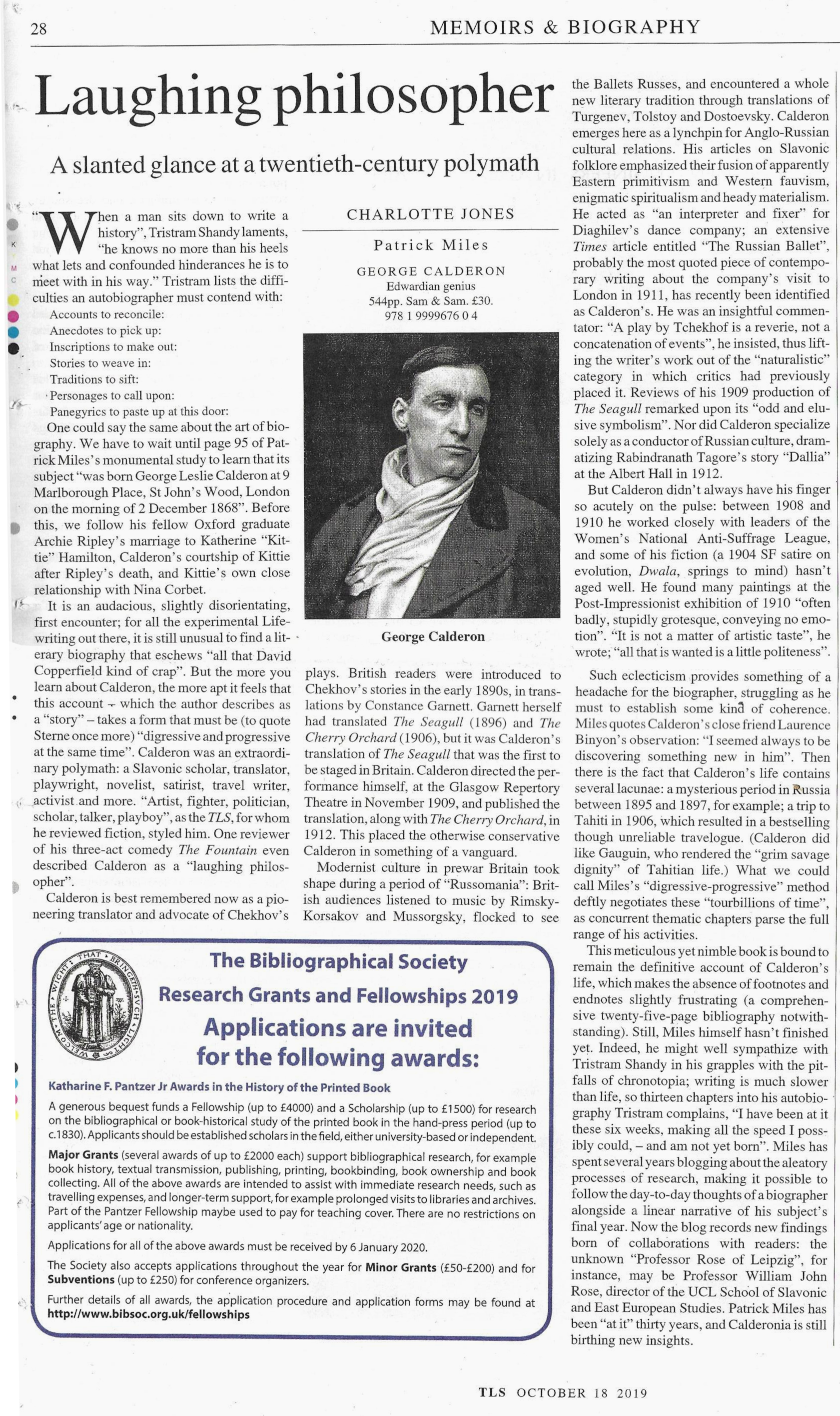
If I may be so bold I’ll throw into the Oxford quad Javier Marias’s novel, All Souls. Here’s a taste, courtesy of Penguin and Amazon: “At High Table in an Oxford College, the pretty, young tutor Clare Bayes attracted all eyes, not least to her fetching decolletage. No one’s eyes were sharper, however, than those of the visiting Spanish lecturer, invited as a guest on this occasion. In due course, the two young people were lovers, unbeknown to Clare’s husband. And if the Spaniard was at pains to cover their tracks, his beloved left evidence of adultery with gay abandon — and all this in a university that was a forcing house of gossip and intrigue, a place where ‘at every word a reputation dies’. This affair between the canny Latin and the flightly Englishwoman forms the central thread in a brilliantly-wrought tapestry of Oxford life, at once affectionate in its insight and hilarious in its ironic portrayals of Senior Common Room worthies.”
Horace Hare’s acid and immensely readable Oxford Confessions deserve to sell even more pleasingly than Yale classicist Erich Segal’s Harvard/Radcliffe smash-hit weepie, Love Story. Paramount Pictures made a fortune in the early 1970s from the film adaptation of Segal’s story, starring Ryan O’Neal and Ali MacGraw (‘Love means never having to say you’re sorry’). Wake up Netflix! Who better than Ralph Fiennes for the role of the machinating Professor Hare? And Jessie Buckley would of course be a shoo-in for the spellbinding Irish phantom who has him in thrall…